


 Top Rated Course

We may not have the course you’re looking for. If you enquire or give us a call on +44 1344 203 999 and speak to our training experts, we may still be able to help with your training requirements.
Persuasive Writing: Definition, Tips and Techniques for Explained
The Knowledge Academy 06 March 2026Persuasive Writing is a non-fiction form that uses logic, emotion, and credibility to influence readers to agree with a viewpoint or take action. It presents clear, well-structured arguments supported by strong evidence and relevant examples. The goal is to shape opinions, inspire positive change, and encourage informed decisions.

Training Outcomes Within Your Budget!
We ensure quality, budget-alignment, and timely delivery by our expert instructors.
Table of Contents
Persuasive Writing plays a key role in communication across marketing, education, and everyday conversations. It helps writers present ideas clearly while connecting with readers on a practical level. Strong arguments make messages more memorable and impactful.
Whether you are drafting an article, email, or speech, the right approach can influence how people think and respond. Understanding its techniques builds confidence and clarity in your message. Let’s explore how you can start applying these methods effectively.
Table of Contents
1) What is Persuasive Writing
2) The Importance of Persuasive Writing
3) The 3 Persuasion Techniques
4) Persuasive Writing Structure
5) 7 Persuasive Writing Techniques
6) 8 Effective Tips for Persuasive Writing
7) Benefits of Persuasive Writing
8) Conclusion
What is Persuasive Writing
Persuasive Writing make use of logic grounded in evidence, emotive language, and ethical appeals to convey an opinion or viewpoint. It can also inspire readers to take specific actions or adopt new point of view. This style of writing is often employed in professional settings, such as when drafting job application cover letters or submitting articles to industry publications.

The Importance of Persuasive Writing
Persuasive Writing offers direction on how to structure an argument and consolidate the advantages and disadvantages of a topic in a single document. Engaging in this style of writing can enhance your ability to think critically and boost your self-assurance.
You can also use Persuasive Writing to gather backing for a fresh movement, like promoting eco-friendly products, or for modernising old procedures, such as implementing a new office rule. Understanding Types of Report Writing can further enhance this skill by providing structured ways to present convincing arguments and evidence.
The 3 Persuasion Techniques
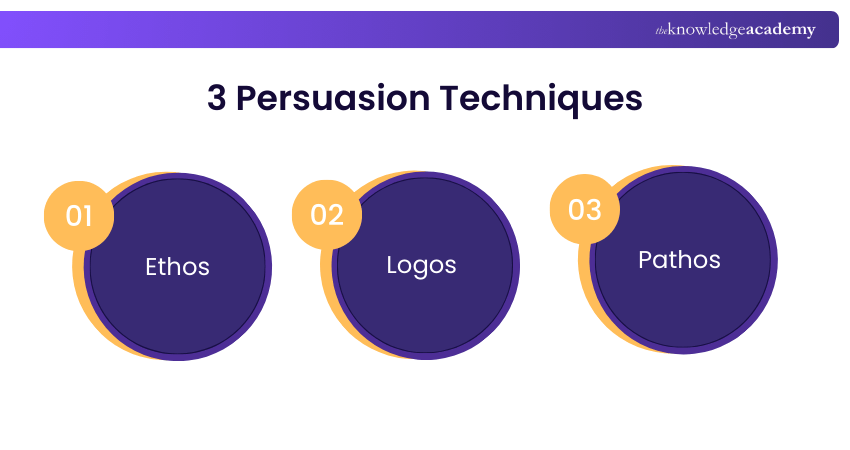
In Persuasive Writing, the success of your argument typically hooks on your capacity to fascinate your audience using several techniques of persuasion. These are identified as ethos, logos, and pathos. These tools aid in engaging with your audience and strengthening your argument. The means of convincing people include:
Ethos
Ethos is a persuasive method that gains audience approval by emphasising credibility. Ethos advertising methods appeal to the esteemed "character" of a speaker, presenter, writer, or brand. Examples of ethos are used to persuade the audience that the advertiser is trustworthy and moral.
Logos
Logos are the appeal to logic and reason. This persuasive method includes employing facts, statistics, logical arguments, and clear reasoning to validate your claims. By appealing to the reader's logical faculties, you make your argument more logical and interesting.
Pathos
Pathos is a persuasion technique that targets emotions. Persuasive Writing usually makes use of emotional language, vivid examples, and personal anecdotes to bring out emotions of the reader. By appealing to the emotions of the reader, you can enhance the relevance and effectiveness of your argument.
Persuasive Writing Structure
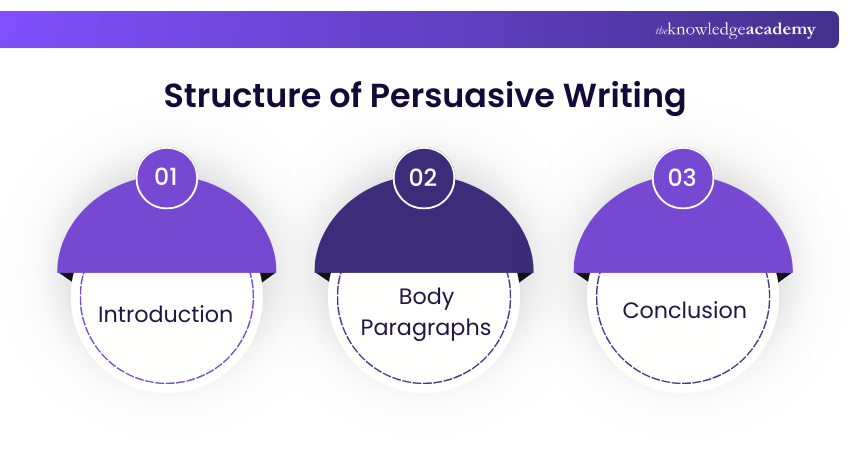
Persuasive Writing is one that persuades the reader to think in a certain way or take a certain course of action by explicitly stating their position and backing it up with convincing arguments. To do this, authors employ an ordered methodology that helps them to take the audience through a concise introduction up to logical arguments to reach a convincing conclusion.
Introduction
a) Clearly state your thesis or main argument so the reader knows your position right from the start.
b) Use the introduction to set the foundation for your argument, ensuring your stance is obvious and easy to understand from the beginning.
Body Paragraphs
a) Focus each paragraph on one key point that supports your overall thesis to keep your argument logical and well‑organised.
b) Strengthen each point with evidence, examples, or explanations to make your argument more convincing.
c) Consider including a counterargument to show awareness of the opposing view, then explain why your viewpoint is stronger.
Conclusion
a) Restate your thesis clearly to reinforce the central argument of your piece.
b) End with a strong, impactful final message that leaves the reader thinking about your viewpoint or motivates them toward your intended action.
Strive to be the better version of yourself with our Personal Development Courses, Sign up today!
7 Persuasive Writing Techniques
A persuasive message becomes far more impactful when you use proven psychological techniques that influence how people think, feel, and respond. These strategies help you communicate more effectively and increase the chances of winning others over to your viewpoint.
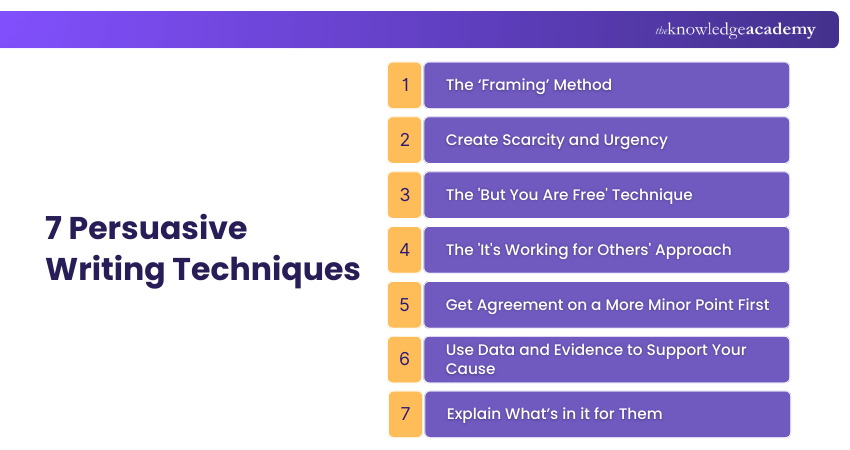
1) The ‘Framing’ Method
Framing is the process of displaying information in a manner that has an influence on its interpretation by the audience. With the appropriate approach, timing, and wording, you will be able to affect whether your message will have a positive impact or not, which is the so-called half-full or half-empty.
2) Create Scarcity and Urgency
When individuals perceive that something is scarce or might easily run out, they want it more. The scarcity is known to elicit automatic responses, which motivate the audience more to take action before it is too late, particularly when there is actual scarcity or a time constraint.
3) The 'But You Are Free' Technique
This is achieved by giving your request and underlining that the other party has the free will to give or withhold. The resistance will be minimised as they will feel that their autonomy is being respected and hence be more willing to agree.
4) The 'It's Working for Others' Approach
Social proof refers to people being more inclined to emulate behaviours that other people have already undertaken. You also need to demonstrate that the idea has worked or been supported by others, particularly in situations that are not so certain.
5) Get Agreement on a More Minor Point First
Getting a small first yes will raise the chances of getting an agreement in the future. This exploits the fact of commitment and consistency; once individuals become committed to something, they would like to remain consistent with their decision.
6) Use Data and Evidence to Support Your Cause
Use of clear and confident speech and facts makes your message more believable. Being precise and prepared makes your audience have confidence in what you are saying and gives it seriousness.
7) Explain What’s in it for Them
Individuals can be easily convinced when they realise the individual gains. Bringing to the fore the positive impact your proposal has on them makes them more likely to buy in and makes your message more appealing.
8 Effective Tips for Persuasive Writing
These tips will help to enhance your skills and improve your Persuasive Writing:
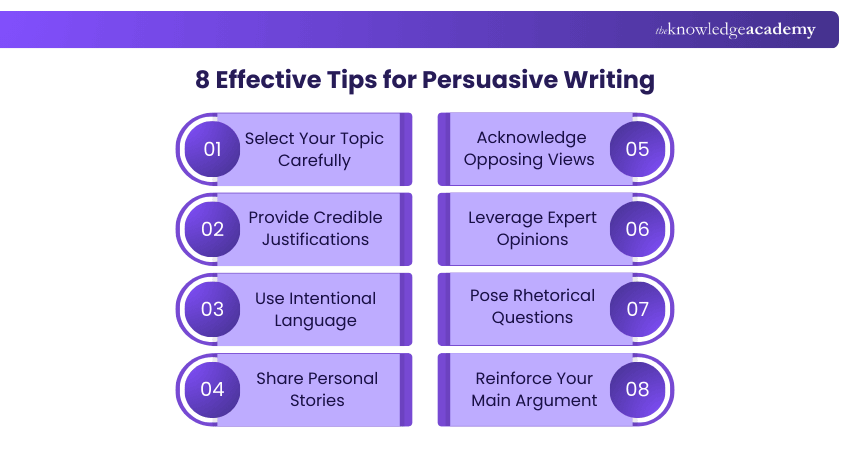
1) Select Your Topic Carefully
Select and explore the subject of your writing as well as the particular steps you wish your audience to follow. If you have knowledge in a specific area, you can make use of your knowledge to help you decide on a topic. The stronger your writing is likely to be, the more passionate you feel about the topic in any case.
2) Provide Credible Justifications
Providing credible justifications means backing your claims with clear evidence and logical reasoning so your audience can trust you. Using reliable facts, concise explanations, and a confident tone strengthens your message and boosts your credibility as a writer. This shows you’ve done your research and makes your argument more persuasive.
3) Use Intentional Language
Use powerful verbs and adjectives, language that provokes sensations and motivates a specific course of action. Incorporating personal pronouns such as "we" or "us" can help readers feel included in the broader discussion.
4) Share Personal Stories
Personal anecdotes are short stories that demonstrate your point. You can utilise them to emphasise your evidence and evoke empathy for your point of view. Anecdotes can be useful when writing about a specific cause or promoting a product to an unfamiliar target audience, as they offer a relatable context.
5) Acknowledge Opposing Views
Offer a contrasting perspective on your topic to demonstrate the credibility of your own viewpoint. Consider researching a similarly logical perspective that is supported by others so you can effectively counter it. Readers may perceive a balanced argument as genuine, as it acknowledges the existence of differing opinions while still affirming your own stance.
6) Leverage Expert Opinions
Identify a highly respected leader in the relevant field or industry who shares your views on the topic or product. Thoughtfully include direct or paraphrased quotes from them in your arguments to bolster their credibility. Demonstrating that a well-known individual supports your stance can significantly enhance the believability of your argument.
7) Pose Rhetorical Questions
Rhetorical questions are those posed without looking for an answer. They can be used to directly engage the reader and outline a particular point. This technique encourages readers to pause and consider the writing, prompting them to form a hypothetical response and thereby engaging them with your perspective.
8) Reinforce Your Main Argument
Make sure you begin and conclude your Persuasive Writing with your main argument and a direct request for action from your audience. Ensure that your position on the topic is clearly communicated to the reader, along with your desired emotional response from them.
Turn ideas into stories enhance your writing potential with our Creative Writing Course -Register Now!
Benefits of Persuasive Writing
Persuasive essay writing is a beneficial skill. It allows a writer to present their ideas clearly, in an efficient and satisfying manner.
a) Influences Opinions and Decisions: Helps shape opinions and encourages others to support your ideas or take desired actions.
b) Inspires Action: Motivates audiences to respond to calls-to-action (CTAs), whether in marketing, campaigns, or personal appeals.
c) Builds Stronger Arguments: Enhances critical thinking by encouraging you to evaluate different perspectives and create well-structured arguments.
d) Improves Communication Skills: Refines your ability to convey ideas clearly and concisely, making your messages more impactful.
e) Establishes Credibility: Strengthens your authority and trustworthiness by presenting logical, well-supported viewpoints.
f) Useful Across Multiple Contexts: Applies to various areas such as business proposals, social media, marketing, education, and personal interactions.
g) Fosters Emotional Connection: Leverages emotional appeals to engage readers and build rapport with your audience.
h) Encourages Collaboration and Support: Helps you gain allies and support for your initiatives, projects, or viewpoints.
Conclusion
Strong arguments, clear structure, and thoughtful language can make any message more impactful and memorable. Persuasive Writing helps you present ideas with confidence while encouraging readers to think, respond, and act. We hope this blog gave you useful insights and a clear starting point for applying these techniques in your own work.
Develop stronger self-awareness and better relationship skills with Emotional Intelligence Training – Begin now!
Frequently Asked Questions
Can Persuasive Writing be Used in Digital Marketing?

Yes, Persuasive Writing is widely used in digital marketing to guide customers toward making purchases or taking action. It creates compelling content that influences opinions, improves engagement, and increases conversions on websites and campaigns.
What is a Call to Action in Persuasive Writing?
A call to action is a clear statement that urges the reader to take a specific step, such as signing up, clicking a link, or making a purchase. It tells the audience what to do next and encourages immediate action by highlighting the benefit of responding.
What are the Other Resources and Offers Provided by The Knowledge Academy?
The Knowledge Academy takes global learning to new heights, offering over 3,000+ online courses across 490+ locations in 190+ countries. This expansive reach ensures accessibility and convenience for learners worldwide.
Alongside our diverse Online Course Catalogue, encompassing 17 major categories, we go the extra mile by providing a plethora of free educational Online Resources like Blogs, eBooks, Interview Questions and Videos. Tailoring learning experiences further, professionals can unlock greater value through a wide range of special discounts, seasonal deals, and Exclusive Offers.
What is The Knowledge Pass, and How Does it Work?
The Knowledge Academy’s Knowledge Pass, a prepaid voucher, adds another layer of flexibility, allowing course bookings over a 12-month period. Join us on a journey where education knows no bounds.
What are the Related Courses and Blogs Provided by The Knowledge Academy?
The Knowledge Academy offers various Personal Development Courses, including the Dealing with Difficult People Training, Supervisor Training, and Stress Management Course. These courses cater to different skill levels, providing comprehensive insights into Bibliography.
Our Business Skills Blogs cover a range of topics related to Persuasive Writing, offering valuable resources, best practices, and industry insights. Whether you are a beginner or looking to advance your Business skills, The Knowledge Academy's diverse courses and informative blogs have got you covered.

The Knowledge Academy


Global Training Provider
The Knowledge Academy is a world-leading provider of professional training courses, offering globally recognised qualifications across a wide range of subjects. With expert trainers, up-to-date course material, and flexible learning options, we aim to empower professionals and organisations to achieve their goals through continuous learning.

Upcoming Business Skills Resources Batches & Dates
Date
 Persuasion Training
Persuasion Training
Fri 3rd Jul 2026
Persuasion Training
Fri 4th Sep 2026
Persuasion Training
Fri 18th Dec 2026

 If you wish to make any changes to your course, please


