


 Top Rated Course

We may not have the course you’re looking for. If you enquire or give us a call on +44 1344 203 999 and speak to our training experts, we may still be able to help with your training requirements.
BATNA: A Detailed Explanation
Charlotte Wilson 07 March 2026Best Alternative to a Negotiated Agreement (BATNA) is the plan you’ll follow if a negotiation fails, helping you assess when to accept or walk away from a deal. It helps ensure informed decisions, stronger negotiation positions, and improved outcomes. Overall, it improves confidence and prevents rushed compromises.

Training Outcomes Within Your Budget!
We ensure quality, budget-alignment, and timely delivery by our expert instructors.
Table of Contents

Negotiations are a delicate balance of strategy, timing, and confidence. Knowing when to step back can be just as powerful as knowing when to move forward. That is exactly what BATNA, or Best Alternative to a Negotiated Agreement suggests.
Often viewed as your “plan B” in any Negotiation, BATNA gives you the clarity and leverage to make smarter decisions without feeling pressured into unfavourable terms. In this blog, we’ll unpack what BATNA means and how mastering it can turn even the toughest discussions into opportunities for success. Let’s begin to negotiate smarter!
Table of Contents
1) What is a BATNA?
2) How to Identify BATNA?
3) Importance of BATNA
4) Advantages and Disadvantages of BATNA
5) BATNA and Negotiation Tactics
6) Example of BATNA
7) What is a Weak BATNA?
8) What is the BATNA Rule?
9) Conclusion
What is a BATNA?
Best Alternative to a Negotiated Agreement, or BATNA, refers to the most favourable action an individual, a business or an organisation can take if negotiations fail and no agreement is reached. In simple terms, it represents your best backup plan and the option you will choose if the current discussion doesn’t lead to a satisfactory outcome.
Having a clear BATNA gives you negotiating power because it sets a baseline for what you’re willing to accept. It helps you stay objective, avoid emotional decisions, and negotiate from a position of strength rather than desperation.

How to Identify BATNA?
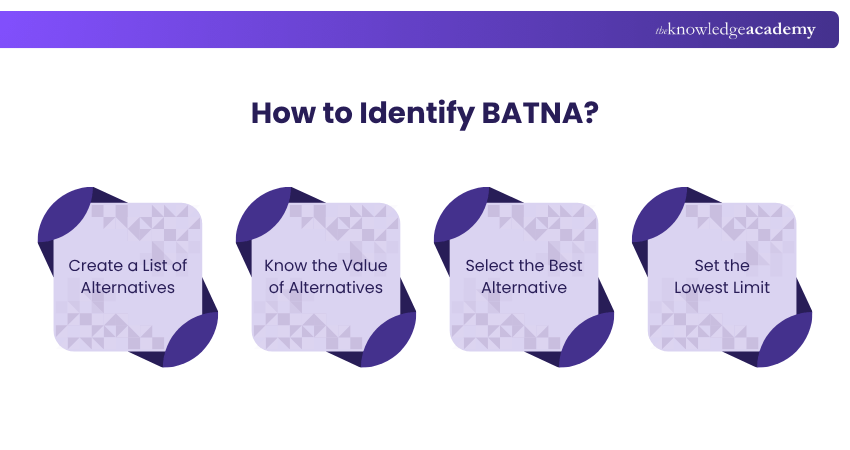
Negotiation success depends on various factors. It goes without saying that BATNA is a tool that proves to be a winner when brought to the negotiation table. Listed below are some principles required to quickly identify BATNA:
1) Create a List of Alternatives
A negotiator without a list of alternatives gives the other party an advantage. Negotiations aim to reach a favourable decision, but there's always a chance of failure. To mitigate this, negotiators should prepare a flexible list of preferred alternatives. This allows them to consider various options and adapt as negotiations progress, switching to alternatives when needed.
2) Know the Value of Alternatives
After listing alternatives for a negotiation, the next step is to evaluate each one's value, not just in monetary terms but overall benefits. Consider factors like merits, demerits, warranty, and lifespan. This comprehensive assessment helps prioritise the alternatives effectively.
3) Select the Best Alternative
After the listing and evaluating part is over, the next step is to choose the best option based on how well it matches the negotiation offer. The preferred alternative might not always be the best overall but should align with key factors. For example, in a work setting, an option offering more free time might be chosen over a higher salary.
4) Set the Lowest Limit
The final step in creating the Best Alternative to a Negotiated Agreement (BATNA) is setting the lowest acceptable limit, below which you would walk away from Selling and Negotiation. This limit acts as a guide, signalling when to move to your BATNA if the other party doesn't meet your minimum requirements.
Importance of BATNA
BATNA is crucial in both personal and professional negotiations. It helps individuals and organisations make informed decisions by providing a clear benchmark for evaluating offers. By understanding their best alternative, negotiators can identify whether a proposal is truly beneficial and avoid unfavourable deals that compromise their interests.
A strong BATNA also strengthens negotiation power, allowing one to walk away if terms are unsatisfactory. It fosters creativity and flexibility by encouraging exploration of alternative solutions, often leading to mutually beneficial outcomes. Ultimately, BATNA enhances decision-making, confidence, and leverage; making it a vital tool for achieving fair and effective agreements.
Bring productivity to your every interaction with our Effective Communication Skills Course - Register today!
Advantages and Disadvantages of BATNA
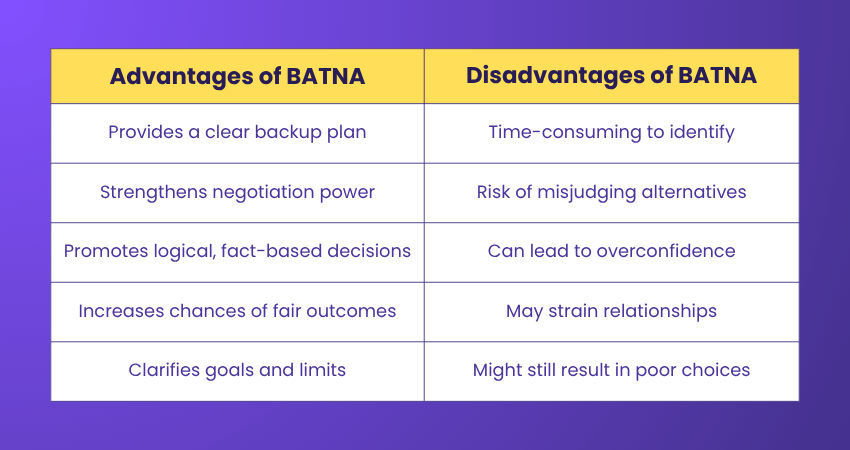
Having a strong BATNA can be a big advantage in any negotiation. It helps you stay calm, make smarter decisions, and know what to do if the deal doesn’t work out. But finding and analysing your best alternative can take time, effort, and sometimes money. So, it is important to know both its advantages and disadvantages:
Advantages of BATNA
1) Provides a Reliable Backup Plan: Ensures you have an alternative plan if negotiations don’t succeed.
2) Strengthens Negotiation Power: A strong BATNA gives you leverage, helping you negotiate from a position of confidence rather than pressure.
3) Encourages Fact-based Decisions: By making discussions with logic and data, BATNA reduces emotional bias during negotiations.
4) Increases the Likelihood of Agreement: When all parties have well-defined alternatives, it often leads to more realistic and acceptable outcomes.
5) Promotes Strategic Clarity: Knowing your limits and alternatives allows you to focus on achieving practical results.
Disadvantages of BATNA
1) Takes Time and Effort: Analysing and developing realistic alternatives can require significant effort and resources.
2) Risk of Miscalculation: Negotiators may overestimate or underestimate the value of their alternatives, leading to poor decisions.
3) Can Create Overconfidence: Relying too heavily on a perceived strong BATNA might cause rigidity or missed opportunities for collaboration.
4) Potential to Strain Relationships: Emphasising alternatives too strongly may make the negotiation feel competitive rather than cooperative.
5) Possibility of Disadvantageous Choices: Even with preparation, there is always a risk of choosing an option that later proves less beneficial.
BATNA and Negotiation Tactics
Incorporating your BATNA into negotiation preparation is essential for maximising your chances of success. Here are key Negotiation Techniques for effectively utilising it as a source of power and leverage:
1) Incorporating BATNA During Preparation
Before entering a negotiation, thoroughly analyse your BATNA and align it with your negotiation goals. Identify your Negotiation Agreement’s key strengths and advantages and consider how they can be strategically used to influence the negotiation. Use it as a benchmark to evaluate proposed agreements and determine their value relative to your alternatives.
2) Using BATNA to Your Advantage
Your BATNA represents your best alternative, giving you leverage and power in the negotiation. Communicate your awareness of your Negotiated Agreement to the other party. Also, demonstrate your willingness and ability to walk away if the Negotiated Agreement does not meet your needs. This can encourage the other party to make more favourable concessions by creating a sense of urgency.
3) Revealing or Concealing Your BATNA
The decision of whether to reveal or conceal your BATNA depends on the specific negotiation context. If it is strong and you believe it will strengthen your position, strategically reveal it to demonstrate your negotiating power. Also, encourage the other party to improve their offer. However, if it is too weak or uncertain, it may be advantageous to keep it confidential, allowing you to explore potential agreements without revealing your alternatives.
Learn to communicate more efficiently with our Communication Skills Training - Register now!
Example of BATNA
Let’s take a hypothetical situation and understand BATNA in real life simulation:
Alex needs a laptop and is negotiating with Chris to buy one. Chris offers to sell his laptop to Alex for £800. Alex searches online and finds a similar laptop valued at £600. Alex's BATNA is £600. If Chris does not offer a price lower than £600, Alex will consider his best alternative to a negotiated agreement. Alex is willing to pay up to £600 for the laptop but would ideally want to pay £500.
If Chris demands a price higher than £600, Alex will walk away from the deal. If we assume Chris can sell his laptop to someone else for £650, then £650 is Chris's BATNA. In this case, an agreement will not be made, as Chris wants at least £650, while Alex will pay a maximum of £600.
However, if Chris’s best alternative is selling the laptop to a store for £550, then both parties can come to an agreement, as Chris's reservation point would be £550. Therefore, the zone of potential agreement would be between £550 and £600, allowing the two parties to potentially reach a deal.
Identifying Your BATNA
With the below-mentioned simple steps, you can identify your BATNA effectively.
1) Think of all the actions you can take if the current negotiation fails.
2) Analyse the pros, cons, and realistic value you will get from each alternative option.
3) Select the option that gives you the most benefit and least risk.
4) Use your BATNA as a benchmark to decide whether to accept or walk away.
Achieve negotiation excellence and perfect your BATNA with our Contract Negotiation Course – Sign up now!
What is a Weak BATNA?
A weak BATNA means you have limited or poor alternatives if a negotiation fails. In other words, it means that you don’t have a strong backup plan or a better option outside the current deal. That's why you need to have a strong BATNA to negotiate in a place of strength. You don’t have to select anything with compulsion or without any other choices.
For example, if you’re negotiating a job offer and you don’t have any other offers with you, then your BATNA is weak. This makes it harder to negotiate for higher pay or better benefits.
What is the BATNA Rule?
The BATNA rule is very straightforward. You need to always avoid agreeing to a deal that offers less value than your Best Alternative to a Negotiated Agreement. It serves as a guiding principle to help you make logical, informed choices instead of emotional or pressured ones. This rule encourages rational decision-making and ensures you only agree to terms that genuinely serve your interests.
Conclusion
Mastering the art of BATNA empowers individuals to make more informed decisions and secure favourable outcomes. Understanding this concept allows them to develop strong negotiation skills and employ effective negotiation tactics. So, harness its power and become a skilled negotiator to navigate complex negotiation scenarios.
Frequently Asked Questions
Can we Negotiate Without Having a BATNA?

Negotiation is tough indeed. It becomes even more challenging if strong alternatives are not present. It is never wise to enter a serious negotiation without knowing BATNA.
Why is Negotiation Important in Business and Your Career?
It is important to know that negotiation and conflict resolution are interconnected. Negotiation skills help to deal with disputes when they crop up, but they also help prevent them.
What are the Other Resources and Offers Provided by The Knowledge Academy?
The Knowledge Academy takes global learning to new heights, offering over 3,000+ online courses across 490+ locations in 190+ countries. This expansive reach ensures accessibility and convenience for learners worldwide.
Alongside our diverse Online Course Catalogue, encompassing 17 major categories, we go the extra mile by providing a plethora of free educational Online Resources like Blogs, eBooks, Interview Questions and Videos. Tailoring learning experiences further, professionals can unlock greater value through a wide range of special discounts, seasonal deals, and Exclusive Offers.
What is The Knowledge Pass, and How Does it Work?
The Knowledge Academy’s Knowledge Pass, a prepaid voucher, adds another layer of flexibility, allowing course bookings over a 12-month period. Join us on a journey where education knows no bounds.
What are Related Courses and Blogs Provided by The Knowledge Academy?
The Knowledge Academy offers various Communication Skills Courses including Contract Negotiation Training, Business Contract Law Training and Contract Management Certification. These courses cater to different skill levels, providing comprehensive insights into Types of Communication Skills.
Our Business Skills Blogs cover a range of topics related to BATNA, offering valuable resources, best practices, and industry insights. Whether you are a beginner or looking to advance your Contract Management skills, The Knowledge Academy's diverse courses and informative blogs have got you covered.

Charlotte Wilson


Soft Skills and Business Training Manager
Charlotte Wilson is an expert in soft skills development, with over 14 years of experience helping individuals and teams improve communication, productivity and emotional intelligence in the workplace. Her training content is focused on enhancing interpersonal effectiveness and fostering positive, collaborative environments across all levels of an organisation.
View Detail
Upcoming Business Skills Resources Batches & Dates
Date
 Public Speaking Course
Public Speaking Course
Fri 27th Mar 2026
Public Speaking Course
Fri 29th May 2026
Public Speaking Course
Fri 31st Jul 2026
Public Speaking Course
Fri 2nd Oct 2026
Public Speaking Course
Fri 27th Nov 2026

 If you wish to make any changes to your course, please


