


 Top Rated Course

We may not have the course you’re looking for. If you enquire or give us a call on +44 1344 203 999 and speak to our training experts, we may still be able to help with your training requirements.
Nature vs Nurture: Debate in Psychology
The Knowledge Academy 14 February 2026Nature vs Nurture is a psychological debate about whether human traits are from genetic inheritance (nature) or environmental influences (nurture). Nature vs Nurture is a psychological debate about whether human traits are from genetic inheritance or environmental influences. Both are critical in shaping human development.

Training Outcomes Within Your Budget!
We ensure quality, budget-alignment, and timely delivery by our expert instructors.
Table of Contents
The question of Nature vs Nurture Psychology has been a longstanding topic of fascination and debate in Psychology. Are we shaped more by the genes we inherit or by the environments and experiences we are exposed to? This timeless question challenges us to consider the influences that drive human behaviour and development.
In this blog, we’ll explore the Nature vs Nurture debate and how both factors influence personal development, child growth, Mental Health, and intelligence. Get ready to uncover surprising insights and discover how these forces work together to shape who we are! Let’s dive into this fascinating journey of human development.
Table of Contents
1) Nature and Nurture Defined
2) Nature
3) Nurture
4) Nature vs Nurture
5) Examples of Nature vs Nurture
6) What is Chomsky's Theory of Nature vs Nurture?
7) Conclusion
Nature and Nurture Defined
Nature and Nurture are two key concepts used in Psychology to explain human development and behaviour. Nature focuses on genetic inheritance and biological factors present from birth. Nurture highlights the role of environment, upbringing, education, and life experiences. When they are combined, they provide a balanced framework for understanding why people grow, think, and behave differently.

Nature
Nature is the foundation of who we are, encoded in our DNA. It determines our physical traits, innate talents, and behavioural tendencies before we are even born. Like a seed with the potential to grow into a towering oak, our genes provide the blueprint for our abilities and characteristics, from eye colour to intelligence.
However, Nature alone does not define us. Life experiences, choices, and surroundings shape how this genetic plan unfolds. Even identical twins with the same DNA grow into distinct individuals. Nature provides the outline, but it is an experience that fills in the details, shaping who we ultimately become.
What is Nativism?
Nativism is a rather controversial ideology that led to some dramatic trouble in some parts of history! It is an ideology that believes that everything about a person, like mental and physical characteristics, is inherited and predetermined during birth.
In the early 20th century, this ideology gave way to a racially biased eugenics movement. Lucky for us, the concept of “selective breeding”, which suggested only certain people should be allowed to reproduce, did not stick around. It was rather looked down upon after losing momentum during World War II as it was the ideology behind the Nazis’ ethnic cleansing (killing people based on their ethnicity or religious beliefs).
Nurture
Nurture is the invisible hand that sculpts the raw marble of genetics, shaping personality, beliefs, and potential through life’s experiences. It is the warmth of a caregiver’s embrace, the wisdom in a mentor’s words, and the trials that forge resilience. Like an artist with a brush, Nurture paints over the canvas of nature, adding depth, colour, and meaning to who we become.
While Nature provides the blueprint, Nurture builds the masterpiece. It is the storm that strengthens roots, the wind that guides a sail, and the fire that tempers steel. Growth is not just about where we begin but how life’s hands shape us along the way.
Learn how you can prevent psychological distress that can lead to extreme adversities. Sign up for our Prevention Psychology Training - Register now!
Nature vs Nurture
Here’s the debate of Nature vs Nurture: it examines how our genetic inheritance (Nature) and the environment around us (Nurture) influence who we become. Both factors play an important role in shaping our traits, behaviours, and development, often interacting to determine our growth and potential.
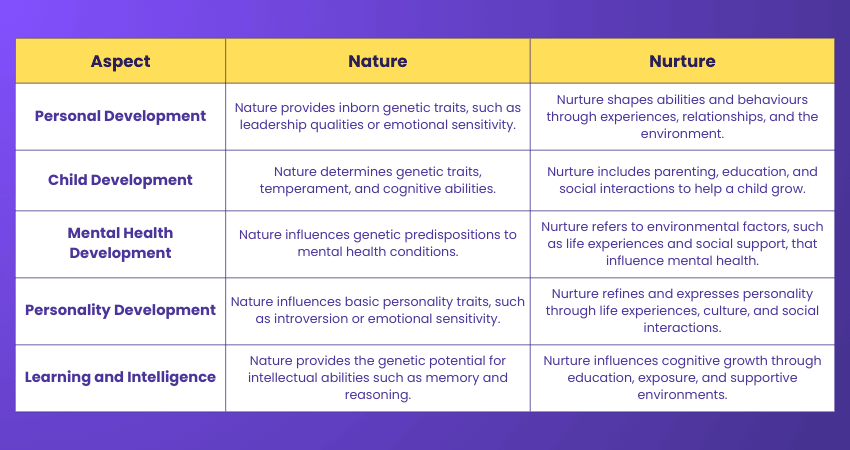
1) Personal Development
Here’s how Nature and Nurture influence our personal growth:
Nature:
a) Nature refers to inborn genetic traits, such as leadership qualities or emotional sensitivity.
b) These traits form the foundation of personality and abilities.
c) Nature sets the stage for how we approach challenges and interactions.
Nurture:
a) Nurture involves experiences, relationships, and environmental factors that shape our abilities and behaviours.
b) It refines and enhances inborn traits, influencing growth and development.
c) A nurturing environment fosters resilience, confidence, and Emotional Intelligence (EI).
2) Child Development
Here’s how Nature and Nurture impact child development:
Nature:
a) Nature determines a child’s genetic traits, temperament, cognitive abilities, and physical features.
b) Inherited characteristics influence the child's potential for growth in various areas.
Nurture:
a) Nurture includes the impact of parenting, education, and social interactions.
b) It shapes emotional, intellectual, and social development.
c) A supportive environment helps children reach their full potential.
3) Mental Health Development
Here’s how Nature and Nurture affect mental health development:
Nature:
a) Nature includes genetic predispositions to mental health conditions such as anxiety, depression, and schizophrenia.
b) It influences emotional regulation and stress response.
Nurture:
a) Nurture refers to environmental factors like childhood experiences and trauma.
b) Social support, upbringing, and life experiences impact how mental health challenges manifest.
c) A nurturing environment can foster resilience, while negative experiences can increase risks.
4) Personality Development
Here’s how Nature and Nurture shape personality:
Nature:
a) Nature influences basic personality traits, such as introversion, extraversion, and emotional sensitivity.
b) Inborn traits contribute to the foundation of personality.
Nurture:
a) Nurture shapes personality through life experiences, social interactions, and environmental influences.
b) Parenting styles, education, culture, and relationships refine the expression of innate traits.
5) Learning and Intelligence
Here’s how Nature and Nurture assist learning and intelligence:
Nature:
a) Nature provides the genetic potential for intellectual abilities such as memory, reasoning, and focus.
b) Some children may inherit stronger cognitive abilities.
Nurture:
a) Nurture includes access to education, quality of teaching, and parental support.
b) Environmental factors, exposure to experiences, and a stimulating learning environment foster cognitive growth.
Aid in creating a safe space for everyone around you with our Mindfulness Training - Sign up now!
Examples of Nature vs Nurture
The Nature vs Nurture debate can be seen in everyday human traits such as intelligence, personality, and behaviour. For example, a child may inherit a natural aptitude for music or athletics (Nature), but without practice, encouragement, and access to learning opportunities (Nurture), that potential may never fully develop. This shows how genetic ability often needs environmental support to flourish.
Another clear example is language development. Humans are born with the biological capacity to learn language, yet the specific language, accent, and vocabulary depend entirely on the environment in which a person grows up. Cultural influences, education, and social interaction all shape how this natural ability is expressed over time.
What is Chomsky's Theory of Nature vs Nurture?
Noam Chomsky is a renowned linguist, philosopher, and cognitive scientist best known for his theory of innate language acquisition. He proposed that language development is largely driven by Nature, suggesting that humans are born with an innate ability to acquire language.
He introduced the idea of a Language Acquisition Device (LAD), meaning children are born with a natural ability to learn language and understand grammar without being formally taught. This challenged the belief that language is learned only by copying others or through practice.
Chomsky gave more importance to Nature alone. However, he did not ignore the role of Nurture. Although children are born with the ability to learn a language, they must hear and interact with language early in life for it to develop properly. This shows that both natural ability and environmental exposure are necessary for language learning.
Conclusion
The Nature vs Nurture debate reveals that both genetics and environment play crucial roles in shaping who we are. While Nature provides the foundation, Nurture refines and moulds us through life experiences. Understanding the balance between the two helps us better comprehend human behaviour and development, unlocking the mysteries of who we truly are.
Learn to manage stress mindfully and build resilience with our Handle Stress and Develop Your Resilience Course - Register now!
Frequently Asked Questions
Can Nurture Change Nature?

Nurture can influence the expression of inborn traits, but it cannot completely change the genetic foundation. Environmental factors, experiences, and upbringing can shape and refine abilities, but genetic predispositions still play a key role.
Is Intelligence Nature or Nurture?
Intelligence is shaped by both Nature and Nurture. Genetic factors provide cognitive potential, but education, environment, and life experiences play a significant role in developing and enhancing intellectual abilities over time.
What are the Other Resources and Offers Provided by The Knowledge Academy?
The Knowledge Academy takes global learning to new heights, offering over 3,000+ online courses across 490+ locations in 190+ countries. This expansive reach ensures accessibility and convenience for learners worldwide.
Alongside our diverse Online Course Catalogue, encompassing 19 major categories, we go the extra mile by providing a plethora of free educational Online Resources like Blogs, eBooks, Interview Questions and Videos. Tailoring learning experiences further, professionals can unlock greater value through a wide range of special discounts, seasonal deals, and Exclusive Offers.
What is The Knowledge Pass, and How Does it Work?
The Knowledge Academy’s Knowledge Pass, a prepaid voucher, adds another layer of flexibility, allowing course bookings over a 12-month period. Join us on a journey where education knows no bounds.
What are the Related Courses and Blogs Provided by The Knowledge Academy?
The Knowledge Academy offers various Mental Health Courses, including the Child Psychology Course, Mindfulness Training, and Psychology of Personal Growth Training. These courses cater to different skill levels, providing comprehensive insights into How to Practice Mindfulness.
Our Health & Safety Blogs cover a range of topics related to Nature vs Nurture, offering valuable resources, best practices, and industry insights. Whether you are a beginner or looking to advance your Psychology knowledge, The Knowledge Academy's diverse courses and informative blogs have you covered.

The Knowledge Academy


Global Training Provider
The Knowledge Academy is a world-leading provider of professional training courses, offering globally recognised qualifications across a wide range of subjects. With expert trainers, up-to-date course material, and flexible learning options, we aim to empower professionals and organisations to achieve their goals through continuous learning.

Upcoming Health & Safety Resources Batches & Dates
Date
 Child Psychology Course
Child Psychology Course
Fri 8th May 2026
Child Psychology Course
Fri 25th Sep 2026
Child Psychology Course
Fri 18th Dec 2026

 If you wish to make any changes to your course, please


