
ITIL® Certification Training

accredited by

Our ITIL® 5 Foundation course is accredited by PeopleCert

Online Instructor-led (2 days)

Classroom (2 days)

Online Self-paced (16 hours)

ITIL® 5 Foundation Certification Exam Information

ITIL® 5 Foundation Certification Course Outline

Module 1: Key Concepts of Digital Product and Service Management

  • Product and Service Management
    • Digital Product and Service Management
    • Product, Service as a Key Concept of Digital Product and Service Management
    • Digital Product, Digital Service as a Key Concept of Digital Product and Service Management
    • ITIL Product and Service Lifecycle as a Key Concept of Digital Product and Service Management
  • Service Offerings
    • Service Offering and Service Interactions
    • Service Offering and Service Interactions
    • Service Actions, Transfer of Goods, Access to Resources
  • Value Co-Creation
    • Value and Value Co-Creation
    • Cost and Risk
    • Output and Outcome
    • Understand the Difference Between Output and Outcome
    • How Value Contributes to Value Co-Creation?
    • How Outcomes, Costs, Risks Contribute to Value Co-Creation?

Module 2: Service Relationships

  • Value Co-Creation
    • How Utility, Warranty, User Experience, Sustainability Contributes to Value Co-Creation?
  • Service Relationships

Module 3: The ITIL Value System (ITIL VS)

  • Components of the ITIL Value System
    • Components of the ITIL Value System and their Role in an Organization: Guiding Principles, Governance, Value Chain, Management Practices, Continual Improvement
  • ITIL Value System (ITIL VS) and its purpose

Module 4: Governance

  • Governance
    • Define Governance
    • Enabling Nature and the Activities of Governance

Module 5: ITIL Guiding Principles

  • Value Co-Creation
    • Explain how Feedback Contributes to Value Co-Creation
  • ITIL Guiding Principles

Module 6: Value Chain and ITIL Management Practices

  • Introduction to ITIL Product and Service Lifecycle
  • Purpose and Scope of ITIL Product and Service Lifecycle Activities
  • Value Chain
  • Management Practices

Module 7: Value Streams: Mapping and Management

  • Key Concepts of Value Stream Mapping and Management
  • Application of Value Streams
  • Purpose of Value Stream Mapping and Management

Module 8: Continual Improvement

  • ITIL Continual Improvement Model
  • List the Steps of the ITIL Continual Improvement Model
  • Understand the Steps of the ITIL Continual Improvement Model
  • Describe Continual Improvement within the ITIL Value System and its role in the Organisation 

Module 9: Four Dimensions of Product and Service management

  • Introduction to the ITIL Four Dimensions of Product and Service Management
  • Internal Factors and External Factors
  • Introduction to AI
  • ITIL AI Governance

Module 10: ITIL and Other Frameworks Integration

  • ITIL and DevOps
  • ITIL and PRINCE2

Show moredown

Who Should Attend this ITIL® 5 Foundation Certification?

This ITIL® 5 Certification is ideal for professionals seeking a modern understanding of digital product and service management, value co-creation, and service lifecycle practices, while supporting progression along the ITIL Certification Path. It is particularly suitable for the following professionals:

  • IT Service Management Professionals
  • IT Managers
  • Service Delivery Managers
  • Service Desk Analysts
  • IT Support Professionals
  • Digital Product Managers
  • Service Owners
  • DevOps Practitioners

Prerequisites of the ITIL® 5 Foundation Certification Course

There are no formal prerequisites for this ITIL 5 Certification. It is suitable for beginners as well as professionals who want to build a foundational understanding of modern IT services and digital product management concepts.
 

ITIL® 5 Foundation Certification Overview

This ITIL® 5 Certification introduces delegates to modern digital product and service management practices, focusing on value co-creation, service relationships, experience management, and continual improvement.

This certification helps professionals understand how to deliver value across the service lifecycle, improve service performance, and align ITIL practices with business needs.

This 2-Day ITIL® Version 5 Foundation Certification Course offered by The Knowledge Academy provides structured learning aligned with the latest ITIL framework, covering the ITIL Value System, Four Dimensions model, value streams, and emerging practices such as AI and automation.

ITIL® 5 Certification Course Objectives

  • To understand modern digital product and service management concepts
  • To learn the principles of value co-creation and service relationships
  • To gain knowledge of the ITIL Value System and Four Dimensions model
  • To understand lifecycle activities across digital products and services
  • To explore continual improvement, governance, and value stream management
  • To recognise the role of AI, automation, and DevOps

Upon completion of this ITIL® 5 Foundation Certification Training, delegates will have a clear understanding of modern digital product and service management practices and be able to apply ITIL principles. This helps in supporting value creation, service improvement, and effective service delivery, strengthening their readiness for diverse ITIL Career Opportunities.

ITIL® 5 Certification Pathway

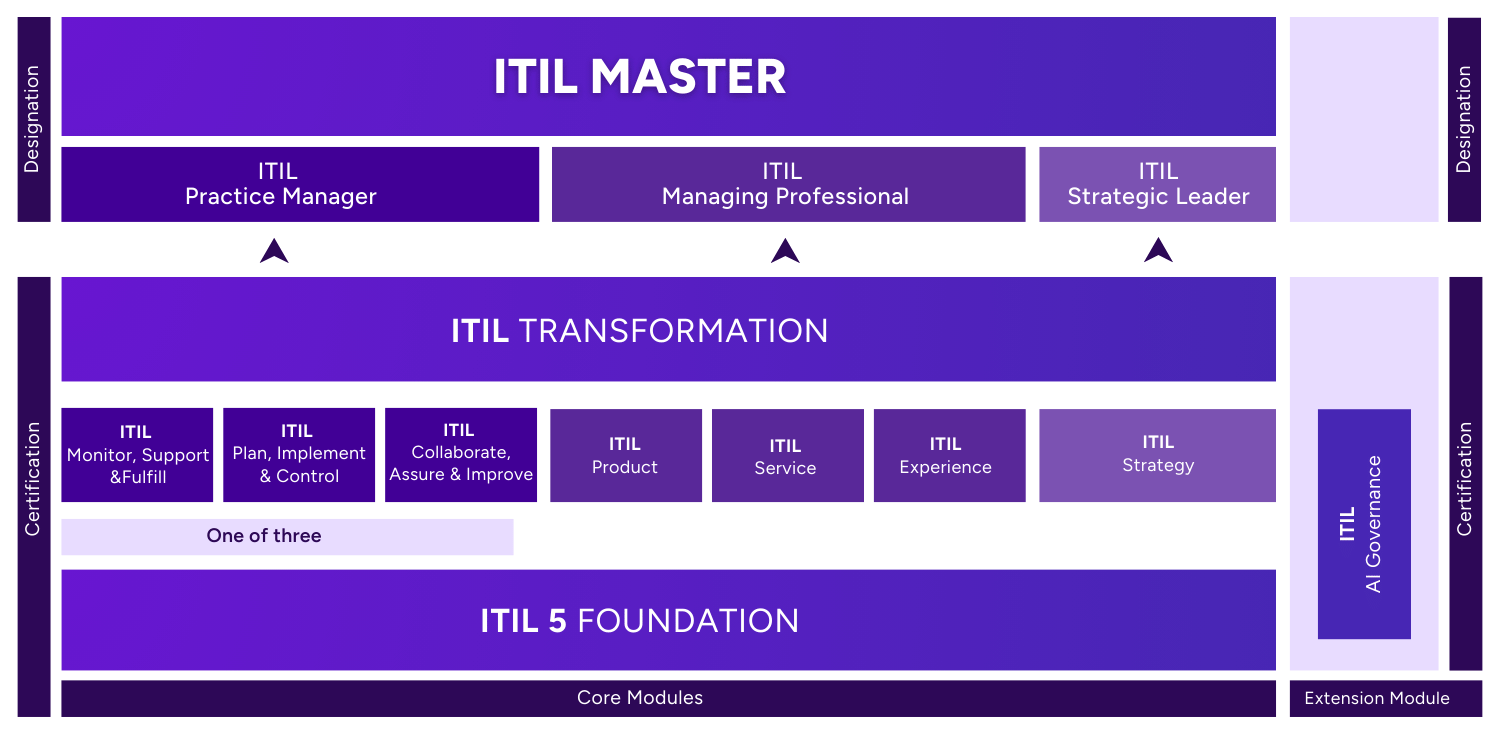
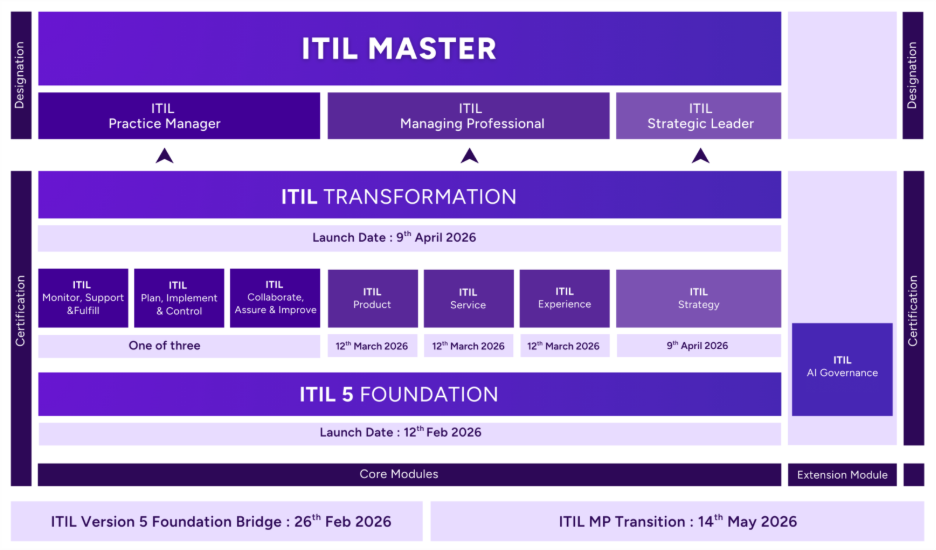
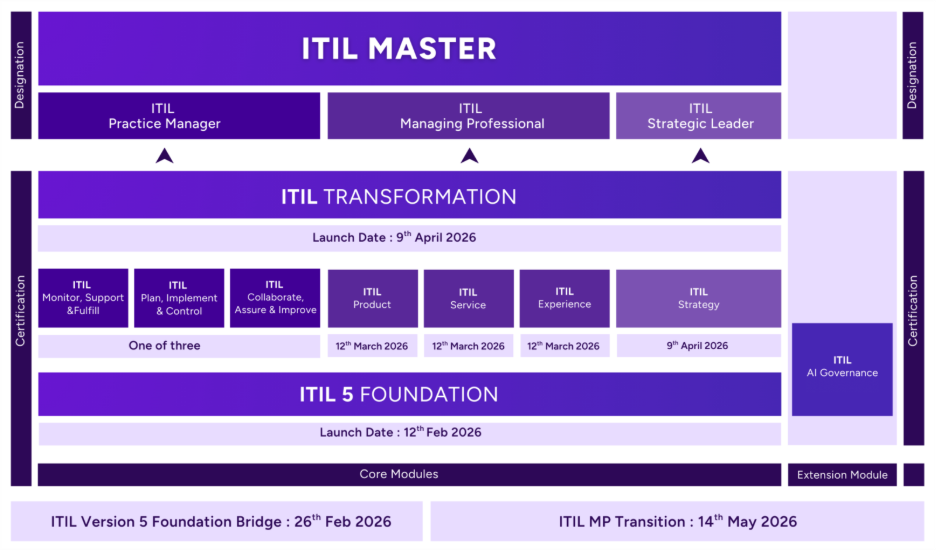
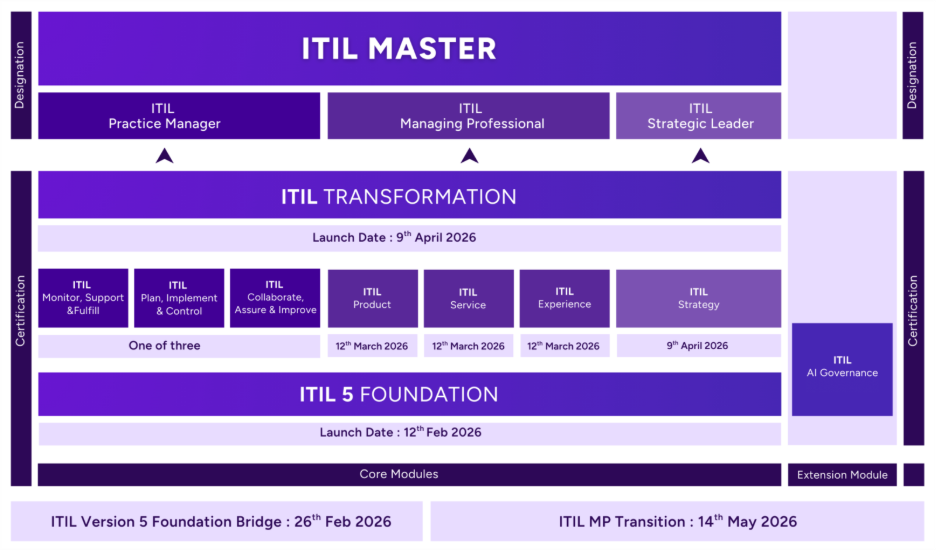
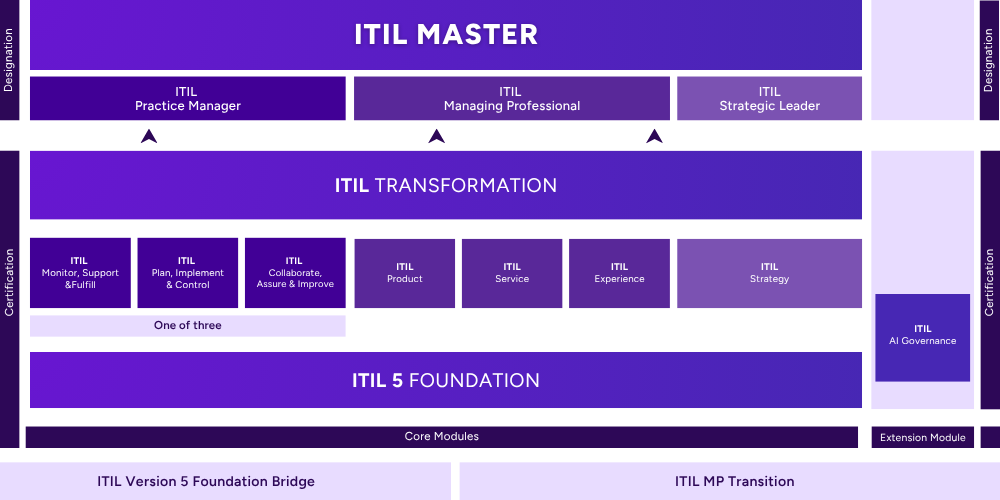
The ITIL® Version 5 Certification pathway follows a step-by-step progression, where learners begin with core concepts and advance through practice, management, and strategy leadership roles.

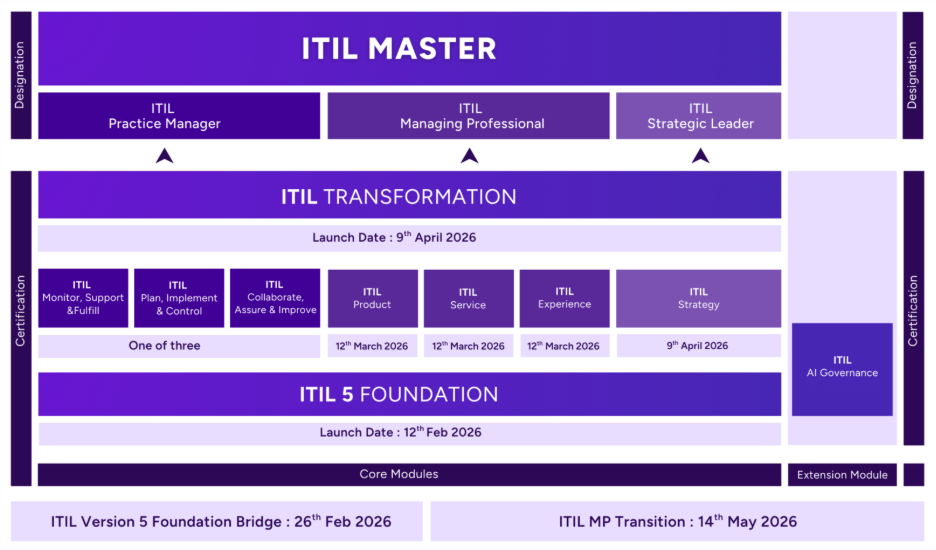
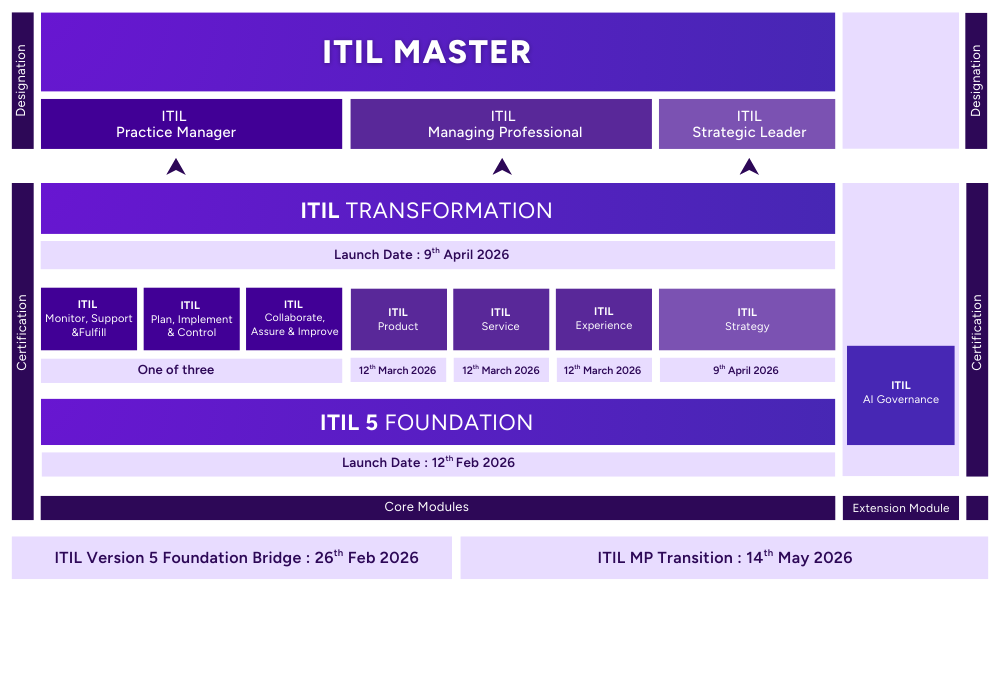
ITIL® (Version 5) certifications progress from ITIL 5 Foundation into Practice Manager, Managing Professional, and Strategic Leader pathways, supported by the ITIL® Transformation module. An AI Governance module extends capability in responsible AI management. 

ITIL Version 5 Courses Launch Date

ITIL 5 Foundation = 12th Feb 2026

ITIL Version 5 Foundation Bridge = 26th Feb 2026

ITIL Service, ITIL Product, ITIL experience = 12th March 2026

ITIL Strategy, Transformation = 9th April 2026

ITIL MP Transition = 14th May 2026

ITIL Version 5 Certification Pathway 

Show moredown

What's Included in this ITIL® Version 5 Foundation Course?

  • World-Class Training from Experienced Instructors
  • ITIL (Version 5) Foundation Examination
  • Digital Delegate Pack

Show moredown

ITIL® 5 Foundation Certification Exam Information

The ITIL® 5 Foundation exam assesses delegate understanding of core concepts in digital product and service management. It validates knowledge of the ITIL framework, key terminology, value creation principles, and foundational practices required to support modern, value-driven service management environments.

The ITIL Version 5 Foundation Exam is in the following format:

  • Question Type: Multiple Choice
  • Total Questions: 40
  • Pass Mark: 65%
  • Duration: 60 Minutes
  • Open Book/ Closed Book: Closed Book

Show moredown

accredited by

Our ITIL® Version 5 Foundation Bridge course is accredited by PeopleCert

Online Instructor-led (1 days)

Classroom (1 days)

Online Self-paced (8 hours)

ITIL® 5 Foundation Bridge Exam Information

ITIL® Version 5 Foundation Bridge Training Course Outline

Module 1: Key Concepts of Digital Product and Service Management

  • Product and Service Management
  • Service Offering
  • Value Co-Creation

Module 2: Service Relationships

  • Organisations
  • Providers, Consumers, and Vendors
  • Roles in Managing, Delivering, and Consuming Services
  • Service Consumer Roles
  • Consumer Roles Example
  • Service Relationship Model
  • Types of Service Relationships: Basic, Cooperative, and Collaborative
  • Service Journey (1/2)
  • Service Journey (2/2)
  • Service Quality and Service Level
  • Service Level Metrics (1/2)
  • Service Level Metrics (2/2)
  • Service Level Agreements

Module 3: ITIL Value System (ITIL VS)

  • Components of the ITIL Value System
    • Guiding Principles, Governance, Value Chain, Management Practices, Continual Improvement
  • ITIL Value System and its Purpose

Module 4: Governance

  • Governing Bodies and Governance
  • Governance of Digital Technology

Module 5: ITIL Guiding Principles

  • What is an ITIL Guiding Principle?
  • Recap of the ITIL Guiding Principles
  • Using Automation and AI
  • Principles Interaction

Module 6: Value Chain, Lifecycle Activities and ITIL Management Practices

  • Introduction to ITIL Product and Service Lifecycle
  • Purpose of the ITIL Product and Service Lifecycle Management Activities
  • Value Chain
  • Management Practices

Module 7: Value streams

  • Key Concepts of Value Stream Mapping and Management
  • Purpose of Value Stream Mapping and Management

Module 8: Continual improvement

  • ITIL Continual Improvement Model
    • List the Steps of the ITIL Continual Improvement Model
    • Understand the Steps of the ITIL Continual Improvement Model 
    • Describe Continual Improvement within the ITIL Value System and its Role in the Organisation 

Module 9: Four Dimensions of Product and Service Management and AI

  • Introduction to the ITIL Four Dimensions of Product and Service Management
  • Internal Factors and External Factors
  • Introduction to AI
  • ITIL AI Governance

Module 10: ITIL and other Frameworks Integration

  • ITIL and DevOps
  • ITIL and PRINCE2

Show moredown

Who Should Attend the ITIL® Version 5 Foundation Bridge Training?

This training is designed for professionals who already hold ITIL® 4 Foundation and want to transition smoothly to ITIL® Version 5. It focuses on updated concepts, terminology, and practices without revisiting foundational ITIL knowledge. The following professionals can benefit the most from the course:

  • IT Service Managers
  • IT Operations Managers
  • Service Delivery Managers
  • Product Managers
  • IT Consultants
  • Digital Transformation Managers
  • Governance, Risk, and Compliance Professionals

Prerequisites of the ITIL® Version 5 Foundation Bridge Training

Delegates must hold a valid ITIL® 4 Foundation certification before attending this Bridge training. This prerequisite ensures existing ITIL knowledge is in place, allowing full focus on the updated concepts, enhancements, and new practices introduced in ITIL® Version 5.

ITIL® Version 5 Foundation Bridge Training Overview

ITIL® Version 5 Foundation Bridge Training introduces delegates to the latest evolution of the ITIL framework, focusing on digital product and service management. It explains how ITIL has progressed beyond ITIL® 4 to support modern value creation, lifecycle thinking, and digital operating models.

This training supports professionals who already hold ITIL® 4 Foundation by building clarity around new Version 5 concepts. It strengthens understanding of value streams, governance, digital experience, and emerging areas.

This 1-Day course by The Knowledge Academy enables delegates to transition confidently to ITIL® Version 5 without revisiting foundational content. It provides focused insight into updated terminology, practices, and structures, supporting progression into advanced ITIL® Version 5 Certifications.

ITIL® Version 5 Foundation Bridge Training Objectives

  • To understand the evolution from ITIL® 4 to ITIL® Version 5
  • To explore updated product and service lifecycle concepts in Version 5
  • To gain insight into value streams, governance, and digital experience
  • To apply ITIL® Version 5 terminology and principles effectively
  • To prepare for progression into advanced ITIL® Certifications

Upon completion of this ITIL® Version 5 Foundation Bridge Course, delegates will gain a clear understanding of Version 5 changes, supporting a confident transition from ITIL® 4 and continued professional development in modern service management roles.

Show moredown

What’s Included in this ITIL® Version 5 Foundation Bridge Training?

  • World-Class Training Sessions from Experienced Instructors
  • Interactive Learning with 24*7 Support
  • Digital Delegate Pack

Show moredown

ITIL® 5 Foundation Bridge Exam Information 

The ITIL® 5 Foundation Bridge exam assesses a delegate’s understanding of the updated concepts introduced in ITIL Version 5. It validates knowledge of key framework enhancements, revised terminology, and the integration of digital product and service management practices for professionals transitioning from previous ITIL certifications. 

The ITIL® 5 Foundation Bridge Exam is in the following format: 

  • Question Type: Multiple Choice 
  • Total Questions: 20 
  • Pass Mark: 65%
  • Duration: 30 Minutes 
  • Open Book/Closed Book: Closed Book 

Show moredown

accredited by

Our ITIL® 5 Product Certification course is accredited by PeopleCert

Online Instructor-led (2 days)

Classroom (2 days)

ITIL® Version 5 Product Certification Course Outline

Module 1: ITIL Foundation Recap and Digital Products and Services Overview

  • Introduction to Digital Products and Services
  • Digital Product and Service Lifecycle Management Activities

Module 2: Discover

  • Key Concepts and Practices of the ‘Discover’ Activity
  • Steps and Outputs of the ‘Discover’ Activity
  • Success Factors and Metrics of the ‘Discover’ Activity

Module 3: Design

  • Key Concepts and Practices of the 'Design' Activity
  • Steps and Outputs of the 'Design' Activity
  • Success Factors and Metrics of the 'Design' Activity

Module 4: Acquire

  • Key Concepts and Practices of the 'Acquire' Activity
  • Steps and Outputs of the 'Acquire' Activity
  • Success Factors and Metrics of the 'Acquire' Activity

Module 5: Build

  • Key Concepts and Practices of the 'Build' Activity
  • Steps and Outputs of the 'Build' Activity
  • Success Factors and Metrics of the 'Build' Activity

Module 6: Transition

  • Key Concepts and Practices of the 'Transition' Activity
  • Steps and Outputs of the 'Transition' Activity
  • Success Factors and Metrics of the 'Transition' Activity

Module 7: Operate

  • Key Concepts and Practices of the 'Operate' Activity
  • Steps and Outputs of the 'Operate' Activity
  • Success Factors and Metrics of the 'Operate' Activity

Module 8: Deliver

  • Key Concepts and Practices of the 'Deliver' Activity
  • Steps and Outputs of the 'Deliver' Activity
  • Success Factors and Metrics of the 'Deliver' Activity

Module 9: Support

  • Key Concepts and Practices of the 'Support' Activity
  • Steps and Outputs of the 'Support' Activity
  • Success Factors and Metrics of the 'Support' Activity

Module 10: The ITIL Product and Service Lifecycle

  • Managing the End-to End Lifecycle
  • ITIL, AI, and Other Frameworks

Module 11: ITIL and Other Frameworks

  • ITIL, AI, and Other Frameworks

Show moredown

Who Should Attend this ITIL® Version 5 Product Certification? 

The ITIL® Version 5 Product Certification is ideal for professionals who want to strengthen their understanding of product-oriented service management and apply ITIL® 5 principles in real-world environments. This certification is beneficial for professionals such as: 

  • IT Service Managers 
  • Service Delivery Professionals 
  • IT Architects and Planners 
  • IT Consultants 
  • Advisory Professionals 
  • Project Managers 

Prerequisites of the ITIL® Version 5 Product Certification 

There are no formal prerequisites for this ITIL® 5 Product Certification. However, delegates should have completed ITIL® Version 5 Foundation Certification. 

ITIL® Version 5 Product Certification Overview

The ITIL® Version 5 Product Training Course provides a structured understanding of how products are designed, managed, and evolved to support service value creation. It explores product lifecycles, service relationships, and the integration of products within the ITIL® Value System.

This 2-Day course offered by The Knowledge Academy equips delegates with the knowledge required to apply ITIL product and service lifecycle principles in practical environments. Delegates will learn how to manage lifecycle activities, evaluate success metrics, and align digital products with organisational objectives.

The ITIL Version 5 Foundation Certification Course is already available. Please check it out to get started on the ITIL Certification pathway.

ITIL® (Version 5) Product Certification

Show moredown

What's Included in this ITIL® Version 5 Product Certification?  

  • World-Class Training from Experienced Instructors  
  • Digital Delegate Pack 

Show moredown

accredited by

Our ITIL® 5 Service Certification course is accredited by PeopleCert

Online Instructor-led (2 days)

Classroom (2 days)

ITIL® 5 Service Certification Course Outline

Module 1: ITIL Foundation Recap and Digital Products and Services Overview

  • Introduction to Digital Products and Services
  • Digital Product and Service Lifecycle Management Activities

Module 2: Discover

  • Digital Product and Service Lifecycle Management Activities
  • Key Concepts and Practices of the 'Discover’ Activity
  • Steps and Outputs of the 'Discover’ Activity
  • Success Factors and Metrics of the 'Discover’ Activity

Module 3: Design

  • Digital Product and Service Lifecycle Management Activities
  • Key Concepts and Practices of the 'Design' Activity
  • Steps and Outputs of the 'Design' Activity
  • Success Factors and Metrics of the 'Design' Activity

Module 4: Acquire

  • Digital Product and Service Lifecycle Management Activities
  • Key Concepts and Practices of the 'Acquire' Activity
  • Steps and Outputs of the 'Acquire' Activity
  • Success Factors and Metrics of the 'Acquire' Activity

Module 5: Build

  • Digital Product and Service Lifecycle Management Activities
  • Key Concepts and Practices of the 'Build' Activity
  • Steps and Outputs of the 'Build' Activity
  • Success Factors and Metrics of the 'Build' Activity

Module 6: Transition

  • Digital Product and Service Lifecycle Management Activities
  • Key Concepts and Practices of the 'Transition' Activity
  • Steps and Outputs of the 'Transition' Activity
  • Success Factors and Metrics of the 'Transition' Activity

Module 7: Operate

  • Key Concepts and Practices of the 'Operate' Activity
  • Steps and Outputs of the 'Operate' Activity
  • Success Factors and Metrics of the 'Operate' Activity

Module 8: Deliver

  • Key Concepts and Practices of the 'Deliver' Activity
  • Steps and Outputs of the 'Deliver’ Activity
  • Success Factors and Metrics of the 'Deliver' Activity

Module 9: Support

  • Key Concepts and Practices of the 'Support' Activity
  • Steps and Outputs of the 'Support' Activity
  • Success Factors and Metrics of the 'Support' Activity

Module 10: The ITIL Product and Service Lifecycle

  • Managing the End-to-End Lifecycle
  • ITIL, AI and Other Frameworks

Module 11: ITIL and Other Frameworks

  • ITIL, AI and Other Frameworks

Show moredown

Who Should Attend this ITIL® Version 5 Service Certification?

The ITIL® Version 5 Service Certification is designed for professionals who want to deepen their knowledge of service management and apply ITIL® 5 principles to improve service delivery and value creation. It is ideal for individuals involved in designing, managing, or supporting IT services in any organisation. This course is particularly beneficial for:

  • IT Service Managers
  • Service Delivery Professionals
  • IT Architects and Planners
  • IT Consultants
  • Advisory Professionals
  • Project Managers
  • Project Managers

Prerequisites of the ITIL® Version 5 Service Certification

There are no formal prerequisites for this ITIL® 5 Service Certification. However, delegates should have completed ITIL® Version 5 Foundation Certification to ensure a solid understanding of core ITIL® concepts.

ITIL® Version 5 Service Certification Overview 

The ITIL® Version 5 Service Certification Course provides a structured understanding of how services are designed, delivered, and optimised to create value. It explores service lifecycles, service relationships, governance, and continual improvement, aligned with the ITIL® Value System and modern service management practices. 

This 2-Day course offered by The Knowledge Academy equips delegates with the knowledge required to apply ITIL service lifecycle practices confidently in professional environments. Delegates will learn how to manage lifecycle activities, evaluate success metrics, and align digital services with organisational goals.

The ITIL Version 5 Foundation Certification Course is already available. Please check it out to get started on the ITIL Certification pathway.

ITIL® (Version 5) Service Certification

Show moredown

What's Included in this ITIL® Version 5 Service Certification?

  • World-Class Training from Experienced Instructors
  • Digital Delegate Pack

Show moredown

accredited by

Our ITIL® 5 Experience Certification course is accredited by PeopleCert

Online Instructor-led (2 days)

Classroom (2 days)

ITIL® 5 Experience Certification Course Outline

Module 1: ITIL Foundation Recap and Experience Overview

  • Key Concepts of ITIL
  • Key Concepts of Experience

Module 2: Experience Stakeholders and Tensions

  • Service Stakeholders
    • Key Experience Stakeholders’ Roles
    • Consumer Stakeholders’ Roles
    • Explain the Provider Stakeholders’ Roles

Module 3: Experience and the ITIL Four Dimensions

  • Experience and the ITIL Four Dimensions
    • How Experience Integrates/Influences/is reflected in all ITIL Four Dimensions
    • How to Improve Experience through the 'Organisations and People' Dimension
    • How to Improve Experience through the 'Partners and Suppliers' Dimension
    • How to Improve Experience through the 'Information and Technology' Dimension
    • How to Improve Experience through the 'Value Streams and Processes' Dimension
  • Apply the ITIL Four Dimensions

Module 4: Experience in the ITIL Product and Service Lifecycle

  • Experience in the ITIL Product and Service Lifecycle
    • Value Chain Activities
    • Functional and Relational Interactions
    • Apply Stakeholder Role Mapping
    • Differentiate Functional vs. Relational Interactions

Module 5: Capturing Experience: Evidence, Signals, and Quality

  • Key Concepts of Experience Capture
  • Experience Evidence

Module 6: Service Journeys: Relationships, Agreements, and Stakeholder Journeys

  • Service Relationships, Agreements, and Journeys
  • Organisations
  • Consumer Stakeholders
  • Provider Stakeholders

Module 7: Continual Experience Improvement

  • Digital Experience Improvement
    • Apply the Notice – Interpret – Hypothesize – Experiment Loop within the ITIL Continual Improvement Model
    • Differentiate Improvements by the System versus Improvements to the System
    • Role of Trust and Psychological Safety in Experience Improvement

Module 8: AI, Experience, and Governance

  • Experience Management in the AI Context
  • AI Governance

Module 9: ITIL and Other Frameworks

  • ITIL and DevOps
  • ITIL and PRINCE2

Show moredown

Who Should Attend ITIL® Version 5 Experience?  

ITIL® 5 Experience is ideal for professionals who want to strengthen their understanding of experience-led product and service management in digital environments. It is particularly suitable for those involved in designing, delivering, and improving service experiences across modern IT and business landscapes, including: 

  • IT Service Management Professionals 
  • IT Managers and Service Leaders 
  • Service Delivery and Operations Managers 
  • Digital and Product Managers 
  • Service Owners 
  • Customer and Experience Management Professionals 
  • DevOps and Digital Transformation Practitioners 

Prerequisites for ITIL® Version 5 Experience  

Learners must complete the ITIL® Version 5 Foundation before attending ITIL® Version 5 Experience. Those who have completed the ITIL ® 4 Foundation are required to complete the ITIL® Version 5 Bridge Course prior to progressing to this Experience module. 

ITIL® 5 Experience Certification Overview

ITIL® Version 5 Experience focuses on applying experience-led thinking to improve how digital products and services are delivered and perceived. It explains how experience insights support value co-creation, strengthen service relationships, and enhance outcomes across value streams.

This 2-Day course offered by The Knowledge Academy equips delegates with the knowledge required to apply ITIL experience management principles in real-world service environments. Delegates will learn how to interpret experience signals, map stakeholder roles, and implement structured improvement approaches to enhance service outcomes.

The ITIL Version 5 Foundation Certification Course is already available. Please check it out to get started on the ITIL Certification pathway.

ITIL® 5 Experience Certification

Show moredown

What’s Included in this ITIL® Version 5 Experience?  

  • World-Class Training from Experienced Instructors 
  • Digital Delegate Pack

Show moredown

accredited by

Our ITIL® 5 Strategy Certification course is accredited by PeopleCert

Online Instructor-led (2 days)

This course will be launching on 9th April 2026. To join the waitlist, contact us. 

Show moredown

Who Should Consider ITIL® Version 5 Strategy?  

ITIL® 5 Strategy is suited to professionals who are responsible for setting direction, shaping service priorities, and aligning IT initiatives with organisational goals. It is particularly relevant for individuals involved in leadership, planning, and governance roles, such as: 

  • IT Managers and Senior Leaders 
  • Service and Product Owners 
  • Digital and Transformation Leads 
  • Portfolio and Programme Managers 
  • Business Strategy and Governance Professionals 
  • Risk, Compliance, and Decision-Making Roles 

Entry Requirements for ITIL® Version 5 Strategy Training 

To progress to ITIL® Version 5 Strategy, learners must first complete the ITIL® Version 5 Foundation. Individuals who hold the ITIL® 4 Foundation will need to complete the ITIL® Version 5 Bridge Course before moving forward with this Strategy module.

ITIL® 5 Strategy Certification Overview

ITIL® Version 5 Strategy centres on using strategic thinking to guide how services and digital products create sustained value. It explains how organisations use governance, prioritisation, and strategic alignment to support effective decision-making across portfolios and value streams.

This course will be launching on 9th April 2026. To join the waitlist, contact us.

The ITIL Version 5 Foundation Certification Course is already available. Please check it out to get started on the ITIL Certification pathway.

ITIL® 5 Strategy Certification


Show moredown

What’s Included in this ITIL® Version 5 Strategy?  

  • World-Class Training from Experienced Instructors 
  • Digital Delegate Pack 

Show moredown

accredited by

Our ITIL® 5 Transformation Certification course is accredited by PeopleCert

Online Instructor-led (2 days)

This course will be launching on 9th April 2026. To join the waitlist, please contact us.

Show moredown

Who Should Attend this ITIL® Version 5 Transformation Certification? 

The ITIL® Version 5 Transformation Certification is designed for professionals responsible for leading, supporting, or enabling change across service organisations. It is particularly beneficial for: 

  • IT Service Managers 
  • Transformation and Change Managers 
  • Digital and Technology Leaders 
  • IT Consultants and Advisory Professionals 
  • Enterprise Architects 
  • Programme and Project Managers 

Prerequisites of the ITIL® Version 5 Transformation Certification 

There are no formal prerequisites for this ITIL® 5 Transformation Certification. However, delegates should have completed the ITIL® Version 5 Foundation Certification. 

ITIL® Version 5 Transformation Certification Overview

The ITIL® Version 5 Transformation Certification provides a structured understanding of how organisations design, govern, and execute transformation initiatives. It explores organisational change, digital evolution, value stream optimisation, and continual improvement within the ITIL® Value System.

This course will be launching on 9th April 2026. To join the waitlist, please contact us.

The ITIL Version 5 Foundation Certification Course is already available. Please check it out to get started on the ITIL Certification pathway.

ITIL® (Version 5) Transformation Certification

Show moredown

What's Included in this ITIL® Version 5 Transformation Certification? 

  • World Class Training from Experienced Instructors 
  • Digital Delegate Pack 

Show moredown

accredited by

Our ITIL® 5 AI Governance Training course is accredited by PeopleCert

Online Instructor-led (2 days)

ITIL AI Governance Training launching soon. To join the waitlist, please contact us

Show moredown

Who Should Attend this ITIL® 5 AI Governance Course?

The ITIL® 5 AI Governance Course is designed for professionals responsible for managing, implementing, or overseeing Artificial Intelligence within organisational digital services and IT environments. It is particularly valuable for delegates who must ensure that AI technologies are implemented responsibly, ethically, and in accordance with established governance and regulatory frameworks.

  • This training may be beneficial for:
  • IT Service Managers
  • Business Leaders and Executives
  • AI and Machine Learning Engineers
  • Data Scientists and Data Professionals
  • Business and Data Analysts
  • Project Managers
  • Ethics and Governance Specialists

Prerequisites for ITIL® 5 AI Governance Course

There are currently no formal prerequisites for attending this training. However, a basic understanding of IT service management concepts or ITIL practices may be beneficial.

ITIL® Version 5 AI Governance Course Overview

ITIL AI Governance Training explores principles for managing Artificial Intelligence responsibly within digital services and organisational environments. Delegates examine AI risk management, ethical considerations, governance frameworks, and regulatory compliance requirements.

This course will be launching soon. To join the waitlist, please contact us.

The ITIL Version 5 Foundation Course is already available. Please check it out to get started on the ITIL pathway.

ITIL Version 5 launch schedule

Show moredown

What’s Included in this ITIL® Version 5 AI Governance Course?

  • World-Class Training from Experienced Instructors
  • Digital Delegate Pack

Show moredown

accredited by

Our ITIL® 5 Managing Professional Transition course is accredited by PeopleCert

Online Instructor-led (5 days)

This course will be launching on 14th April 2026. To join the waitlist, please contact us.

Show moredown

Who Should Attend this ITIL® 5 Managing Professional Transition?

The ITIL® Version 5 Managing Professional (MP) Transition Training is designed for professionals who want to update their existing ITIL knowledge and align it with modern service management practices with the Version 5 framework. This course is particularly suitable for:

  • IT Service Management Professionals
  • IT Managers
  • Service Delivery Managers
  • IT Consultants
  • Service Desk Managers
  • IT Operations Professionals

Prerequisites of the ITIL® 5 Managing Professional Transition

There are no formal prerequisites for this ITIL® Version 5 Managing Professional Transition. However, delegates are recommended to have completed the ITIL® 4 Managing Professional (MP) Transition Certification or be currently working in a managerial-level IT service management role to ensure they can effectively understand the updated ITIL practices and concepts.

ITIL® 5 Managing Professional Transition Overview

The ITIL® Version 5 Managing Professional (MP) Transition Course introduces updated service management concepts and practices aligned with the latest ITIL framework. It focuses on improving service delivery, strengthening stakeholder value, and supporting digital transformation initiatives.

This course will be launching on 14th May 2026. To join the waitlist, please contact us.

The ITIL Version 5 Foundation Certification Course is already available. Please check it out to get started on the ITIL Certification pathway.

ITIL Version 5 launch schedule

Show moredown

What's Included in this ITIL® 5 Managing Professional Transition?

  • World-Class Training from Experienced Instructors
  • Digital Delegate Pack

Show moredown

accredited by

Our ITIL® 4 Foundation course is accredited by PeopleCert

Online Instructor-led (2 days)

Classroom (2 days)

Online Self-paced (16 hours)

Official PeopleCert ITIL® 4 Foundation Exam

ITIL® 4 Foundation Certification Course Outline

Module 1: Introduction

  • What is ITIL®?
  • ITIL® 4 Certification Journey
  • Course Objectives
  • About the Course

Module 2: Key Concepts of Service Management

  • Concept of Value
    • What Do We Mean by Value?
    • Definition of Value
    • What is an Organisation?
    • How is Value Created Between Organisations?
    • Service Relationships
    • Providers and Consumers Co-Create Value
  • Stakeholder and Service Consumer Roles
    • Stakeholders
    • Service Provider Organisations
    • Service Consumer Organisations
    • Other Stakeholders
    • How is Value Created?
    • Service Consumer Roles
    • Activity
  • Service Offerings
    • What is a Product?
    • What is a Service?
    • What is a Service Offering?
  • Creating Value with Services
    • Value Co-Creation
    • Service Provider
    • What are Service Consumers?
    • What are Products and Services?
    • Definitions
    • What are Service Relationships?
    • What is the Meaning of Service Provision?
    • What is Service Consumption?
    • Service Relationship Management
    • How Organisations Co-Create Value?
    • Service Relationship Model
    • Value, Outcomes, Costs, and Risk
    • Definitions
    • What Can Be Described as Utility and Warranty?
    • Review and Reflect
    • Quiz

Module 3: Key Concepts of ITIL® 4

  • Four Dimensions of Service Management
    • Holistic Approach to Service Management
    • Four Dimensions of Service Management
    • Organisations and People
    • What do the Dimensions Includes?
    • What is Culture, and Why is it Needed?
    • What a Supportive Culture Requires?
    • What to Pay Attention to?
    • Organisational Complexities
    • Information and Technology
    • Things to Consider
    • Partners and Suppliers
    • Organisations and their Partners and Suppliers
    • Forms of Cooperation
    • What Goes into Supplier Strategy?
    • What is a Value Stream?
    • Value Streams and Processes
    • Questions to create, deliver and improve
  • Activity
  • ITIL® Service Value System
    • ITIL® SVS
    • ITIL® SVS Inputs
    • Governance
    • Challenges of Silos
    • Need for Continual Improvement
    • Applying the SVS
  • Service Value Chain
    • Introduction to the ITIL® Service Value Chain
    • Opportunity Vs Demand
    • Converting Inputs into Outputs
    • Service Value Chain, its Practices, and Value Streams
    • Activities
    • Review and Reflect Quiz

Module 4: Guiding Principles

  • Introduction to the Guiding Principles
    • What is a Guiding Principle?
    • Focus on Value
    • How is Value is Perceived?
    • CX and UX
    • How Would You Apply this Principle?
    • Start Where You Are
    • Assess Where You Are
    • Role of Measurement
    • Applying the Principle
    • Progress Iteratively with Feedback
    • Role of Feedback
    • Use of Feedback Loops
    • Iteration and Feedback Together
    • Collaborate and Promote Visibility
    • Communication and Visibility
    • Key Collaboration Pairs
    • Promote Visibility
    • Think and Work Holistically
    • Keep it Simple and Practical
    • Judging What to Keep
    • Conflicting Objectives
    • Applying the Principle
    • Optimise and Automate
    • Road to Optimisation
    • Using Automation
    • Applying the Principle
    • Activity: Case Studies
  • Using the Guiding Principles
    • Guiding Principles in Context
    • Guiding Principles Your Examples
    • Principle Interaction
    • Applying the Guiding Principles
    • Guiding Principles: Task
    • Principle Interaction
    • Review and Reflect Quiz
    • Extension Activity 2

Module 5: ITIL® 4 Management Practices

  • Purpose of the ITIL® Practices
    • Management Practices
    • 34 ITIL® Management Practices
    • General Management Practices
    • Service Management Practices
    • Technical Management Practices
  • Overview of Eight ITIL® Practices
    • Eight Practices
    • Information Security Management
    • Contribution of Information Security Management to SVC
    • Relationship Management
    • Supplier Management
    • Evaluating and Selecting Suppliers
    • Contribution of Supplier Management to SVC
    • IT Asset Management
    • Contribution of IT Asset Management to SVC
    • Service Configuration Management
    • Contribution of Service Configuration Management to SVC
    • Monitoring and Event Management
    • Contribution of Monitoring and Event Management to SVC
    • Deployment Management
    • Approaches for Deployment
    • Contribution of Deployment Management to SVC
    • Release Management
    • Contribution of Release Management to SVC
  • Key Management Practices – Part 1
    • What is an Incident?
    • Incident Management Guidance
    • Incident Management Tools
    • Incident Updates
    • Types of Incidents
    • Collaboration
    • Swarming
    • Third-Party Products and Services
    • Incident Management Contribution to SVC
    • Service Request Management
    • What is a Service Request?
    • Steps for Request Fulfilment
    • Request Processes and Procedures
    • Service Request Management Contribution to the SVC
    • Methods of Fulfilling Requests
    • Service Desk
    • Automation
    • Task: Service Desk ‘Pitch’
    • Service Desk Provisions
    • Service Desk Support
    • Service Desk Skills
    • Service Desk Contribution to the SVC
  • Key Management Practices – Part 2
    • Problem Management
    • Phases of Problem Management
    • Identifying a Problem
    • Problem Control
    • Workaround
    • Error Control
    • Links to Other Practices
    • Interfaces
    • Problem Management Contribution to the SVC
    • Continual Improvement
    • Applying Continual Improvement
    • Continual Improvement Model
    • What is the Vision?
    • Where are We Now?
    • Where do We Want to Be?
    • CSFs and KPIs
    • How do We get There?
    • Take Action
    • Did we Get There?
    • How do We Keep the Momentum?
    • Methods to Continually Improve
    • Continual Improvement Activity
    • Tracking
    • CI Responsibility
    • Continual Improvement Contribution to the SVC
  • Key Management Practices – Part 3
    • Service Level Management
    • Activity
    • Service Level Agreements
    • Key requirements for SLAs
    • Watermelon SLA Effect
    • Customer Engagement
    • Customer Feedback
    • Metrics
    • Service Level Management Contribution to the SVC
    • Change Enablement
    • Define Change
    • Scope of Change Enablement
    • Change Authority
    • Types of Change
    • Scheduling
    • Change Enablement Contribution to the SVC
  • Review and Reflect
    • Quiz
    • Activities
    • Course Review
    • What’s Next?

Show moredown

Who should attend this ITIL® 4 Foundation Certification Training?

The ITIL® 4 Foundation Certification Course is crafted to provide a comprehensive understanding of the ITIL® framework, catering to a broad spectrum of individuals within and beyond the IT industry. This ITIL Certification is particularly valuable for:

  • IT Managers
  • Service Desk Managers
  • System Administrators
  • Network Engineers
  • IT Consultants
  • Project Managers
  • Business Analysts

Prerequisites of the ITIL® 4 Foundation Certification

There are no formal prerequisites for attending this ITIL® 4 Foundation Certification Course.

ITIL® 4 Foundation Certification Course Overview

The Knowledge Academy's ITIL 4 Foundation Certification Course introduces modern IT service management (ITSM). This is a worldwide recognised certification which puts emphasis on the ITIL® 4 framework, service value system (SVS), guiding principles, continual improvement and practices.

Learners also examine the integration of ITIL® with Agile, Lean and DevOps to provide customer value and enhance digital transformation.

ITIL® 4 Foundation Training is ideal for IT Professionals, Service Desk Staff, Business and Project Managers, or anyone seeking ITSM best practices. It serves as the entry point to advanced ITIL® qualifications and supports effective IT service delivery.

ITIL® 4 Foundation Certification Course Objectives

  • To understand the key concepts and value of IT service management
  • To explore the ITIL® service value system and guiding principles
  • To recognise ITIL® practices and how they enable business value creation
  • To prepare for the ITIL® 4 Foundation Certification exam with confidence
  • To build a foundation for progressing to advanced ITIL® modules and certifications

This 2-day ITIL 4 Foundation Training Course is a blend of training delivered by instructors, practical examples, and examination-based training. At the culmination of the learning, learners will be knowledgeable enough to put ITIL® into practice and competent enough to receive the ITIL® 4 Foundation Certification exam.

Jumpstart your career in the field of IT service management with The Knowledge Academy's ITIL® 4 Foundation Certification Course.

What Skills Will You Acquire ITIL® 4 Foundation Certification?

  • Service Operation: Develop support and analysis skills for ITSM, including monitoring, maintaining, and optimising IT systems and infrastructure.
  • Problem Management: Learn how to reduce the likelihood and impact of incidents by identifying root causes, managing workarounds, and addressing known errors.
  • Digital Transformation: Understand the processes for transforming IT systems to a digital model, collaborating effectively with stakeholders, and managing implementation plans.

Unlock Career Opportunities With ITIL® 4 Foundation Certification

  • IT Specialist Application Development
  • IT Specialist Change Management
  • IT Operations Specialist
  • IT Development Manager
  • IT Service Operations Manager
  • IT Team Leader
  • Chief Digital Officer
  • IT Project Manager
  • Transformation Manager
  • IT Service Manager
  • Digital Product Manager

Show moredown

What's included in this ITIL® 4 Foundation Certification Course?

  • The ITIL® 4 Foundation Examination
  • World-Class Training from Experienced ITIL® Instructors
  • ITIL® 4 Foundation Certificate
  • Digital Delegate Pack

Show moredown

ITIL® 4 Foundation Exam Information

The ITIL® 4 Foundation Certification Training Course introduces the core concepts and principles of ITIL® 4, equipping them with a foundational understanding of the IT Service Management framework and its modern, agile, and end-to-end service lifecycle management practices. 

  • Question Type: Multiple Choice 
  • Total Questions: 40 
  • Total Marks: 40 Marks 
  • Pass Mark: 65% or 26/40 Marks 
  • Duration: 60 minutes 
  • Open Book/ Closed Book: Closed Book

ITIL® is a registered trademark of the PeopleCert group. Used under licence from PeopleCert. All rights reserved.

The Swirl logo™ is a registered trademark of the PeopleCert group. Used under licence from PeopleCert. All rights reserved.

Show moredown

accredited by

Our ITIL® 4 Management course is accredited by PeopleCert

Online Instructor-led (2 days)

Classroom (2 days)

Online Self-paced (16 hours)

Official PeopleCert ITIL® 4 Specialist: Create Deliver and Support (CDS) Exam

ITIL 4 Specialist: Create, Deliver and Support Certification Course Outline

Module 1: Organisational Structures

  • Organisational Structures
  • Team Culture
  • Continual Improvement Culture
  • Collaborative Culture
  • Customer-Oriented Mindset
  • Positive Communication

Module 2: Effective Teams

  • Capabilities, Roles and Competencies
  • Workforce Planning
  • Employee Satisfaction Management
  • Results-Based Measuring and Reporting

Module 3: Information Technology to Create, Deliver and Support Services

  • Integration and Data Sharing
  • Reporting and Advanced Analytics
  • Collaboration and Workflow
  • Robotic Process Automation
  • Artificial Intelligence and Machine Learning
  • CI/CD
  • Information Model

Module 4: Value Streams

  • Anatomy of a Value Stream
  • Designing a Value Stream
  • Value Stream Mapping

Module 5: Value Stream to Create, Deliver and Support Services

  • Value Stream Model for Creation of a New Service

Module 6: Value Stream for User Support

  • Value Stream Model for Restoration of a Live Service

Module 7: Prioritise and Manage Work

  • Managing Queues and Backlogs
  • Prioritising Work
  • Swarming
  • Shift-Left Approach

Module 8: Commercial and Sourcing Considerations

  • Build or Buy
  • Sourcing Models
  • Service Integration and Management

Show moredown

Who should attend this ITIL® 4 Specialist: Create, Deliver, and Support CDS Certification?

This ITIL® 4 Specialist: Create, Deliver and Support Course is designed for IT practitioners and leaders who are involved in the creation, delivery, and support of digital products and services. This ITIL Certification Training is beneficial for a wide range of professionals, such as:

  • IT Service Managers
  • IT Operations Managers
  • Service Desk Managers
  • Technical Support Engineers
  • DevOps Professionals
  • IT Project Managers
  • ITIL® Foundation Certificate Holders

Prerequisites of the ITIL® 4 Specialist: Create, Deliver, and Support CDS Certification

Candidates must have the ITIL® 4 Foundation Certificate to study this ITIL® 4 Specialist: Create, Deliver, and Support Course.

ITIL ® 4 Specialist: Create, Deliver and Support Certification Overview

The ITIL® 4 Specialist: Create, Deliver, and Support Training is a specialised course that is designed to provide IT professionals with the knowledge and skills required to effectively create, deliver, and support IT services aligned with the ITIL 4 framework. In today's rapidly evolving IT landscape, this training plays a crucial role in empowering IT professionals to drive service excellence and customer satisfaction.

IT Service Managers, IT professionals, Service Desk Managers, and anyone involved in the delivery and support of IT services should prioritise participating in the ITIL® 4 Specialist: Create, Deliver, and Support Training. This training is essential for individuals seeking to enhance their understanding of IT service management practices, adopt a service-oriented approach, and optimise IT service delivery processes.

This 2-day ITIL® Certification Training by The Knowledge Academy covers a wide range of topics, including service design principles, service delivery models, service level management, service transition, and service improvement practices. Delegates will learn how to design and implement service offerings, manage service portfolios, ensure service continuity, and optimise service performance.

ITIL ® 4 Specialist: Create, Deliver and Support Certification Course Objectives

  • To understand the key concepts, principles, and practices of IT service management in alignment with the ITIL 4 framework
  • To learn how to design and create IT services that meet the needs and expectations of customers and stakeholders
  • To develop skills in delivering and supporting IT services lifecycle, from design to retirement
  • To explore service management processes and functions, including service level management, service desk operations, and incident management
  • To optimise IT service delivery processes and continuously improve service quality and performance
  • To empower IT professionals to drive service excellence and customer satisfaction through effective IT service management practices

Upon completion of the ITIL® 4 Specialist: Create, Deliver, and Support Training, delegates will be equipped with the knowledge, skills, and certification necessary to effectively create, deliver, and support IT services in accordance with the ITIL 4 framework. They will be better prepared to align IT services with business objectives, improve service quality and performance, and drive organisational success through efficient and customer-focused IT service management practices.

Show moredown

What’s included in this ITIL® 4 Specialist: Create, Deliver, and Support CDS Certification Training?

  • ITIL® 4 Specialist: Create, Deliver and Support (CDS) Examination
  • World-Class Training Sessions from Experienced Instructors
  • Digital Delegate Pack

Show moredown

ITIL® 4 Specialist: Create, Deliver and Support (CDS) Exam Information

The ITIL® 4 Specialist: Create, Deliver and Support CDS exam is for IT practitioners and leaders who design digital products and services, and who deliver and support them to agreed levels. The exam information is as follows: 

  • Question Type: Multiple Choice 
  • Total Questions: 40  
  • Total Marks: 40 Marks  
  • Pass Mark: 70%, or 28/40 Marks 
  • Duration: 90 Minutes 
  • Open Book/ Closed Book: Closed Book

Show moredown

accredited by

Our ITIL® 4 Strategy course is accredited by PeopleCert

Online Instructor-led (2 days)

Classroom (2 days)

Online Self-paced (16 hours)

Official PeopleCert ITIL® 4 Strategist: Direct, Plan and Improve DPI Exam

ITIL® 4 Strategist Certification: Direct, Plan and Improve (DPI) Course Outline

Module 1: Core concepts of DPI

  • Basics of Direction
  • Basics of Planning
  • Basics of Improvement
  • Other Core Elements for Value Co-creation

Module 2: DPI through Service Value System and Guiding Principles

  • DPI on the SVS
  • DPI of Guiding Principles

Module 3: Role of Direction in Strategy Management

  • Introducing Strategy Management
  • Developing Effective Strategies
  • Defining Structures and Methods for Decision Making

Module 4: Implementation of Strategies

  • Managing Risks
  • Making Decisions through Portfolio Management
  • Directing via Governance, Risk, and Compliance (GRC)

Module 5: Introduction to Assessment and Planning

  • Core Concepts of Assessment
  • Conducting Effective Assessment
  • Core Concepts of Planning

Module 6: Assessment and Planning Through VSM

  • Introducing VSM
  • Developing Value Stream Maps
  • Knowing more About VSM

Module 7: Measurement, Reporting, and Continual Improvement

  • Measurement and Reporting
  • Alignment of Measurements and Metrics
  • Success Factors and Key Performance Indicators
  • Continual improvement

Module 8: Measurements and Continual Improvement through Dimensions and SVS

  • Measurements for the Four Dimensions
  • Continual Improvement of the Service Value chain and Practices

Module 9: OCM Principles and Methods

  • Basics of OCM
  • OCM Throughout DPI and Service Value Chain
  • Resistance and Reinforcement

Module 10: Communication with Stakeholders

  • Basics of Effective Communication
  • Communication with Stakeholders

Module 11: SVS Development Using Four Dimensions

  • Organisations and People in the SVS
  • Partners and Suppliers in the SVS
  • Value Streams and Processes in the SVS
  • Information and Technology in the SVS

Show moredown

Who should attend this ITIL® 4 Strategist: Direct, Plan, and Improve (DPI) Training?

This ITIL 4 Strategist Direct Plan and Improve Course is an advanced-level ITIL® Certification ideal for anyone who wants to learn how to use ITIL® 4 principles for strategic direction, planning, and advancement of IT services. This ITIL Certification Course is especially beneficial for professionals in the following roles:

  • IT Service Management (ITSM) Professionals
  • Senior IT Managers
  • Business Relationship Managers
  • IT Project Managers
  • IT Programme Managers
  • Quality Assurance Managers
  • IT Consultants

Prerequisites of the ITIL® 4 Strategist: Direct, Plan, and Improve (DPI) Training

To pursue the ITIL 4 Strategist Direct Plan and Improve Course, candidates must understand ITIL® 4 concepts and have passed the ITIL® 4 Foundation Certification Exam.

ITIL® 4 Strategist: Direct, Plan and Improve (DPI) Certification Course Overview

The ITIL® 4 Strategist: Direct, Plan, and Improve (DPI) Training Course focuses on equipping professionals with essential skills in strategic planning, governance, and continual improvement. It’s designed to help organisations achieve their business goals by aligning IT strategies with broader objectives and enhancing service quality.

Proficiency in ITIL® 4 DPI is crucial for IT Managers, Business Leaders, Change Managers, and professionals involved in organisational planning and improvement. Mastering these skills helps drive efficiency, governance, and strategic alignment, making it essential for those aspiring to advance their ITIL® expertise.

This 2-day ITIL Certification Course by The Knowledge Academy covers a wide range of topics, including strategic planning principles, performance management, risk management, and continual improvement practices. Delegates will learn how to assess current capabilities, identify improvement opportunities, develop strategic plans, and drive organisational change

ITIL® 4 Strategist: Direct, Plan and Improve (DPI) Certification Course Objectives

  • To understand the key concepts and principles of strategic planning and improvement in IT service management
  • To learn how to assess current capabilities, identify improvement opportunities, and set strategic objectives
  • To develop skills in developing and implementing IT service improvement plans and initiatives
  • To explore performance management, risk management, and measurement techniques for driving continual improvement
  • To understand the role of governance, leadership, and culture in driving strategic alignment and service excellence
  • To empower IT professionals to lead strategic initiatives, drive organisational change, and optimise IT service delivery

Upon completion of the ITIL Certification, delegates will be equipped with the knowledge, skills, and certification necessary to strategically direct, plan, and improve IT services in alignment with organisational objectives. They will be better prepared to drive organisational change, optimise resources, and continuously improve service delivery to meet evolving business needs and customer expectations.

Show moredown

What's included in this ITIL® 4 Strategist: Direct, Plan, and Improve (DPI) Certification Course?

  • ITIL® 4 Strategist: Direct, Plan and Improve (DPI) Examination
  • World-Class Training Sessions from Experienced Instructors
  • ITIL® 4 Strategist: Direct, Plan and Improve Certificate
  • Digital Delegate Pack

Show moredown

ITIL® 4 Strategist: Direct, Plan and Improve (DPI) Exam Information

The ITIL® 4 Strategist: Direct, Plan and Improve (DPI) Exam assesses participants' understanding of the ITIL® 4 principles and practices related to strategic planning, governance, and continual improvement. 

  • Question Type: Multiple Choice 
  • Total Questions: 40  
  • Total Marks: 40 Marks  
  • Pass Mark: 70%, or 28/40 Marks 
  • Duration: 90 Minutes 
  • Open Book/ Closed Book: Closed Book

Show moredown

accredited by

Our ITIL® 4 Management course is accredited by PeopleCert

Online Instructor-led (2 days)

Classroom (2 days)

Online Self-paced (16 hours)

Official PeopleCert ITIL® 4 Specialist: Drive Stakeholder Value (DSV) Exam

ITIL® 4 Specialist: Drive Stakeholder Value Course Outline

Module 1: How Customer Journeys are Designed

  • Concept of the Customer Journey
  • Ways of Designing and Improving Customer Journeys

Module 2: How to Target Markets and Stakeholders

  • Characteristics of Markets
  • Understand Marketing Activities and Techniques
  • How to Describe Customer Needs and Internal and External Factors that Affect These
  • How to Identify Service Providers and Explain their Value Propositions

Module 3: How to Foster Stakeholder Relationships

  • Concepts of Mutual Readiness and Maturity
  • Different Supplier and Partner Relationship Types, and how these are Managed
  • How to Develop Customer Relationships
  • How to Analyse Customer Needs
  • How to Use Communication and Collaboration Activities and Techniques

Module 4: Know How to Shape Demand and Define Service Offerings

  • Methods for Designing Digital Service Experiences Based on Value-Driven, Data-Driven and User-Centred Service Design
  • Approaches for Selling and Obtaining Service Offerings
  • How to Capture, Influence and Manage Demand and Opportunities
  • How to Collect, Specify and Prioritise Requirements from a Diverse Range of Stakeholders
  • How the Business Analysis Practice Can be Applied 

Module 5: How To Align Expectations And Agree Details Of Services

  • How to Plan for Value Co-Creation
  • How to Negotiate and Agree Service Utility, Warranty and Experience
  • How the Service Level Management Practice Can be Applied to Enable And Contribute to Service Expectation Management

Module 6: How to Onboard and Offboard Customers and Users

  • Key Transition, Onboarding and Offboarding Activities
  • Ways of Relating with Users and Fostering User Relationships
  • How Users are Authorised and Entitled to Services
  • Different Approaches to Mutual Elevation of Customer, User and Service Provider Capabilities
  • How to Prepare Onboarding and Offboarding Plans
  • How to Develop User Engagement and Delivery Channels
  • How the Service Catalogue Management Practice Can be Applied 
  • How the Service Desk Practice Can be Applied 

Module 7: How to Act Together to Ensure Continual Value Co-Creation 

  • How Users Can Request Services
  • Methods for Triaging of User Requests
  • Concept of User Communities
  • Methods for Encouraging and Managing Customer and User Feedback
  • How to Foster a Service Mindset 
  • How to Use Different Approaches to Provision Of User Services
  • How to Seize And Deal With Customer and User ‘Moments Of Truth’
  • How the Service Request Management Practice Can Be Applied 

Module 8: How to Realise and Validate Service Value

  • Methods for Measuring Service Usage and Customer and User Experience and Satisfaction
  • Methods to Track and Monitor Service Value 
  • Different Types of Reporting of Service Outcome and Performance
  • Understand Charging Mechanisms
  • How to Validate Service Value
  • How to Evaluate and Improve the Customer Journey
  • How the Portfolio Management Practice Can be Applied 

Show moredown

Who should attend this ITIL® 4 Specialist: Drive Stakeholder Value DSV Training Course?

This ITIL® 4 Specialist: Drive Stakeholder Value Training Course is designed for anyone who wants to learn how to improve the way their organisation delivers value to its stakeholders. This ITIL® Certification is especially beneficial for the following professionals:

  • Customer Service Managers
  • IT Service Managers
  • Project Managers
  • Product Managers
  • Business Relationship Managers
  • Marketing and Outreach Teams in IT
  • Business Analysts

Prerequisites of the ITIL® 4 Specialist: Drive Stakeholder Value DSV Training Course

Eligibility for this ITIL® 4 Specialist: Drive Stakeholder Value Course requires holding an ITIL® 4 Foundation Certificate in IT Service Management.

ITIL® 4 Specialist: Drive Stakeholder Value Course Overview

The ITIL® 4 Specialist: Drive Stakeholder Value Course is a dynamic and intensive training designed to equip individuals and professionals with the knowledge and skills to drive stakeholder value within an organisation. ITIL® (Information Technology Infrastructure Library) is a globally recognised framework for IT service management that emphasises delivering value to stakeholders.

Understanding stakeholder value is crucial for individuals and professionals working in IT Service Management, Project Management, and Business Relationship Management. IT service Managers, Business Analysts, Service Desk Managers, and individuals involved in service design and delivery should aim to master this subject to ensure that IT services meet the needs and expectations of stakeholders.

This intensive 2-day ITIL® 4 Specialist: Drive Stakeholder Value Course, offered by The Knowledge Academy, covers the key concepts of ITIL® 4, with a focus on driving stakeholder value. It includes practical exercises, case studies, and real-world scenarios to enable delegates to apply ITIL® 4 principles in their professional roles effectively.

ITIL® 4 Specialist: Drive Stakeholder Value Course Objectives

  • To understand the principles and concepts of ITIL® 4, with a focus on driving stakeholder value
  • To learn how to identify, engage, and manage stakeholders effectively
  • To develop skills in shaping service experiences and ensuring value co-creation
  • To apply ITIL® 4 principles to enhance stakeholder satisfaction and business outcomes
  • To improve stakeholder management practices and contribute to service excellence

Upon completing the ITIL Certification, delegates will benefit from enhanced knowledge and practical skills in stakeholder management and value co-creation. They will be well-equipped to identify, engage, and manage stakeholders effectively, ensuring that IT services align with business objectives and deliver value to stakeholders.

Show moredown

What’s included in this ITIL® 4 Specialist: Drive Stakeholder Value DSV Certification Course?

  • World-Class Training Sessions from Experienced Instructors
  • ITIL® 4 Specialist: Drive Stakeholder Value Certificate
  • ITIL® 4 Specialist: Drive Stakeholder Value Examination
  • Digital Delegate Pack

Show moredown

Official PeopleCert ITIL® 4 Specialist: Drive Stakeholder Value (DSV) Exam Information

The ITIL® 4 Specialist: Drive Stakeholder Value module is for IT professionals who foster relationships with stakeholders to co-create value. Drive Stakeholder Value benefits anyone who manages customer journeys, experiences, or expectations. 

  • Question Type: Multiple Choice 
  • Total Questions: 40  
  • Total Marks: 40 Marks  
  • Pass Mark: 70%, or 28/40 Marks 
  • Duration: 90 Minutes 
  • Open Book/ Closed Book: Closed Book

Show moredown

accredited by

Our ITIL® 4 Management course is accredited by PeopleCert

Online Instructor-led (2 days)

Classroom (2 days)

Online Self-paced (16 hours)

Official PeopleCert ITIL® 4 Specialist: High Velocity IT Exam

ITIL® 4 Specialist Certification: High Velocity IT Certification Course Outline

Module 1: Understand Concepts Regarding the High-Velocity Nature of the Digital Enterprise 

  • Understand the Following Terms
    • Digital Organisation
    • High-Velocity IT
    • Digital Transformation
    • IT Transformation
    • Digital Product
    • Digital Technology
  • Understand When the Transformation to High-Velocity IT is Desirable and Feasible
  • Understand the Five Objectives Associated with Digital Products to Achieve
    • Valuable Investments 
    • Fast Development 
    • Resilient Operations 
    • Co-Created Value 
    • Assured Conformance 

Module 2: Digital Product Lifecycle In Terms Of The ITIL Operating Model

  • How High-Velocity IT Relates To
  • Four Dimensions of Service Management
  • ITIL Service Value System
  • Service Value Chain
  • Digital Product Lifecycle

Module 3: Importance of the ITIL Guiding Principles and Other Fundamental Concepts 

  • Understand the Following Principles, Models and Concepts:
    • Ethics
    • Safety Culture
    • Lean Culture
    • Toyota Kata
    • Lean, Agile, Resilient, Continuous
    • Service-Dominant Logic
    • Design Thinking
    • Complexity Thinking
  • How to Use the Following Principles, Models and Concepts:
    • Help Get Customers’ Jobs Done
    • Trust and be Trusted
    • Continually Raise the Bar
    • Accept Ambiguity and Uncertainty
    • Commit to Continual Learning

Module 4: How to Contribute to Achieving Value with Digital Products

  • How the Service Provider Ensures Valuable Investments are Achieved
  • How to Use the Following Practices to Contribute to Achieving Valuable Investments
    • Portfolio Management
    • Relationship Management
  • How the Service Provider Ensures Fast Development is Achieved
  • How to Use the Following Practices to Contribute to Achieving Fast Development
    • Architecture Management
    • Business Analysis
    • Deployment Management
    • Service Validation and Testing
    • Software Development and Management
  • How the Service Provider Ensures Resilient Operations are Achieved
  • How to Use the Following Practices to Contribute to Achieving Resilient Operations
    • Availability Management
    • Capacity and Performance Management
    • Monitoring and Event Management
    • Problem Management
    • Service Continuity Management
    • Infrastructure and Platform Management
  • How the Service Provider Ensures Co-Created Value is Achieved
  • How to Use the Following Practices to Contribute to Achieving Co-Created Value 
    • Relationship Management
    • Service Design
    • Service Desk
  • How the Service Provider Ensures Assured Conformance is Achieved
  • How to Use the Following Practices to Contribute to Achieving Assured Conformance
    • Information Security Management
    • Risk Management

Show moredown

Who should attend this ITIL® 4 Specialist: High-Velocity IT Certification Course?

This ITIL® 4 Specialist: High-Velocity IT Training is designed for IT professionals who work within or towards high-velocity environments and are frequently associated with digital transformation projects. It is beneficial for a variety of professionals such as:

  • IT Project Managers
  • IT Programme Managers
  • Service Managers
  • Quality Assurance (QA) Managers
  • Business Relationship Managers
  • Business Analysts
  • DevOps Engineers

Prerequisites of the ITIL® 4 Specialist: High-Velocity IT Certification Course

Holding an ITIL® 4 Foundation Certification is a must before attending this ITIL® 4 Specialist: High Velocity IT Course.

ITIL® 4 Specialist: High Velocity IT Training Course Overview

The ITIL® 4 Specialist: High-Velocity IT Training is a specialised course aimed at equipping IT professionals with the knowledge and skills needed to thrive in a fast-paced, digital environment. In today's rapidly evolving IT landscape, this ITIL Course is essential for individuals seeking to understand and implement IT practices that enable organisations to deliver high-speed services while maintaining quality and resilience.

IT Managers, Service Managers, DevOps Engineers, and anyone involved in IT service delivery should prioritise participating in the ITIL® 4 Specialist: High Velocity IT Training Course. This ITIL Course is particularly relevant for professionals working in organisations that prioritise agility, innovation, and rapid deployment of IT services.

This 2-day ITIL Certification Course covers a wide range of topics, including agile methodologies, lean principles, DevOps practices, and cloud computing. Participants will learn how to leverage these concepts to accelerate service delivery, increase agility, and drive continuous improvement.

ITIL® 4 Specialist: High Velocity IT Training Objectives

  • To understand the principles and concepts of high-velocity IT in the context of digital transformation
  • To learn how to apply agile methodologies and DevOps practices to accelerate service delivery
  • To explore lean principles and techniques for optimising workflows and reducing waste
  • To understand the role of automation, cloud computing, and containerisation in high-velocity IT
  • To develop skills in building resilient and scalable IT systems that can adapt to change quickly
  • To empower IT professionals to drive innovation, agility, and continuous improvement within their organisations

Upon completion of the ITIL Certification, participants will be equipped with the knowledge, skills, and confidence needed to implement high-velocity IT practices and drive digital transformation within their organisations. They will be better prepared to meet the demands of a rapidly changing digital landscape, deliver value to customers at high speed, and maintain a competitive edge in the market.

Show moredown

What’s included in this ITIL® 4 Specialist: High-Velocity IT Certification Course?

  • ITIL® 4 Specialist: High-Velocity IT Examination
  • World-Class Training Sessions from Experienced Instructors
  • Digital Delegate Pack

Show moredown

Official PeopleCert ITIL® 4 Specialist: High Velocity IT Exam Information

The ITIL® 4 Specialist: High-Velocity IT module helps you with converging business and IT goals, recognising and managing complex adaptive systems, bridging the development and operations gap, and improving performance with Lean, Agile, and DevOps. 

  • Question Type: Multiple Choice 
  • Total Questions: 40  
  • Total Marks: 40 Marks  
  • Pass Mark: 70%, or 28/40 Marks 
  • Duration: 90 Minutes 
  • Open Book/ Closed Book: Closed Book

Show moredown

accredited by

Our ITIL® 4 Strategy course is accredited by PeopleCert

Online Instructor-led (2 days)

Classroom (2 days)

Online Self-paced (16 hours)

Official PeopleCert ITIL® 4 Leader: Digital and IT Strategy DITS Exam

ITIL® 4 Leader: Digital and IT Strategy DITS Course Outline

Module 1: Understand the Key Concepts of Service Management

  • Recall the Definition of:
    • Service
    • Utility
    • Warranty
    • Customer
    • User
    • Service Management
    • Sponsor
  • Describe the Key Concepts of Creating Value with Services:
    • Cost
    • Value
    • Organisation
    • Outcome
    • Output
    • Risk
    • Utility
    • Warranty
  • Describe the Key Concepts of Service Relationships:
    • Service Offering
    • Service Relationship Management
    • Service Provision
    • Service Consumption

Module 2: Understand How the ITIL Guiding Principles Can Help an Organisation Adopt and Adapt Service Management

  • Describe the Nature, Use, and Interaction of the Guiding Principles
  • Explain the Use of the Guiding Principles:
    • Focus on Value
    • Start Where You Are
    • Progress Iteratively with Feedback
    • Collaborate and Promote Visibility
    • Think and Work Holistically
    • Keep It Simple and Practical
    • Optimise and Automate

Module 3: Understand the Four Dimensions of Service Management

  • Describe the Four Dimensions of Service Management:
    • Organisations and People
    • Information and Technology
    • Partners and Suppliers
    • Value Streams and Processes

Module 4: Understand the Purpose and Components of the ITIL Service Value System

  • Describe the ITIL Service Value System

Module 5: Understand the Activities of the Service Value Chain, and How They Interconnect

  • Describe the Interconnected Nature of the Service Value Chain and How This Supports Value Streams
  • Describe the Purpose of Each Value Chain Activity:
    • Plan
    • Improve
    • Engage
    • Design & Transition
    • Obtain/Build
    • Deliver & Support

Module 6: Know the Purpose and Key Terms of 15 ITIL Practices

  • Recall the Purpose of the Following ITIL Practices:
    • Information Security Management
    • Relationship Management
    • Supplier Management
    • IT Asset Management
    • Monitoring and Event Management
    • Release Management
    • Service Configuration Management
    • Deployment Management
    • Continual Improvement
    • Change Enablement
    • Incident Management
    • Problem Management
    • Service Request Management
    • Service Desk
    • Service Level Management
  • Recall Definitions of the Following ITIL Terms:
    • IT Asset
    • Event
    • Configuration Item
    • Change
    • Incident
    • Problem
    • Known Error

Module 7: Understand 7 ITIL Practices

  • Explain the Following ITIL Practices in Detail, Excluding How They Fit Within the Service Value Chain:
    • Continual Improvement
    • Change Enablement
    • Incident Management
    • Problem Management
    • Service Request Management
    • Service Desk
    • Service Level Management

Show moredown

Who should attend this ITIL® 4 Leader: Digital and IT Strategy (DITS) Training Course?

This ITIL® 4 Leader: Digital and IT Strategy Course is ideal for IT professionals and leaders who are responsible for shaping and driving strategic IT and digital decisions within their organisations. This ITIL Certification beneficial for a variety of professionals including:

  • IT Service Managers
  • IT Project Managers
  • Enterprise Architects
  • Quality Assurance Managers
  • Digital Service Professionals
  • Business Strategists
  • Stakeholders

Prerequisites of the ITIL® 4 Leader: Digital and IT Strategy (DITS) Training Course

Holding an ITIL®4 Foundation Certificate is a must before attending this ITIL® 4 Leader: Digital And IT Strategy Certification.

ITIL® 4 Leader: Digital and IT Strategy (DITS) Certification Course Overview

ITIL stands for Information Technology Infrastructure Library, and it is the most extensively used IT Service Management framework globally. ITIL directs an organisation's and individuals' use of technology as a tool to promote business change, transformation, and development.

IT Executives, IT Directors, Digital Transformation Leaders, and anyone involved in shaping digital and IT strategies within their organisation should prioritise participating in the ITIL® 4 Leader: Digital and IT Strategy (DITS) Certification. This ITIL Certification is essential for individuals seeking to enhance their understanding of digital strategy frameworks, leverage emerging technologies, and drive strategic alignment between IT and business objectives.

In this 2-day ITIL® 4 Leader: Digital and IT Strategy DITS Training Course by The Knowledge Academy, delegates will enlighten their expertise about the basic and advanced concepts about various ITIL guiding principles in Digital and IT Strategy. Delegates will gain in-depth knowledge about the procedures and methods for defining and pushing for a digital and IT strategy.

ITIL® 4 Leader: Digital and IT Strategy (DITS) Certification Course Objectives

  • To understand the impact of disruptive technologies on strategic IT planning and execution
  • To learn to manage risks and enable business value in a digital environment
  • To develop skills to drive successful digital transformation within an IT organisation
  • To gain proficiency in using ITIL frameworks for strategic decisions and operations
  • To develop leadership skills for facilitating effective collaboration in strategy development
  • To attain knowledge to align digital and IT strategies with business objectives.

Upon completion of the ITIL Certification, delegates  will be equipped with the knowledge, skills, and certification necessary to lead digital transformation initiatives and shape IT strategies that drive organisational success. They will be better prepared to navigate the complexities of digital disruption, leverage emerging technologies, and create value through strategic alignment between IT and business objectives.

Show moredown

What’s included in this ITIL® 4 Leader: Digital and IT Strategy (DITS) Training Course?

  • ITIL® 4 Leader: Digital and IT Strategy (DITS) Examination
  • World-Class Training Sessions from Experienced Instructors
  • ITIL® 4 Leader: Digital and IT Strategy (DITS) Certificate
  • Digital Delegate Pack

Show moredown

ITIL® 4 Leader: Digital and IT Strategy DITS​ Exam Information

The ITIL® 4 Leader: Digital and IT Strategy (DITS) Exam assesses participants' knowledge and ability to apply ITIL® 4 concepts and principles related to digital and IT strategy leadership. 

  • Question Type: Multiple Choice 
  • Total Questions: 30  
  • Total Marks: 30 Marks  
  • Pass Mark: 70%, or 21/30 Marks 
  • Duration: 60 Minutes 
  • Open Book/ Closed Book: Closed Book

Show moredown

accredited by

Our ITIL® 4 Extension course is accredited by PeopleCert

Online Instructor-led (2 days)

Classroom (2 days)

Online Self-paced (16 hours)

ITIL® 4 Specialist Acquiring And Managing Cloud Services ITIL® AMCS

ITIL® 4 Specialist Acquiring and Managing Cloud Services ITIL® AMCS​ Course Outline

Unit 1: Understand the Role of Cloud Services in an Organisation

Module 1: Describe the Characteristics of the Cloud
  • What is the Cloud?
Module 2: Describe the Approaches to Cloud Adoption
  • Approaches to Migrating Existing Services
  • One-Off Migrations
  • Evolutionary Migrations
  • Big-Bang Migrations
Module 3: Cloud Deployment Models and Cloud Service Models
  • Types of Cloud Solution
  • Cloud Service Models
  • Standard and Non-Standard Services
  • Deployment Models

Unit 2: Know How to Define an Organisation’s Requirements for Adopting, and Readiness to Adopt, Cloud Solutions

Module 4: Describe the Structure and Content of a Business Case for Cloud
  • Business Case Structure
Module 5: Know How to Define Organisation’s Requirements for Cloud Solutions
  • Defining Requirements for Cloud Services
  • Impact of Cloud Services on Existing Customers
  • Typical Requirements
Module 6: Carry Out an Organisational Readiness Assessment for Cloud Adoption
  • Conducting a Cloud Readiness Assessment
  • Steps in Conducting a Cloud Readiness Assessment
  • Define the Assessment Scope
  • Assess Current Resources
  • Specify the Desired Scope of Cloud Services
  • Assess Operational Readiness
  • Produce an Assessment Report
Module 7: Know How to Communicate a Cloud Business Case
  • Communicating a Business Case

Unit 3: Identify the Types of Cloud Services and Understand Their Applicability to an Organisation's Context

Module 8: Describe the Types of Cloud Service Providers
  • Conducting a Cloud Readiness Assessment
Module 9: Describe the Key Elements of a Cloud Strategy for a Service Consumer
  • Formulating the Cloud Strategy
Module 10: Identify the Available Services that are Relevant to the Organisation’s Context
  • Researching What Services are Available
  • Understanding the CSP Landscape

Unit 4: Understand How Cloud Services are Selected and Procured in the ‘Offer’ Step of the Customer Journey

Module 11: Describe the Costs of Using Cloud Services
  • Costs
  • Exploring Cloud Services
  • Onboarding and Offboarding
  • Co-Creation
  • Under- and Over-Utilisation
  • Outages
Module 12: Describe the Benefits and Opportunities Created by Cloud Services
  • Deciding to Use Cloud Services
  • Benefits and Disbenefits of Using Cloud Services
Module 13: Describe the Key Risks and Disbenefits of Using Cloud Services
  • Risks
  • Shifts in Roles and Responsibilities
  • Unauthorised Procurement of Cloud Services
  • Security of Cloud Services
  • API Vulnerability
  • Maintaining Separation Between Tenants
  • Vendor Lock-in
  • Third-Party Contracting
  • Migration
Module 14: Describe Security and Compliance Considerations of Using Cloud Services
  • Security and Compliance Considerations
  • Visibility
  • Compliance
  • Automation
  • Conflict Between Development and Security Priorities
  • Hybrid IT
  • Role of Service Level Agreements with Onboarded Cloud Services
Module 15: Describe the Inputs and Outputs of a Return on Investment (ROI) for Cloud
  • Return on Investment Process
  • Define the Purpose, Objectives, and Scope of the Assessment
  • Collect Data
  • Review and Analyse the Data
  • Calculate and Report
  • Decide

Unit 5: Know How to Onboard and Offboard Cloud Services

Module 16: Describe the Key Approaches for Migrating to or from the Cloud
  • Moving from In-House to Cloud Solutions
  • Migrating from One Cloud Service Provider to Another
  • Migrating Away from the Cloud
Module 17: Carry Out the Activities of Onboarding/Offboarding Cloud Services
  • About the Onboard Step: General Considerations
Module 18: Know How to Modify an Operating Model to Support Migration to Cloud Services
  • What Happens to an Operating Model When Moving to the Cloud?

Unit 6: How to Manage the Use of Cloud Services

Module 19: Shared Responsibility Model
  • Shared Responsibility Model
Module 20: How to Measure the Quality of Consumed Cloud Services
  • Managing Cloud Service Quality
Module 21: Describe the Tools, Techniques, Methods, and Controls Used to Manage the Use of Cloud Services
  • Managing the Optimisation of Cloud Service Consumption

Unit 7: Know How to Evaluate and Improve a Cloud Strategy

Module 22: Adjustments for a Cloud Strategy to Respond to VUCA Challenges
  • VUCA and the Value Co-Creation Map
Module 23: Apply the Continual Improvement Model to an Organisation’s Cloud Strategy
  • Continual Improvement and the Value Co-Creation Map for Cloud

Show moredown

Who should attend this ITIL® 4 Specialist: Acquiring and Managing Cloud Services Training Course?

This ITIL® 4 Specialist: Acquiring and Managing Cloud Services (ITIL® AMCS) Course is ideal for anyone who understands relevant ITIL® 4 guidance and enables career development opportunities in the cloud service domain. This ITIL Certification Course is beneficial for these professionals:

  • IT Service Managers
  • Cloud Solution Architects
  • Cloud Service Managers
  • Business Analysts
  • IT Security Professionals
  • DevOps Engineers
  • Cybersecurity Managers

Prerequisites of the ITIL® 4 Specialist: Acquiring and Managing Cloud Services Training Course

There are no formal prerequisites for attending this ITIL® 4 Specialist Course.

ITIL® 4 Specialist: Acquiring and Managing Cloud Services ITIL® AMCS Course Overview

This ITIL® 4 Specialist Acquiring and Managing Cloud Services Course delve into the critical realm of cloud services within the ITIL® 4 framework, exploring their significance in modern IT infrastructures. It elucidates the principles, strategies, and practices essential for effectively acquiring and managing cloud services, aligning them with business objectives. With the accelerating shift to cloud-based solutions, this ITIL Course provides indispensable insights into optimising the utilisation and management of cloud services.

Proficiency in acquiring and managing cloud services is crucial. IT managers, service delivery professionals, cloud architects, and those involved in IT service management can benefit immensely from mastering this domain. It ensures streamlined service delivery, cost optimisation, enhanced scalability, and responsiveness to dynamic business needs.

This intensive 2-day ITIL Certification Training equips delegates with a comprehensive understanding of cloud service acquisition and management within the ITIL® framework. Delegates will gain practical insights into navigating challenges, optimising service delivery, and ensuring seamless integration of cloud services within organisational frameworks. They'll acquire the tools to drive innovation and strategic decision-making regarding cloud utilisation.

ITIL® 4 Specialist: Acquiring and Managing Cloud Services ITIL® AMCS Training Course Objectives

  • To understand the fundamentals of cloud service acquisition in alignment with organisational objectives
  • To explore strategies for effectively managing diverse cloud services and their integration
  • To assess risks and implement best practices for secure and compliant cloud service management
  • To optimise cost, performance, and scalability of cloud services
  • To enhance service delivery by leveraging cloud-based solutions efficiently
  • To establish governance frameworks for sustainable and effective cloud service management
  • To foster a culture of continuous improvement in cloud service acquisition and management

Upon completion of the ITIL Certification, participants will be equipped with the knowledge, skills, and confidence needed to navigate the complexities of cloud computing and effectively manage cloud services within their organisations. They will be better prepared to leverage cloud technology to drive innovation, improve agility, and achieve strategic business objectives.

Show moredown

What’s included in this ITIL® 4 Specialist: Acquiring and Managing Cloud Services ITIL® Training Course?

  • ITIL® 4 Specialist: Acquiring and Managing Cloud Services ITIL® (AMCS) Examination
  • World-Class Training Sessions from Experienced Instructors
  • Digital Delegate Pack

Show moredown

ITIL® 4 Specialist Acquiring And Managing Cloud Services ITIL® AMCS Exam Information

The ITIL® 4 Specialist Acquiring and Managing Cloud Services (ITIL® AMCS) exam evaluates a candidate's proficiency in understanding and applying best practices for cloud service acquisition and management, in alignment with the ITIL® 4 framework's principles and guidelines. 

  • Question Type: Multiple Choice 
  • Total Questions: 40 
  • Total Marks: 40 Marks 
  • Pass Mark: 65% or 26/40 Marks 
  • Duration: 90 Minutes 
  • Open Book/ Closed Book: Closed Book 

Show moredown

Online Instructor-led (1 days)

Classroom (1 days)

Online Self-paced (8 hours)

Root Cause Analysis Course Outline

Module 1: Introduction to Root Cause Analysis 

  • What is Root Cause Analysis?
  • Casual Factors
  • Direct Cause Vs Root Cause
  • Goals of Root Cause Analysis
  • Root Cause Identification

Module 2: Improvement Methodologies

  • 3 Cs
  • Eight Ds
  • PDCA (Plan, Do, Check, Act):
  • DMAIC
  • Kaizen
  • Kaizen Limitations
  • Kepner-Tregoe Analysis

Module 3: Gather and Manage Data

  • Overview
  • Data Collection
  • Gather Data

Module 4: Root Cause Analysis Techniques

  • Introduction
  • Five ‘Whys’
  • Cause and Effect
  • Pareto Analysis
  • Change Analysis
  • Barrier Analysis
  • Scatter Diagrams Correlation and Regression
  • Correlation and Causation
  • Forecasting
  • Pearson's Correlation Coefficient (R)
  • Regression Analysis with Scatter Diagrams
  • Events and Causal Factors Analysis / Flow (Process) Diagram
  • Fault Tree Analysis
  • Control Charts / Run Charts
  • Benefits of using a Control Chart
  • Run Charts

Module 5: Generate and Evaluate Effective Solutions

  • Effective Solution Process
  • 7 Steps of Problem Solving
  • Edward De Bono and The Six Working Hats
  • De Bono’s Six Working Hats
  • Other Prioritisation/Consensus Tools

Show moredown

Who should attend this Root Cause Analysis Training?

This Root Cause Analysis Training is ideal for professionals responsible for identifying, resolving, and preventing operational issues in their organisation. This Training Course can be beneficial for a variety of professionals, including:

  • Quality Assurance Professionals
  • Operations and Production Managers
  • Project Managers and Team Leaders
  • Safety and Risk Management Specialists
  • Process Improvement Specialists
  • Manufacturing and Engineering Staff

Prerequisites of this Root Cause Analysis Training

There are no formal prerequisites for attending this Root Cause Analysis Training. However, a basic understanding of problem-solving and analytical thinking will help delegates get the most out of the course.

Root Cause Analysis Training Overview

Root Cause Analysis (RCA) is a structured method used to identify the underlying reasons behind recurring problems, process failures, and operational inefficiencies. It is widely adopted across industries to support continuous improvement and long-term problem prevention.

This Course is designed for professionals who are responsible for resolving issues, enhancing process reliability, or improving operational outcomes. RCA skills are especially useful in quality management, manufacturing, engineering, project oversight, and safety-critical environments.

This 1-Day Training by The Knowledge Academy provides practical techniques and real-world tools such as the 5 Whys, Pareto Analysis, Fishbone Diagrams, and Fault Tree Analysis. Delegates will gain the skills to collect data, analyse causes, and recommend effective solutions that prevent recurrence.

Root Cause Analysis Training Course Objectives

  • To understand the role of root cause analysis in addressing recurring operational issues
  • To learn various RCA methodologies, techniques, and best practices
  • To develop skills in gathering relevant data and analysing causal factors
  • To identify and address the root causes of incidents and problems effectively
  • To formulate actionable recommendations to prevent recurrence and improve service reliability
  • To equip professionals with tools to support continuous improvement and long-term solutions

By the end of this Root Cause Analysis Training, delegates will be equipped to investigate problems thoroughly, identify root causes, and implement practical solutions that prevent recurrence and improve operational performance.

Root Cause Analysis (RCA) Career Impact Table

Career impact of Root Cause Analysis (RCA) Training with job roles and salary hike

Understand how RCA expertise enhances career progression across key IT and operations roles. As professionals develop investigative and problem-solving skills, they unlock higher-impact positions and salary growth.

  • Project Coordinator: Supports RCA by logging incidents and collecting data (10%–15% hike)
  • Incident Manager: Handles major incidents and initiates RCA processes (15%–20% hike)
  • Problem Manager: Leads RCA investigations and recommends solutions (20%–25% hike)
  • IT Operations Lead: Oversees preventative RCA across systems and teams (20%–30% hike)
  • QA/Testing Manager: Identifies root causes of test failures to enhance quality (15%–25% hike)
  • Service Delivery Manager: Focuses on service health and continuous improvement (25%–30% hike)

Show moredown

What’s included in this Root Cause Analysis Training?

  • World-Class Training Sessions from Experienced Instructors
  • Certificate of Completion
  • Digital Delegate Pack

Show moredown

Online Instructor-led (2 days)

Classroom (2 days)

Online Self-paced (16 hours)

CITSM Exam

Certified IT Service Manager (CITSM) Course Outline

Module 1: Introduction to IT Service Management

  • What is IT Service Management?
  • Why IT Service Management is Important?
  • ITIL Overview
  • ITSM Frameworks and Standards

Module 2: Service Strategy

  • Service Strategy Principles and Concepts
  • Service Portfolio Management
  • Financial Management for IT Services
  • Business Relationship Management

Module 3: Service Design

  • Service Design Principles and Concepts
  • Service Level Management
  • Service Catalog Management
  • Capacity Management
  • Availability Management
  • IT Service Continuity Management
  • Information Security Management

Module 4: Service Transition

  • Service Transition Principles and Concepts
  • Change Management
  • Service Asset and Configuration Management
  • Release and Deployment Management
  • Knowledge Management

Module 5: Service Operation

  • Service Operation Principles and Concepts
  • Incident Management
  • Problem Management
  • Request Fulfilment
  • Event Management
  • Access Management

Module 6: Continual Service Improvement

  • Continual Service Improvement Principles and Concepts
  • CSI Approach and Methods
  • Deming's Plan-Do-Check-Act Cycle
  • Service Measurement and Reporting
  • IT Governance

Module 7: ITSM implementation and Challenges

  • ITSM Implementation
  • Challenges in Implementing ITSM
  • ITSM Best Practices and Success Factors
  • ITSM Tools and Technology

Show moredown

Who should attend this Certified IT Service Manager (CITSM) Training?

This Certified IT Service Manager (CITSM) Course is designed to provide delegates with advanced skills and knowledge to manage Information Technology (IT) services effectively and efficiently within an organisation. This Course can be beneficial for a wide range of professionals, including:

  • IT Service Managers
  • IT Service Delivery Managers
  • IT Operations Managers
  • IT Project Managers
  • IT Service Desk Managers
  • IT Governance Professionals
  • IT Risk Managers

Prerequisites of this Certified IT Service Manager (CITSM) Course

There are no formal prerequisites for attending this Certified IT Service Manager (CITSM) Training. However, a basic understanding of Information Technology, Service Delivery, and their fundamental concepts would be beneficial for the delegates.

Certified IT Service Manager (CITSM) Course Overview

The Certified IT Service Manager (CITSM) Course is an advanced training designed to equip IT professionals with the knowledge and skills required to effectively manage and optimise IT service delivery in alignment with business objectives and industry best practices. As organisations increasingly rely on IT services to drive business success, the role of IT service managers becomes paramount in ensuring the delivery of high-quality and efficient IT services.

IT Service Managers, IT Directors, Service Delivery Managers, and anyone responsible for overseeing IT service operations should prioritise participating in the Certified IT Service Manager (CITSM) Course. This Certification Course is particularly relevant for professionals seeking to enhance their understanding of IT service management principles, frameworks, and techniques to drive organisational success.

This 2-Day Certified IT Service Manager (CITSM) Certification covers a wide range of topics, including IT service strategy, service design, service transition, service operations, and continual service improvement. Delegates will learn how to develop service strategies, design service portfolios, manage service transitions, and optimise service operations to meet business needs and customer expectations.

Certified IT Service Manager (CITSM) Course Objectives

  • To understand the key concepts and principles of IT service management
  • To learn how to align IT services with business objectives and customer needs
  • To develop skills in designing, transitioning, and operating IT services effectively
  • To understand how service principles align with common frameworks and standards
  • To understand the role of IT service managers in driving continual service improvement
  • To empower IT professionals to lead and manage IT service delivery initiatives effectively

Upon completion of this Certification Course, delegates will be equipped with the knowledge, skills, and certification necessary to excel in IT service management roles. They will be better prepared to align IT services with business objectives, improve service quality and efficiency, and drive organisational success through effective IT service delivery practices.

Show moredown

What’s included in this Certified IT Service Manager (CITSM) Training?

  • Certified IT Service Manager (CITSM) Examination
  • World-Class Training Sessions from Experienced Instructors
  • Certified IT Service Manager (CITSM) Certificate
  • Digital Delegate Pack

Show moredown

Certified IT Service Manager (CITSM) Exam Information

To acquire this certification, delegates will need to sit an examination. The exam is included with the course fee and will take place at the end of the second day. The exam format is detailed below:

  • Questions Type: Multiple Choice
  • Total Questions: 30
  • Total Marks: 30 Marks
  • Pass Mark: 63%, or 19/30 marks
  • Duration: 60 Minutes
  • Open Book/Closed Book: Open Book

Show moredown

accredited by

Our ITIL® 4 Extension course is accredited by PeopleCert

Online Instructor-led (2 days)

Classroom (2 days)

Online Self-paced (16 hours)

ITIL® 4 Specialist Sustainability in Digital and IT Training (ITIL® SDIT) Exam

ITIL® 4 Specialist: Sustainability in Digital and IT Training ITIL® SDIT Course Outline

Unit 1: Understand the Key Concepts of Sustainability

Module 1: Describe the Benefits of Sustainability for an Organisation
  • Benefits of Sustainability
Module 2: Describe the Key Concepts of Sustainability
  • What is Sustainability?
  • Sustainability Models, Issues, and Concepts
Module 3: Explain the Purpose of the UN Sustainable Development Goals and their role in an Organisation’s Sustainability
  • 17 UN Sustainable Development Goals
  • Role of the UN SDGs for Sustainability Vision
Module 4: Explain the Purpose of the UN Global Compact Principles and their role in Organisations’ Sustainability
  • Ten Principles of the UN Global Compact
Module 5: Describe the Triple Bottom Line Model and the Scope of Each of the Three Pillars
  • Triple Bottom Line
Module 6: Describe the Concept of Externalities
  • Impact of Sustainability Initiatives
Module 7: Describe the Key Challenges of Sustainability
  • Growing Human Population
  • Waste Management
  • Greenhouse Gas Emission
  • Digital Poverty
  • Digital Carbon Footprint
Module 8: Describe the Key Sustainability Solutions
  • Corporate Social Responsibility
  • Responsible Sourcing
  • Sustainable Consumption and Production
  • Circular Economy

Unit 2: Understand the Value, Benefits, Costs, and Risks of Sustainability

Module 9: Describe the Purpose of a Materiality Assessment
  • Materiality Assessment
  • Why Conduct a Materiality Assessment?
  • How to Conduct a Materiality Assessment?
  • Materiality Assessment by DEFRA
  • Materiality Assessment Outputs
Module 10: Describe the Key Sources of Organisational Sustainability Risks
  • Sustainability Risk Assessment
Module 11: Describe the Key Organisation-Level Stakeholder Groups and their Expectations
  • Stakeholders
Module 12: Describe the Key Types and Sources of Sustainability Standards and Regulations
  • Regulations and Standards
Module 13: Explain the Role of Services and the Service Economy in Sustainability
  • Other Kinds of Sustainable Business Model
  • Approaches Supporting Sustainable Business Models
Module 14: Explain the Recommendations for Sustainability Return on Investment (ROI)/Value on Investment
  • Return on Investment in Sustainability

Unit 3: How Digital and Information Technology Support Sustainability

Module 15: Explain the Role of Digital Technology in Sustainability
  • Role of Technology in Sustainability
  • Digital Transformation for Sustainability
  • Sustainable IT
Module 16: Describe How Digital Technology Impacts Sustainability
  • Digital Sustainability

Unit 4: Know How to Plan Sustainability for an Organisation

Module 17: Explain the Role of Sustainability in an Organisation’s Vision
  • Business, Digital, and Sustainability Vision
Module 18: Describe the Key Due Diligence Considerations for Sustainability
  • Diligence Analysis
Module 19: Explain the Key Concerns of Achieving Sustainability in a Volatile, Uncertain, and Complex Environment
  • Principles-Based Approach Vs Procedures-Based Approach vs Model-Based Approach
  • Using Cynefin and Sense-Making to Address Complexity
Module 20: Describe the Three Dimensions (Aspects) of Strategic Planning
  • Sustainability Business Model
  • Evolution of Sustainability Planning
  • Sustainable Products and Services
  • Designing Sustainable Products and Services
  • Organisational Ecosystem
Module 21: Describe the Key Elements of an Organisational Sustainability Strategy
  • Strategies for Sustainability
Module 22: Describe the Key Elements of Sustainability Culture
  • Values and Culture
Module 23: Know How to Address Sustainability in an Organisation’s Vision
  • Defining the Vision
  • Triple Bottom Line for Vision

Unit 5: How Organisational Sustainability is Assessed, Maintained, and Improved

Module 24: Describe the Key Concepts of Measurement and Reporting
  • Metrics and KPIs
  • Common Sustainability Metrics
Module 25: Explain How the Following Support Sustainability
  • Innovations
  • Communication and Collaboration
  • Governance and Audit
Module 26: Explain How the Following ITIL Practices Support Sustainability
  • Organisational Change Management
  • Strategy Management
  • Software Development and Management
  • Supplier Management

Show moredown

Who should attend this ITIL® 4 Specialist: Sustainability in Digital and IT (ITIL®-SDIT) Training Course?

This ITIL® 4 Specialist: Sustainability in Digital and IT Course is ideal for anyone interested in learning how service organisations can address sustainability challenges related to their digital and IT strategies, tactics, and operations, with a focus on ITIL®'s Service Value Chain and ITIL® practices. This ITIL Certification Course training course is beneficial for these professionals:

  • IT Managers
  • Business Analysts
  • Service Design Managers
  • Supply Chain Managers
  • Sustainability Officers and Managers
  • Digital Transformation Leaders
  • Cloud Service Managers and Strategists

Prerequisites of the ITIL® 4 Specialist: Sustainability in Digital and IT Training (ITIL®-SDIT) Course

There are no formal prerequisites for attending this ITIL® 4 Specialist: Sustainability in Digital and IT (ITIL® SDIT) Training Course.

ITIL® 4 Specialist: Sustainability in Digital and IT Training (ITIL® SDIT) Course Overview

The ITIL® 4 Specialist: Sustainability in Digital and IT Training is a specialised course aimed at educating IT professionals on integrating sustainability practices into digital and IT operations. In today's rapidly changing world, sustainability has become a critical consideration for organisations striving to minimise their environmental impact and promote social responsibility.

IT Managers, Sustainability Officers, Digital Transformation Leaders, and anyone involved in IT operations should prioritise participating in the ITIL® 4 Specialist: Sustainability in Digital and IT Training. This ITIL Course is particularly relevant for professionals seeking to align IT initiatives with sustainability goals and contribute to environmental stewardship and corporate sustainability efforts.

This 2-day ITIL Certification covers a wide range of topics, including sustainable IT principles, green IT strategies, energy-efficient technologies, and sustainable procurement practices. Participants will learn how to assess the environmental impact of IT operations, develop sustainability strategies, and implement initiatives to reduce carbon footprint and promote environmental sustainability.

ITIL® 4 Specialist: Sustainability in Digital and IT Training (ITIL® SDIT) Training Course Objectives

  • To understand sustainable practices in digital and IT services
  • To implement circular economy principles in IT operations
  • To minimise environmental impact and reduce waste
  • To optimise resource usage in IT and digital services
  • To develop strategies for sustainable IT service management
  • To enhance corporate social responsibility through IT sustainability

Upon completion of the ITIL® Course, participants will be equipped with the knowledge, skills, and confidence needed to integrate sustainability practices into digital and IT operations effectively. They will be better prepared to drive environmental stewardship, promote social responsibility, and contribute to the long-term sustainability of their organisations and communities.

Show moredown

What’s included in this ITIL® 4 Specialist: Sustainability in Digital and IT Training Course?

  • ITIL® 4 Specialist: Sustainability in Digital and IT Training ITIL® (SDIT) Examination
  • World-Class Training Sessions from Experienced Instructors
  • Digital Delegate Pack

Show moredown

ITIL® 4 Specialist Sustainability in Digital and IT Training (ITIL® SDIT) Exam Information 

The ITIL® 4 Specialist: Sustainability in Digital and IT (ITIL® SDIT) Exam assesses participants' understanding of the ITIL® 4 concepts and practices related to sustainability in the context of digital and IT services. 

  • Question Type: Multiple Choice 
  • Total Questions: 35 
  • Total Marks: 35 Marks 
  • Pass Mark: 65% or 23/35 Marks 
  • Duration: 60 Minutes 
  • Open Book/ Closed Book: Closed Book 

Show moredown

accredited by

Our ITIL® 4 Extension course is accredited by PeopleCert

Online Instructor-led (3 days)

Classroom (3 days)

Online Self-paced (24 hours)

ITIL® 4 Specialist Business Relationship Management Training Exam

ITIL® 4 Specialist: Business Relationship Management Training Course Outline

Module 1: Key Concepts of Business Relationship Management

  • Identify the Purpose, PSFs, and Value of the BRM Practice
  • Key Challenges of Business Relationship Management
  • Key Stakeholders of Service Relationships
  • Service Journey Model
  • Types of Service Relationships
  • Role of BRM in Each Type of Service Relationship

Module 2: BRM Value Streams and Processes

  • ITIL® Service Value Chain Model
  • Roles and Relationships of Service Value Streams, Practices, and Processes in the Creation of Value
  • Understand the Two Main Processes of the BRM Practice
  • Know how to Develop and Apply Relationship Models
  • Know how to Integrate BRM in the Organisation's Value Streams

Module 3: How to Apply the BRM Models and Techniques?

  • How to Apply the Following in the Context of BRM?

Module 4: BRM Roles, Skills, and Organisational Solutions

  • Understand the Key Skills Required for BRM
  • Responsibilities of the Relationship Manager and Relationship Agent Roles
  • Know how to Apply the LACMT Model to BRM Activities
  • Know how to Position BRM within an Organisational Structure

Module 5: How Does Information and Technology Support and Enable BRM?

  • Identify the Key Inputs and Outputs of the BRM Practice
  • Describe the key BRM Automation Tools and their Role in the Practice

Module 6: Role of Partners and Suppliers in BRM

  • Understand the Complexity of Service Relationships
  • Understand the Dependencies of BRM on Third Parties

Module 7: How to Develop the BRM Capability in an Organisation?

  • Understand the Key Concepts of the ITIL Maturity Model
  • Know how to Apply Capability Criteria to Plan BRM Capability Development
  • Identify Key Metrics and Methods for Improving BRM Capabilities
  • Apply the Key Steps of the BRM Capability Development

Show moredown

Who should attend this ITIL® 4 Specialist: Business Relationship Management Training Course?

This ITIL® 4 Specialist: Business Relationship Management Course is suitable for IT professionals who are involved in establishing and managing the relationships between service providers and consumer organisations, and their stakeholders.  The ITIL Certification is beneficial for these professionals:

  • Business Relationship Managers
  • Service Level Managers
  • Business Analysts
  • IT Directors
  • Account Managers
  • Project Managers
  • Service Portfolio Managers

Prerequisites of the ITIL® 4 Specialist: Business Relationship Management Training Course

To attend the ITIL® 4 Specialist: Business Relationship Management training, participants need to have a basic understanding of ITIL® 4 principles and preferably have completed the ITIL® 4 Foundation certification.

ITIL® 4 Specialist: Business Relationship Management Course Overview

In the rapidly evolving landscape of IT service management, the ITIL® 4 Specialist: Business Relationship Management (BRM) Training Course emerges as a critical component. This ITIL Course focuses on the indispensable discipline of Business Relationship Management, highlighting its relevance in fostering effective communication and collaboration between IT service providers and their business partners.

Understanding the dynamics of Business Relationship Management is crucial for IT professionals, Business Analysts, and Service Managers. ITIL® 4 Specialist: BRM is designed for those aiming to enhance their skills in managing relationships between IT and business stakeholders. As organisations strive for alignment between IT services and business goals, individuals with expertise in BRM are well-positioned to drive value.

This 3-day ITIL Certification Training by The Knowledge Academy provides a comprehensive and practical approach to ITIL® 4 Specialist: BRM. Delegates will delve into the intricacies of BRM processes, stakeholder engagement, and communication strategies. The course equips participants with the tools to create a collaborative environment, facilitating the achievement of business objectives through effective IT service management.

ITIL® 4 Specialist: Business Relationship Management Training Course Objectives

  • To understand the principles and practices of ITIL® 4 Business Relationship Management
  • To explore effective communication strategies between IT and business stakeholders
  • To master the processes and techniques for stakeholder engagement
  • To gain insights into aligning IT services with business objectives
  • To enhance skills in creating a collaborative and value-driven IT environment
  • To obtain the ITIL® 4 Specialist: Business Relationship Management Certification

Upon completing this ITIL Certification course, delegates will benefit by gaining a comprehensive understanding of BRM, enhancing their ability to bridge the gap between IT and business, and earning a valuable certification that validates their expertise in ITIL® 4 Specialist: Business Relationship Management.

Show moredown

What’s included in this ITIL® 4 Specialist: Business Relationship Management Training Course?

  • ITIL® 4 Specialist: Business Relationship Management Training Examination
  • World-Class Training Sessions from Experienced Instructors
  • Digital Delegate Pack

Show moredown

ITIL® 4 Specialist Business Relationship Management Training Exam Information 

The ITIL® 4 Specialist: Business Relationship Management Training Exam assesses participants' understanding of the ITIL® 4 principles and practices related to business relationship management. This certification focuses on building strong relationships between IT and business to ensure effective collaboration and value delivery. 

  • Question Type: Multiple Choice 
  • Total Questions: 40 
  • Total Marks: 40 Marks 
  • Pass Mark: 65%, or 26/40 Marks 
  • Duration: 90 minutes 
  • Open Book/ Closed Book: Closed book

Show moredown

accredited by

Our ITIL® 4 Extension course is accredited by PeopleCert

Online Instructor-led (3 days)

Classroom (3 days)

Online Self-paced (24 hours)

ITIL® 4 Specialist: IT Asset Management Training Exam

ITIL® 4 Specialist: IT Asset Management Training Course Outline

Module 1: Key Concepts of ITAM

  • Purpose, PSFs, and Value of the ITAM Practice
  • Apply Iterative and Interdependent Scoping to IT Asset Types and IT Asset Register
  • Benefits of Standard IT Assets
  • ITAM’s Relationship with Governance, Compliance, and Policies of the Organisation
  • Apply an Organisation's Sustainability Objectives to ITAM
  • Identify the Key Challenges of ITAM

Module 2: ITM Value Streams and Processes

  • Roles and Relationships of Service Value Streams, Practices, and Processes in the Creation of Value
  • Value of a Common Approach to IT Asset Lifecycle Management
  • Sustainability Aspects of IT Asset Decommissioning and Disposal Actions
  • Know How to Verify, Audit, and Analyse IT Assets
  • Apply IT Asset Lifecycle Models
  • Critical Nature of Records and Documentation
  • How to Integrate ITAM into the Organisation's Value Streams?
  • Relationship between ITAM and the Service Configuration Management Practice

Module 3: ITAM Roles, Skills, and Organisational Solutions

  • Key Skills required for ITAM
  • Responsibilities of the Following Roles
    • IT Asset Manager
    • License Manager
    • IT Asset Owner
    • IT Asset Custodian
    • IT Asset Consumer
  • How to Apply the LACMT Model to ITAM Activities?
  • How to Position ITAM within an Organisational Structure?

Module 4: How Does Information and Technology Support and Enables ITAM?

  • Key Inputs and Outputs of the ITAM Practice
  • Key ITAM Automation Tools and their Role in the Practice

Module 5: Understand the Role of Partners and Suppliers in ITAM

  • Types of Service Relationships
  • Complexity of Service Relationships
  • Consistent Approach to ITAM Across the Organisation's Ecosystem

Module 6: How to Develop ITAM Organisational Capabilities?

  • Key Concepts of the ITIL Maturity Model
  • How to Apply Capability Criteria to Plan ITAM Capability Development?
  • Key Metrics and Methods for Improving ITAM Capabilities
  • Apply the Key Steps of the ITAM Capability Development

Show moredown

Who should attend this ITIL® 4 Specialist: IT Asset Management Training Course?

This ITIL® 4 Specialist: IT Asset Management Course is suitable for IT professionals who are involved in managing costs and risks, monitoring and ensuring compliance, and good governance of IT assets. Professionals who will benefit the most from this ITIL Certification Course are:

  • IT Financial Managers
  • IT Procurement Specialists
  • IT Asset Managers
  • Project Managers
  • Risk Managers
  • Business Continuity Managers

Prerequisites of the ITIL® 4 Specialist: IT Asset Management Training Course

Holding an ITI® 4 Foundation Certificate is a must before attending this ITIL® 4 Specialist: IT Asset Management Training Course.

ITIL® 4 Specialist: IT Asset Management Training Course Overview

The ITIL® 4 Specialist: IT Asset Management Training is a specialised course designed to equip IT professionals with the knowledge and skills necessary to effectively manage IT assets throughout their lifecycle. In today's complex IT environment, where organisations rely on a wide range of assets to support their operations, proper management of IT assets is essential for optimising costs, mitigating risks, and ensuring compliance with regulatory requirements.

IT Managers, Asset Managers, Procurement Professionals, and anyone involved in IT asset management should prioritise participating in the ITIL® 4 Specialist: IT Asset Management Training. This ITIL Training is particularly relevant for professionals seeking to enhance their understanding of IT asset management principles, processes, and best practices.

This 3-day ITIL Certification Training covers a wide range of topics, including IT asset lifecycle management, inventory management, software asset management, license compliance, and asset disposal. Participants will learn how to establish an effective IT asset management framework, conduct asset inventories, track asset usage and performance, and optimise asset utilisation.

ITIL® 4 Specialist: IT Asset Management Training Course Objectives

  • To understand the key concepts and principles of IT asset management in the context of IT service management
  • To learn how to establish an effective IT asset management framework and governance structure
  • To develop skills in conducting asset inventories, tracking asset usage, and managing asset lifecycle
  • To explore software asset management practices, including license management and compliance
  • To understand the role of IT asset management in cost optimisation, risk mitigation, and compliance management

Upon completion of the ITIL Certification Training, participants will be equipped with the knowledge, skills, and confidence needed to effectively manage IT assets throughout their lifecycle. They will be better prepared to optimise asset utilisation, reduce costs, mitigate risks, and ensure compliance with regulatory requirements, ultimately contributing to improved efficiency and effectiveness of IT operations within their organisations.

Show moredown

What’s included in this ITIL® 4 Specialist: IT Asset Management Training Course?

  • ITIL® 4 Specialist: IT Asset Management Training Examination
  • World-Class Training Sessions from Experienced Instructors
  • Digital Delegate Pack

Show moredown

ITIL® 4 Specialist: IT Asset Management Training Exam Information 

The ITIL® 4 Specialist: IT Asset Management Training Exam assesses participants' understanding of the ITIL® 4 concepts and practices related to IT asset management. This certification focuses on effective management and optimisation of IT assets throughout their lifecycle. 

  • Question Type: Multiple-Choice 
  • Total Questions: 40 
  • Total Marks: 40 Marks 
  • Pass Mark: 65%, or 26/40 Marks  
  • Duration: 90 minutes 
  • Open Book/ Closed Book: Closed Book

Show moredown

accredited by

Our ITIL® 4 Practice course is accredited by PeopleCert

Online Instructor-led (3 days)

Classroom (3 days)

Online Self-paced (24 hours)

ITIL® 4 Specialist: Monitor, Support, and Fulfil Exam

ITIL® 4 Specialist: Monitor, Support, and Fulfil Training Course Outline

Module 1: Understand the Key Concepts of Service Management

  • Recall the Definition Of:
    • Service
    • Utility
    • Warranty
    • Customer
    • User
    • Service Management
    • Sponsor
  • Describe the Key Concepts of Creating Value with Services:
    • Cost
    • Value
    • Organisation
    • Outcome
    • Output
    • Risk
    • Utility
    • Warranty
  • Describe the Key Concepts of Service Relationships:
    • Service Offering
    • Service Relationship Management
    • Service Provision
    • Service Consumption

Module 2: How the ITIL Guiding Principles Can Help an Organisation Adopt and Adapt Service Management

  • Describe the Nature, Use and Interaction of The Guiding Principles
  • Explain the Use of The Guiding Principles:
    • Focus on Value
    • Start Where You Are
    • Progress Iteratively with Feedback
    • Collaborate and Promote Visibility
    • Think and Work Holistically
    • Keep It Simple and Practical
    • Optimise and Automate

Module 3: Four Dimensions of Service Management

  • Four Dimensions of Service Management:
    • Organisations and People
    • Information and Technology
    • Partners and Suppliers
    • Value Streams and Processes

Module 4: Understand the Purpose and Components of The ITIL Service Value System

  • Describe the ITIL Service Value System

Module 5: Understand the Activities of The Service Value Chain and How They Interconnect

  • Interconnected Nature of The Service Value Chain and How This Supports Value Streams
  • Describe the Purpose of Each Value Chain Activity:
    • Plan
    • Improve
    • Engage
    • Design and Transition
    • Obtain and Build
    • Deliver and Support

Module 6: Know the Purpose and Key Terms Of 15 ITIL Practices

  • Recall the Purpose of The Following ITIL Practices:
    • Information Security Management
    • Relationship Management
    • Supplier Management
    • IT Asset Management
    • Monitoring and Event Management
    • Release Management
    • Service Configuration Management
    • Deployment Management
    • Continual Improvement
    • Change Enablement
    • Incident Management
    • Problem Management
    • Service Request Management
    • Service Desk
    • Service Level Management
  • Recall Definitions of the Following ITIL Terms:
    • IT Asset
    • Event
    • Configuration Item
    • Change
    • Incident
    • Problem
    • Known Error

Module 7: Understand 7 ITIL Practices

  • Following ITIL Practices in Detail, Excluding How They Fit Within the Service Value Chain:
    • Continual Improvement: Continual Improvement Model
    • Change Enablement
    • Incident Management
    • Problem Management
    • Service Request Management
    • Service Desk
    • Service Level Management

Show moredown

Who should attend this ITIL® 4 Specialist: Monitor, Support, And Fulfil Training Course?

The ITIL® 4 Specialist: Monitor, Support, and Fulfil training course is designed for individuals and professionals who have a role or interest in IT service management. This ITIL Certification Course can be beneficial for a wide range of professionals, including:

  • IT Support Specialists
  • IT Managers
  • Service Desk Managers
  • Incident Managers
  • Problem Managers
  • Change Managers
  • Service Level Managers

Prerequisites of the ITIL® 4 Specialist: Monitor, Support, And Fulfil Training Course

To undertake the ITIL® 4 Specialist: Monitor, Support, and Fulfil training, the delegates should possess a fundamental grasp of ITIL® 4 concepts and ideally have completed the ITIL® 4 Foundation certification.

ITIL® 4 Specialist: Monitor, Support, and Fulfil Training Course Overview

The ITIL® 4 Specialist: Monitor, Support, and Fulfil Training Course is a specialised course designed to equip IT professionals with the knowledge and skills required to effectively monitor, support, and fulfil IT services in alignment with the ITIL 4 framework. In today's dynamic IT environment, where organisations rely on robust and reliable IT services to support their business operations, this ITIL Course is imperative.

IT Managers, Service Desk Managers, Support Analysts, and anyone responsible for monitoring and supporting IT services should prioritise participating in the ITIL® 4 Specialist: Monitor, Support, and Fulfil Training Course from our broader ITIL Training suite. This ITIL Certification course is particularly relevant for professionals seeking to enhance their understanding of service monitoring, incident management, problem management, and service desk operations.

This 3-day ITIL Certification training course by The Knowledge Academy covers a wide range of topics, including service monitoring techniques, incident and problem management processes, service request fulfilment, and service desk operations. Participants will learn how to effectively monitor service performance, respond to incidents and problems, fulfil service requests, and ensure customer satisfaction.

ITIL® 4 Specialist: Monitor, Support, and Fulfil Training Objectives

  • To provide a comprehensive understanding of incident management and its importance
  • To equip participants with the essential knowledge and skills for service desk operations
  • To explore the intricacies of problem management and its role in service continuity
  • To highlight the significance of service request management in enhancing user experience
  • To introduce participants to the world of monitoring and event management in IT environments
  • To impart expertise on the optimisation of monitoring and event management for better service outcomes

Upon completion of the ITIL Certification Course, participants will be equipped with the knowledge, skills, and confidence needed to monitor, support, and fulfil IT services effectively. They will be better prepared to respond to incidents and problems, fulfil service requests, and ensure customer satisfaction, ultimately contributing to improved service quality and organisational success.

Show moredown

What's Included in this ITIL® 4 Specialist: Monitor, Support, and Fulfil Training Course?

  • ITIL® 4 Specialist: Monitor, Support, and Fulfil Examination
  • World-Class Training Sessions from Experienced Instructors
  • Digital Delegate Pack

Show moredown

ITIL® 4 Specialist: Monitor, Support, and Fulfil Exam Information

The ITIL® 4 Specialist: Monitor, Support, and Fulfil Exam focuses on evaluating candidates' expertise in monitoring, supporting, and fulfilling IT service delivery and support processes. This exam assesses proficiency in implementing best practices to ensure the continuous monitoring and improvement of IT services, optimising support mechanisms, and fulfilling service requests in alignment with ITIL® 4 principles and frameworks.

  • Question Type: Multiple Choice 
  • Total Questions: 60 
  • Total Marks: 60 Marks 
  • Pass Mark: 65% or 39/60 Marks 
  • Duration: 1 hour and 30 minutes 
  • Open Book/ Closed Book: Closed Book

Show moredown

accredited by

Our ITIL® 4 Practice course is accredited by PeopleCert

Online Instructor-led (3 days)

Classroom (3 days)

Online Self-paced (24 hours)

ITIL® 4 Specialist: Plan, Implement and Control Exam

ITIL® 4 Specialist: Plan, Implement and Control Training Course Outline

Module 1: IT Asset Management

  • Key Concepts of the Practice
    • Purpose of the Practice
    • Practice Success Factors (PSF) and Key Metrics of the Practice
    • IT Asset Types
    • IT Asset Register
    • IT Asset Lifecycle
    • Models and Verification
    • Inventory and Discovery
    • IT Asset Audit
  • Processes of the Practice
    • Inputs and Outputs of the Processes
    • Key Activities of the Processes
    • How to Integrate the Practice in the Organisation’s Value Streams?
  • Roles and Competences of the Practice
    • IT Asset Manager
    • IT Asset Custodian
    • IT Asset Analyst
    • IT Asset Register Administrator
    • License Manager
    • IT Asset Owner
    • IT Asset Consumer
    • Know How to Position the Practice in the Organisational Structure
  • How Information and Technology Support and Enable the Practice
    • Tools Application
    • Apply the Recommendations on Automation
  • Role of Partners and Suppliers in the Practice
    • Dependencies of the Practice on Third Parties
    • Partners and Suppliers Can Support the Practice
  • Recommendations for the Practice Success
    • Recommendations for IT Asset Management Success
    • Supported by the ITIL Guiding Principles

Module 2: Change Enablement (CE)

  • Key Concepts of the Practice
    • PSFs and Key Metrics of the Practice
    • Change and Change Model
    • Standard Change
    • Emergency Change and Change Authority
  • Processes of the Practice
    • Inputs and Outputs of the Processes
    • Key Activities of the Processes
    • Integrate the Practice in the Organisation’s Value Streams
  • Roles and Competences of the Practice
  • Responsibilities of the Key Roles of the Practice
    • Change Manager / Coordinator and Change Authority
    • Position the Practice in the Organisational Structure
  • Information and Technology Support and Enable the Practice
    • Explain the Tools Application
    • Apply the Recommendations on Automation
  • Role of Partners and Suppliers in the Practice
    • Dependencies of the Practice on Third Parties
    • Partners and Suppliers Can Support the Practice
  • ITIL Capability Model Can Be Used to Develop the Practice
    • Capability Criteria Support the Practice Capability Development
  • Recommendations for the Practice Success
    • Recommendations for Change Enablement Success
    • Recommendations Are Supported by the ITIL Guiding Principles?

Module 3: Deployment Management (DM)

  • Key Concepts of the Practice
    • PSFs and Key Metrics of the Practice
    • Environment
    • Continuous Integration
    • Continuous Delivery
    • Continuous and Deployment
  • Processes of the Practice
    • Inputs and Outputs of the Processes
    • Key Activities of the Processes
    • Integrate the Practice in the Organisation’s Value Streams
  • Roles and Competences of the Practice
  • Responsibilities of the Key Roles of the Practice
    • Deployment Manager
    • Deployment Practitioner
    • Position the Practice in the Organisational Structure
  • Information and Technology Support and Enable the Practice
    • Tools Application
    • Apply the Recommendations on Automation
  • Role of Partners and Suppliers in the Practice
    • Dependencies of the Practice on Third Parties
    • Partners and Suppliers Can Support the Practice
  • ITIL Capability Model Can Be Used to Develop the Practice
    • Capability Criteria Support the Practice Capability Development
  • Recommendations for the Practice Success
    • Recommendations for Deployment Management Success
    • How These Recommendations Are Supported by the ITIL Guiding Principles?

Module 4: Release Management (RM)

  • Key Concepts of the Practice
    • Purpose of the Practice
    • PSFs and Key Metrics of the Practice
  • Key Terms/Concepts
    • Release and CI/CD and Release Management
    • Release Model
    • Push/Pull Conditions
  • Processes of the Practice
    • Inputs and Outputs of the Processes
    • Key Activities of the Processes
    • Integrate the Practice in the Organisation’s Value Streams
    • Roles and Competences of the Practice
  • Responsibilities of the Key Roles of the Practice:
    • Release Manager
    • Position the Practice in the Organisational Structure
  • Information and Technology Support and Enable the Practice
    • Tools Application
    • Apply the Recommendations on Automation
  • Role of Partners and Suppliers in the Practice
    • Dependencies of the Practice on Third Parties
    • Partners and Suppliers Can Support the Practice
  • ITIL Capability Model Can Be Used to Develop the Practice
    • Capability Criteria Support the Practice Capability Development
    • Recommendations for the Practice Success
    • Recommendations for Release Management Success
    • How These Recommendations Are Supported by the ITIL Guiding Principles?

Module 5: Service Configuration Management (SCM)

  • Key Concepts of the Practice
    • Purpose of the Practice
    • PSFs and Key Metrics of the Practice
    • Configuration Item (CI)
    • Service Configuration Model
    • CI Lifecycle Model
    • Configuration Management System
    • Configuration Management Database
    • Baseline Configuration
    • Configuration Verification
    • Configuration Inventory
    • Configuration Audit
  • Processes of the Practice
    • Inputs and Outputs of the Processes
    • Key Activities of the Processes
    • Integrate the Practice in the Organisation’s Value Streams
  • Roles and Competences of the Practice
  • Responsibilities of the Key Roles of the Practice:
    • Configuration Manager
    • Configuration Coordinator
    • Configuration Librarian
    • Resource Owner/Custodian
    • Position the Practice in the Organisational Structure
  • Information and Technology Support and Enable the Practice
    • Recommendations on Automation
  • Partners and Suppliers in the Practice
    • Dependencies of the Practice on Third Parties
    • Partners and Suppliers Can Support the Practice
  • ITIL Capability Model Can Be Used to Develop the Practice
    • Capability Criteria Support the Practice Capability Development
  • Recommendations for the Practice Success
    • Recommendations for Service Configuration Management Success
    • How These Recommendations Are Supported by the ITIL Guiding Principles?

Module 6: Plan, Implement, and Control

  • Processes and Value Streams of the Plan, Implement, and Control Practices
    • Role of the Incident Resolution Service Value Stream
    • Role of the Request Fulfilment Service Value Stream
    • Plan, Implement, and Control Practices
  • Information and Technology Support and Enable the Practices
    • Information Is Exchanged Between the Plan, Implement, and Control Practices
  • Recommendations for the Plan, Implement, and Control Practices Success
    • Recommendations for the Plan, Implement, and Control Practices

Show moredown

Who should attend this ITIL® 4 Specialist: Plan, Implement and Control Training Course?

The ITIL® 4 Specialist: Plan, Implement and Control Training Course is tailored for anyone seeking advanced skills in ITIL practices. This ITIL Certification Course is especially advantageous for the following professionals:

  • IT Service Managers
  • IT Operations Managers
  • IT Project Managers
  • IT Consultants
  • Service Desk Managers
  • IT Auditors
  • Configuration Managers

Prerequisites of the ITIL® 4 Specialist: Plan, Implement and Control Training Course

To attend the ITIL® 4 Specialist: Plan, Implement, and Control training, the delegates must have a foundational understanding of ITIL® 4 principles and preferably have completed the ITIL® 4 Foundation certification.

ITIL® 4 Specialist: Plan, Implement and Control Training Course Overview

The ITIL® 4 Specialist: Plan, Implement, and Control Training is a course that is designed to equip IT professionals with the knowledge and skills necessary to effectively plan, implement, and control IT services in alignment with the ITIL 4 framework. In today's dynamic IT landscape, where organisations rely on IT services to support their business objectives, this ITIL Course is essential for professionals involved in service management and delivery roles.

IT Managers, Service Delivery Managers, Project Managers, and anyone responsible for planning and implementing IT services should prioritise participating in the ITIL® 4 Specialist: Plan, Implement, and Control Training. This ITIL Certification course is particularly relevant for professionals seeking to enhance their understanding of service planning, project management, change management, and service validation and testing.

This 3-day ITIL Certification course covers a wide range of topics, including service strategy development, project planning and implementation, change management processes, and service validation and testing techniques. Participants will learn how to develop service strategies, plan and execute projects, manage changes effectively, and validate services to ensure they meet business requirements.

ITIL® 4 Specialist: Plan, Implement and Control Training Course Objectives

  • To understand the key concepts and principles of planning, implementing, and controlling IT services in alignment with ITIL 4
  • To learn how to develop service strategies and plans that align with business objectives and customer needs
  • To develop skills in project management, including project planning, execution, and monitoring
  • To explore change management processes and techniques for managing changes effectively while minimising disruption
  • To understand the importance of service validation and testing in ensuring service quality and compliance with requirements
  • To empower IT professionals to effectively plan, implement, and control IT services to deliver value and meet business objectives

Upon completion of the ITIL Certification Training, participants will be equipped with the knowledge, skills, and confidence needed to plan, implement, and control IT services effectively. They will be better prepared to develop service strategies, manage projects, implement changes, and validate services, ultimately contributing to improved service quality and organisational success.

Show moredown

What’s included in this ITIL® 4 Specialist: Plan, Implement and Control Training Course?

  • ITIL® 4 Specialist: Plan, Implement and Control Training Course Exam
  • World-Class Training Sessions from Experienced Instructors
  • Digital Delegate Pack

Show moredown

ITIL® 4 Specialist: Plan, Implement and Control Training Course Examination Information

The following information gives you an insight into the current structure of the ITIL® 4 Specialist exam.

  • Type of Questions: Multiple Choice
  • Total Questions: 60
  • Number of marks: 60 Marks
  • Pass Mark: 65%, or 39/60
  • Duration: 90 Minutes

Show moredown

accredited by

Our ITIL® 4 Practice course is accredited by PeopleCert

Online Instructor-led (3 days)

Classroom (3 days)

Online Self-paced (24 hours)

ITIL® 4 Specialist Collaborate, Assure and Improve Exam

ITIL® 4 Specialist Collaborate, Assure and Improve Training Course Outline

Module 1: Introduction to the CAI Practices

  • Processes and Value Streams of the Collaborate, Assure and Improve Practices
  • Information is Exchanged Between the Collaborate, Assure and Improve Practices

Module 2: Introduction to Relationship Management

  • Key Concepts of the Relationship Management Practice 
    • Purpose
    • Success Factors and Key Metrics
    • Key Terms or Concepts

Module 3: Introduction to Supplier Management

  • Key Concepts of the Supplier Management Practice 
    • Purpose
    • Practice Success Factors and Key Metrics
    • Key Terms or Concepts

Module 4: Introduction to Service Level Management

  • Key Concepts of the Service Level Management Practice 
    • Purpose
    • Success Factors and Key Metrics
    • Key Terms or Concepts

Module 5: Introduction to Continual Improvement

  • Key Concepts of the Continual Improvement Practice 
    • Purpose
    • Success Factors and Key Metrics
    • Key Terms or Concepts

Module 6: Introduction to Information Security Management

  • Key Concepts of the Information Security Management Practice 
    • Purpose
    • Success Factors and Key Metrics
    • Key Terms or Concepts

Show moredown

Who Should Attend this ITIL® 4 Specialist Collaborate, Assure and Improve Training Course?

This ITIL® 4 Specialist Collaborate, Assure and Improve Training Course is designed for professionals seeking to deepen their understanding and application of advanced ITIL® practices. It is particularly beneficial for:

  • IT Service Managers.
  • Quality Assurance Managers.
  • Change Managers
  • IT Operations Managers.
  • Process Improvement Consultants.
  • Service Desk Managers.
  • IT Project Managers.
  • Business Relationship Managers.

Prerequisites of the ITIL® 4 Specialist Collaborate, Assure and Improve Training Course

There are no formal prerequisites for attending this ITIL® 4 Specialist Collaborate, Assure and Improve Training Course.

ITIL® 4 Specialist Collaborate, Assure and Improve Training Course Overview

The ITIL® 4 Specialist Collaborate, Assure and Improve Training Course focuses on enhancing collaboration, assurance, and continual improvement within IT service management. It helps improve service quality, efficiency, and customer satisfaction while equipping professionals with practical skills for career growth and leadership in service optimisation and transformation initiatives across organisations.

This ITIL Certification opens doors to career advancement opportunities in ITIL® and IT service management, positioning individuals for leadership roles in service improvement initiatives. The course will cover the foundational concepts of relationship management, offering insights into its purpose, success factors, and key metrics. This training will be conducted by our highly professional and skilled trainer, who has years of experience in teaching.

In this 3-Day ITIL® 4 Specialist Collaborate, Assure and Improve Training Course, offered by The Knowledge Academy delegates will embark on a journey through the core components of the ITIL® 4 Specialist Collaborate, Assure, and Improve module. They will gain a deep understanding of the processes, value streams, and information exchanges that underpin effective collaboration, assurance, and improvement practices within IT service management. The course will cover the foundational concepts of relationship management, offering insights into its purpose, success factors, and key metrics.

ITIL® 4 Specialist Collaborate, Assure and Improve Training Course Objectives

  • To comprehend and apply key concepts of relationship management practice
  • To identify and utilise success factors, metrics in relationship management
  • To gain expertise in supplier management for enhancing external partnerships
  • To adeptly negotiate and manage service levels for optimum performance
  • To adopt and implement continual improvement strategies for service enhancements
  • To safeguard information security and ensure comprehensive data integrity management

After attending ITIL® 4 Specialist Collaborate, Assure and Improve Training Course, delegates will be able to streamline processes and value streams, enhancing the exchange of information across different IT service management practices. They will also be able to manage service levels, applying key success factors and metrics to measure and improve service quality.

Show moredown

What's included in this ITIL® 4 Specialist Collaborate, Assure and Improve Training Course?

  • The ITIL® 4 Specialist: Collaborate, Assure and Improve Examination
  • World-class Training from Experienced ITIL® Instructors
  • ITIL® 4 Specialist: Collaborate, Assure and Improve Certificate
  • Digital Delegate Pack

Show moredown

ITIL® 4 Specialist Collaborate, Assure and Improve Exam Information

The ITIL® 4 Specialist Collaborate, Assure and Improve Exam designed for IT professionals who wish to demonstrate their expertise in fostering collaboration, ensuring quality assurance, and driving continuous improvement within the context of IT service management. The following information provides insight into the structure of the ITIL® 4 Specialist Collaborate, Assure and Improve Exam.

  • Question Type: Multiple-Choice
  • Total Questions: 60
  • Total Marks: 60 Marks
  • Pass Marks: 65%, or 39/60 Marks
  • Duration: 90 Minutes
  • Open Book/ Closed Book: Closed Book

Show moredown

accredited by

Our ITIL® 4 Practice course is accredited by PeopleCert

Online Instructor-led (1 days)

Classroom (1 days)

Online Self-paced (8 hours)

ITIL® 4 Practitioner: Service Request Management Exam

ITIL® 4 Practitioner: Service Request Management Training Course Outline

Module 1: Key Concepts of the Practice

  • Purpose of the Practice
  • Practice Success Factors (Psf) Key Metrics of the Practice
  • Key Terms/Concepts
    • Service Request and Its Main Characteristics
    • Service Request Model
    • Request Catalogue

Module 2: Processes of the Practice

  • Inputs and Outputs of the Processes
  • Key Activities of the Processes
  • Integrate the Practice in the Organisation’s Value Streams

Module 3: Roles and Competencies of the Practice

  • Responsibilities of the Key Roles of the Practice
  • How to Position the Practice in the Organisational Structure?

Module 4: How Information and Technology Support and Enable the Practice

  • Tools Application
  • How to Apply the Recommendations on Automation?

Module 5: Role of Partners and Suppliers in the Practice

  • Dependencies of the Practice on Third Parties
  • How Partners and Suppliers Can Support the Practice?

Module 6: How the ITIL Capability Model Can Be Used to Develop the Practice

  • How do Capability Criteria Support the Practice Capability Development?

Module 7: Recommendations for The Practice Success

  • Recommendations for Service Request Management Success and How they are Supported by the ITIL Guiding Principles

Show moredown

Who should attend this ITIL® 4 Practitioner: Service Request Management Training Course?

This ITIL® 4 Practitioner: Service Request Management Course is suitable for a variety of IT professionals who are involved in managing, coordinating, and implementing service requests within an organisation. A few of the professions who will benefit the most with this ITIL Course are:

  • IT Service Management Professionals
  • IT Support Staff
  • IT Professionals
  • IT Project Managers
  • Service Desk Analysts and Technicians
  • Service Managers and Team Leaders
  • Business Managers

Prerequisites of the ITIL® 4 Practitioner: Service Request Management Course

To attend the ITIL® 4 Practitioner: Service Request Management Course, individuals should possess a foundational understanding of ITIL® 4 concepts and ideally have completed the ITIL® 4 Foundation certification.

ITIL® 4 Practitioner: Service Request Management Training Course Overview

The ITIL® 4 Practitioner: Service Request Management Training Course is a specialised course designed to equip IT professionals with the knowledge and skills necessary to effectively manage service requests within an IT service environment. Service request management is a critical process that ensures timely and efficient handling of customer requests for standard services, helping to enhance customer satisfaction.

IT Managers, Service Desk Managers, Service Request Coordinators, and anyone involved in IT service management should prioritise participating in the ITIL® 4 Practitioner: Service Request Management Training Course. This ITIL Course is particularly relevant for professionals seeking to enhance their understanding of service request management principles, processes, and best practices to improve service delivery efficiency.

This 1-day ITIL Certification Training covers a wide range of topics, including service request intake, classification, prioritisation, fulfilment, and closure. Participants will learn how to establish effective service request management processes, automate routine service requests, and optimise service delivery workflows.

ITIL® 4 Practitioner: Service Request Management Course Objectives

  • To understand the importance of service request management in IT service delivery
  • To learn service request management principles, processes, and best practices
  • To develop skills in intake, classification, prioritisation, fulfilment, and closure of service requests
  • To establish effective service request management processes and workflows
  • To explore automation and self-service options for handling routine service requests
  • To empower IT professionals to improve service delivery efficiency and customer satisfaction through effective service request management practices

Upon completion of the ITIL Certification Course, participants will be equipped with the knowledge, skills, and confidence needed to effectively manage service requests within their IT service environment. They will be better prepared to streamline service delivery processes, enhance customer satisfaction, and optimise resource utilisation, ultimately contributing to improved business performance and success.

Show moredown

What’s included in this ITIL® 4 Practitioner: Service Request Management Training Course?

  • ITIL® 4 Practitioner: Service Request Management Examination
  • World-Class Training Sessions from Experienced Instructors
  • Digital Delegate Pack

Show moredown

ITIL® 4 Practitioner: Service Request Management Exam Information 

The ITIL® 4 Practitioner: Service Request Management Exam assesses participants' understanding of the ITIL® 4 principles and practices related to service request management. The exam format is as follows: 

  • Type of Questions: Multiple Choice 
  • Total Questions: 20 
  • Number of marks: 20 Marks 
  • Pass mark: 65%, or 13/20 Marks 
  • Duration: 30 Minutes 
  • Open Book/Closed Book: Closed book

Show moredown

accredited by

Our ITIL® 4 Practice course is accredited by PeopleCert

Online Instructor-led (1 days)

Classroom (1 days)

Online Self-paced (8 hours)

ITIL® 4 Practitioner: Monitoring and Event Management Exam

ITIL® 4 Practitioner: Monitoring and Event Management Training Course Outline

Module 1: Key Concepts of Practice

  • Purpose of the Practice
  • Practice Success Factors and Key Metrics of the Practice
  • Key Terms
    • Event
    • Monitoring
    • Types of Monitoring
    • Metric
    • Threshold
    • Alert
    • Informational, Warning, and Exception Events

Module 2: Processes of the Practice

  • Inputs and Outputs of the Processes
  • Key Activities of the Processes
  • How to Integrate the Practice in the Organisation’s Value Streams?

Module 3: Roles and Competencies of the Practice

  • Responsibilities of the Key Roles of the Practice
  • How to Position the Practice in the Organisational Structure?

Module 4: How Information and Technology Support and Enable the Practice?

  • Tools Application
  • How to Apply the Recommendations on Automation?

Module 5: Role of Partners and Suppliers in Practice

  • Dependencies of the Practice on Third Parties
  • How Partners and Suppliers can Support the Practice?

Module 6: ITIL® Capability Model Use to Develop the Practice

  • How Capability Criteria Support the Practice Capability Development?

Module 7: Recommendations for Practice Success

  • Recommendations for Monitoring and Event Management Success
  • How are they Supported by the ITIL® Guiding Principles?

Show moredown

Who should attend this ITIL® 4 Practitioner: Monitoring and Event Management Training Course?

This ITIL® 4 Practitioner: Monitoring and Event Management Training Course is for anyone involved in ensuring that IT services are delivered efficiently and effectively. Whether you're new to ITIL® or looking to deepen your understanding of this practice, this ITIL Course will provide a comprehensive perspective on monitoring and event management within the service management lifecycle. A few of the professionals who will benefit from the ITIL Certification Course are:

  • Service Management Teams
  • ITIL® Foundation Certificate Holders
  • Service Desk and Support Teams
  • IT Infrastructure Teams
  • IT Managers and Executives
  • Project and Change Managers
  • Monitoring and Event Management Specialists

Prerequisites of the ITIL® 4 Practitioner: Monitoring and Event Management Training Course

To register in the ITIL® 4 Practitioner: Monitoring and Event Management Training Course, delegates should ideally have an ITIL® 4 Foundation Certification or its equivalent. A basic understanding of ITIL® principles and some familiarity with IT Service Management or Operations might also be advantageous for the coursework.

ITIL® 4 Practitioner: Monitoring and Event Management Training Course Overview

The ITIL® 4 Practitioner: Monitoring and Event Management Course provides a comprehensive introduction to monitoring and event management within the ITIL framework. This critical aspect of IT Service Management ensures proactive identification and resolution of issues, contributing to overall service reliability and efficiency.

Understanding monitoring and event management is crucial for IT professionals as it enables them to enhance service quality, minimise downtime, and meet customer expectations. This ITIL® 4 Practitioner Monitoring and Event Management Course is particularly beneficial for IT Managers, System Administrators, and support staff aiming to master these skills to optimise IT service delivery.

In this intensive 1-day ITIL Certification Course by The Knowledge Academy, delegates will gain practical insights into monitoring tools, event correlation, and response strategies. The course equips delegates with the knowledge and techniques needed to identify, analyse, and respond to events in a proactive manner, fostering a resilient IT service environment.

ITIL® 4 Practitioner: Monitoring and Event Management Training Course Objectives

  • To develop skills for proactive event detection and incident response
  • To master the use of monitoring tools and automation recommendations
  • To learn key metrics and thresholds for effective event management
  • To identify and assign responsibilities for key roles within the practice
  • To enhance information and technology support for monitoring events
  • To foster effective collaboration with partners and suppliers for practice success

Upon completion of this ITIL Certification Course, delegates will emerge with a deep understanding of ITIL 4 monitoring and event management principles. They will be equipped with practical skills to implement proactive strategies, ensuring enhanced service reliability and customer satisfaction in their IT service delivery.

Show moredown

What’s included in the ITIL® 4 Practitioner: Monitoring and Event Management Training Course?

  • ITIL® 4 Practitioner: Monitoring and Event Management Training Examination
  • World-Class Training Sessions from Experienced Instructors
  • Digital Delegate Pack

Show moredown

ITIL® 4 Practitioner: Monitoring and Event Management Exam Information 

The ITIL® 4 Practitioner: Monitoring and Event Management Exam evaluates participants' understanding of the ITIL® 4 principles and practices pertaining to monitoring and event management. The exam format is as follows: 

  • Type of Questions: Multiple Choice 
  • Total Questions: 20 
  • Number of marks: 20 Marks 
  • Pass mark: 65%, or 13/20 Marks 
  • Duration: 30 Minutes 
  • Open Book/Closed Book: Closed book

Show moredown

accredited by

Our ITIL® 4 Practice course is accredited by PeopleCert

Online Instructor-led (1 days)

Classroom (1 days)

Online Self-paced (8 hours)

ITIL® 4 Practitioner: Service Desk Exam

ITIL® 4 Practitioner: Service Desk Training Course Outline

Module 1: Key Concepts of the Practice

  • Explain the Purpose of the Practice
  • Practice Success Factors and Key Metrics of the Practice
  • Key Terms and Concepts:
    • Communication Channels Characteristics
    • Omnichannel Communications
    • Service Empathy
    • Moment of Truth

Module 2: Processes of the Practice

  • Describe Inputs and Outputs of the Processes
  • Describe the Key Activities of the Processes
  • How to Integrate the Practice in the Organisation’s Value Streams

Module 3: Roles and Competencies of the Practice

  • Responsibilities of the Key Roles of the Practice
  • Know How to Position the Practice in the Organisational Structure

Module 4: How Information and Technology Support and Enable the Practice

  • Explain the Tools Application
  • Know How to Apply the Recommendations on Automation

Module 5: Role of Partners and Suppliers in The Practice

  • Explain the Dependencies of the Practice on Third Parties
  • Explain How Partners and Suppliers Can Support the Practice

Module 6: How the ITIL Capability Model Can Be Used to Develop the Practice

  • How Capability Criteria Support the Practice Capability Development

Module 7: Recommendations for The Practice Success

  • Recommendations for Service Desk Success Supported by ITIL Principles

Show moredown

Who should attend this ITIL® 4 Practitioner: Service Desk Training Course?

The ITIL® 4 Practitioner: Service Desk Training Course is tailored for IT specialists overseeing the regular functioning of a service desk. The course might also benefit IT professionals who are not directly involved with the service desk tasks but need a good understanding of how it works. A few of the professionals who will benefit the most from this ITIL Certification Course are:

  • Service Desk Analysts
  • Service Desk Managers
  • Application Support Engineers
  • Service Desk Engineers
  • Network Engineers
  • Service Desk Operators
  • Service Desk Technicians
  • IT Support Managers

Prerequisites of the ITIL® 4 Practitioner: Service Desk Training Course

To undertake the ITIL® 4 Practitioner: Service Desk Training Course, participants should have a basic understanding of ITIL® 4 principles and preferably have completed the ITIL® 4 Foundation certification.

ITIL® 4 Practitioner: Service Desk Training Course Overview

ITIL® 4 helps in maximising digital technology to embrace digital transformation, drive corporate strategy, and co-create value with customers. The goal of the course is to capture demand for incident resolution and service requests. ITIL® 4 increases the organisation's and ITSM's adaptability to sudden changes.

The ITIL® 4 Practitioner: Service Desk Training Course provides a comprehensive understanding of service desk principles within the broader ITIL framework. Mastery of ITIL® 4 Practitioner is crucial for IT professionals seeking to enhance service desk operations. This ITIL Course is particularly relevant for Service Desk Managers, Support Analysts, and IT professionals aiming to streamline service delivery and improve customer satisfaction.

This 1-day ITIL Certification Course, by The Knowledge Academy is designed to enlighten managers on how to manage service desks productively if they comprehend the rationale behind the practice, important terminologies, and the function of communication channels. Delegates will learn about the organisation's overall capacity and efficiency, which will be improved by learning how to use the ITIL® Capacity Model for practice development.

ITIL® 4 Practitioner: Service Desk Training Course Objectives

  • To comprehend the core purpose of service desk practices
  • To identify key role responsibilities within the practice
  • To recognise how to structure the practice organisationally
  • To apply tools and technology for practice enablement
  • To manage relationships with partners and suppliers efficiently
  • To use the ITIL® Capability Model for practice development

Upon completion of the ITIL Certification Course, participants will be equipped with the knowledge, skills, and confidence needed to effectively manage service requests within their IT service environment. They will be better prepared to streamline service delivery processes, enhance customer satisfaction, and optimise resource utilisation, ultimately contributing to improved business performance and success.

Show moredown

What’s included in the ITIL® 4 Practitioner: Service Desk Training Course?

  • ITIL® 4 Practitioner: Service Desk Training Examination
  • World-class training sessions from Experienced Instructors
  • Digital Delegate Pack

Show moredown

TIL® 4 Practitioner: Service Desk Exam Information

The ITIL® 4 Practitioner: Service Desk Exam assesses participants' understanding of the ITIL® 4 principles and practices related to service desk operations. This certification focuses on effectively managing and delivering quality support services to users and customers. The exam format is as follows: 

  • Type of Questions: Multiple Choice 
  • Total Questions: 20 
  • Number of marks: 20 Marks 
  • Pass mark: 65%, or 13/20 Marks 
  • Duration: 30 Minutes 
  • Open Book/Closed Book: Closed book

Show moredown

accredited by

Our ITIL® 4 Practice course is accredited by PeopleCert

Online Instructor-led (1 days)

Classroom (1 days)

Online Self-paced (8 hours)

ITIL® 4 Practitioner: Incident Management Exam

ITIL® 4 Practitioner: Incident Management Training Course Outline

Module 1: Key Concepts of the Practice

  • Purpose of the Practice
  • Practice Success Factors (PSF) Key Metrics of the Practice
  • Key Terms/Concepts
    • Incident
    • Incident Model
    • Major Incident
    • Workaround
    • Technical Debt
    • Task Priority
    • Prioritisation

Module 2: Processes of the Practice

  • Inputs and Outputs of the Processes
  • Key Activities of the Processes
  • How to Integrate the Practice in the Organisation's Value Streams?

Module 3: Roles and Competencies of the Practice

  • Responsibilities of the Key Roles of the Practice
    • Incident Manager
    • Roles Involved in Incident Management
  • How to Position the Practice in the Organisational Structure?

Module 4: How Information and Technology Support and Enable the Practice

  • Tools Application
  • Recommendations on Automation

Module 5: Role of Partners and Suppliers in the Practice

  • Dependencies of the Practice on Third Parties
  • How Partners and Suppliers Can Support the Practice?

Module 6: How the ITIL® Capability Model can be used to Develop the Practice?

  • How do Capability Criteria Support the Practice Capability Development?

Module 7: Recommendations for the Practice Success

  • Recommendations for the Incident Management Success
  • How are they Supported by the ITIL® Guiding Principles?

Show moredown

Who should attend this ITIL® 4 Practitioner: Incident Management Training Course?

This ITIL® 4 Practitioner: Incident Management Training Course is intended for IT professionals who are involved in minimising the negative consequences of incidents by restoring normal service operation as quickly as possible. This training course is beneficial for these professionals:

  • Incident Managers
  • IT Support Staff
  • IT Service Managers
  • IT Consultants
  • Business Managers
  • IT Operations Managers
  • Change Managers
  • IT Security Professionals

Prerequisites of the ITIL® 4 Practitioner: Incident Management Training Course

To pursue this ITIL® 4 Practitioner: Incident Management Training, delegates must have an ITI® 4 Foundation Certification. Prior experience in IT service management is also recommended.

ITIL® 4 Practitioner: Incident Management Training Course Overview

The ITIL® 4 Practitioner: Incident Management Training Course is a specialised course designed to equip IT professionals with the knowledge and skills necessary to effectively manage incidents within an IT service environment. Incident management is a critical process that aims to restore normal service operation as quickly as possible and minimise the impact of incidents on business operations.

IT Managers, Incident Managers, Service Desk Analysts, and anyone involved in IT service management should prioritise participating in the ITIL® 4 Practitioner: Incident Management Training Course. This ITIL Course is particularly relevant for professionals seeking to enhance their understanding of incident management principles, processes, and best practices to improve service availability and minimise service disruptions.

The 1-day ITIL Certification Course comprehensively covers all the essential topics, enabling delegates to understand incident management principles, processes, and best practices. Throughout the training, delegates will learn how to effectively identify, prioritise, categorise incidents, how to escalate and communicate incidents to relevant stakeholders, and more.

ITIL® 4 Practitioner: Incident Management Training Course Objectives

  • To learn the processes and activities involved in incident management
  • To gain practical knowledge in incident identification and prioritisation
  • To learn effective communication techniques for incident management
  • To learn how to analyse incident data and use it for continuous improvement
  • To understand the role of incident resolution and recovery in minimising business impact

Upon completing this ITIL Certification Course, delegates will receive a certification that validates their expertise in ITIL® 4 Incident Management, enabling them to enhance their career prospects and contribute significantly to their organisation’s IT service management processes.

Show moredown

What’s included in this ITIL® 4 Practitioner: Incident Management Training Course?

  • ITIL® 4 Practitioner: Incident Management Training Examination
  • World-Class Training Sessions from Experienced Instructors
  • Digital Delegate Pack

Show moredown

ITIL® 4 Practitioner: Incident Management Exam Information 

The ITIL® 4 Practitioner: Incident Management Exam assesses participants' understanding of the ITIL® 4 principles and practices related to incident management. This certification focuses on effectively managing and resolving incidents to minimise business impact and ensure service continuity. The exam format is as follows: 

  • Type of Questions: Multiple Choice 
  • Total Questions: 20 
  • Number of marks: 20 Marks 
  • Pass mark: 65%, or 13/20 Marks 
  • Duration: 30 Minutes 
  • Open Book/Closed Book: Closed book

Show moredown

accredited by

Our ITIL® 4 Practice course is accredited by PeopleCert

Online Instructor-led (1 days)

Classroom (1 days)

Online Self-paced (8 hours)

ITIL® 4 Practitioner: IT Asset Management Exam

ITIL® 4 Practitioner: IT Asset Management Training Course Outline

Module 1: Key Concepts of the Practice

  • Purpose of the Practice
  • PSFs and Key Metrics of the Practice
  • Key Terms/Concepts
    • IT Asset Types
    • IT Asset Register
    • IT Asset Lifecycle
    • IT Asset Lifecycle Models
    • Verification
    • Inventory
    • Discovery
    • IT Asset Audit

Module 2: Processes of the Practice

  • Inputs and Outputs of the Processes
  • Key Activities of the Processes
  • How to Integrate the Practice in the Organisation’s Value Streams?

Module 3: Roles and Competences of the Practice

  • Responsibilities of the Key Roles of the Practice
    • IT Asset Manager
    • IT Asset Custodian
    • IT Asset Analyst
    • IT Asset Register Administrator
    • License Manager
    • IT Asset Owner
    • IT Asset Consumer
  • How to Position the Practice in the Organisational Structure?

Module 4: How Information and Technology Support and Enable the Practice?

  • Tools Application
  • Apply the Recommendations on Automation

Module 5: Role of Partners and Suppliers in the Practice

  • Dependencies of the Practice on Third Parties
  • How Partners and Suppliers can Support the Practice?

Module 6: How the ITIL Capability Model Can Be Used to Develop the Practice?

  • How Capability Criteria Support the Practice Capability Development?

Module 7: Recommendations for the Practice Success

  • Understand ITIL Guiding Principles Supporting Successful IT Asset Management

Show moredown

Who should attend this ITIL® 4 Practitioner: IT Asset Management Training Course?

The ITIL® 4 Practitioner: IT Asset Management Training Course is tailored for anyone seeking ITIL 4 Practitioner certification. This ITIL Certification is especially advantageous for the following professionals:

  • IT Asset Managers
  • IT Service Managers
  • IT Operations Managers
  • ITIL Practitioners
  • Service Delivery Managers
  • IT Governance Professionals
  • IT Asset Analysts

Prerequisites of the ITIL® 4 Practitioner: IT Asset Management Training Course

To attend the ITIL® 4 Practitioner: IT Asset Management Training Course, individuals should possess a foundational understanding of ITIL® 4 concepts and ideally have completed the ITIL® 4 Foundation certification.

ITIL® 4 Practitioner: IT Asset Management Training Course Overview

The ITIL® 4 Practitioner IT Asset Management Training Course is a specialised course designed to equip IT professionals with the knowledge and skills necessary to effectively manage IT assets throughout their lifecycle. IT asset management (ITAM) is crucial for organisations to optimise asset utilisation, minimise costs, mitigate risks, and ensure compliance with regulatory requirements.

IT Managers, Asset Managers, Procurement Professionals, and anyone involved in IT asset management should prioritise participating in the ITIL® 4 Practitioner IT Asset Management Training Course. This ITIL Course is particularly relevant for professionals seeking to enhance their understanding of ITAM principles, processes, and best practices to improve asset lifecycle management and drive business value.

The Knowledge Academy’s 1-day ITIL® 4 Practitioner: IT Asset Management Training Course provides delegates with knowledge about key principles, processes, and roles essential for effective IT Asset Management (ITAM). They will learn about IT asset types, lifecycle models, and the integration of ITAM within organisational value streams. They will gain insights into managing assets from procurement to disposal.

ITIL® 4 Practitioner: IT Asset Management Training Course Objectives

  • To learn how to analyse key metrics and performance indicators in ITAM
  • To integrate ITAM processes effectively within organisational value streams
  • To understand the responsibilities and competencies of key ITAM roles
  • To apply various information and technology to support and enhance ITAM
  • To assess dependencies on third parties and optimise supplier relationships
  • To leverage the ITIL Capability Model for developing robust ITAM capabilities

Upon completion of the ITIL Certification Course, participants will be equipped with the knowledge, skills, and confidence needed to effectively manage IT assets within their organisation. They will be better prepared to optimise asset utilisation, reduce costs, mitigate risks, and ensure compliance with regulatory requirements, ultimately contributing to improved business performance and success.

Show moredown

What’s included in this ITIL® 4 Practitioner: IT Asset Management Training Course?

  • ITIL® 4 Practitioner: IT Asset Management Training Course Exam
  • World-Class Training Sessions from Experienced Instructors
  • Digital Delegate Pack

Show moredown

ITIL® 4 Practitioner: IT Asset Management Training Course Examination Information

The following information gives you an insight into the current structure of the ITIL® 4 Practitioner exam.

  • Type of Questions: Multiple Choice
  • Total Questions: 20
  • Number of Marks: 20 Marks
  • Pass Mark: 65%, or 13/20 Marks
  • Duration: 30 Minutes
  • Open/Closed Book: Closed Book

Show moredown

accredited by

Our ITIL® 4 Practice course is accredited by PeopleCert

Online Instructor-led (1 days)

Classroom (1 days)

Online Self-paced (8 hours)

ITIL® 4 Practitioner: Release Management Exam

ITIL® 4 Practitioner: Release Management Training Course Outline

Module 1: Key Concepts of the Practice

  • Purpose of the Practice
  • PSFs and Key Metrics of the Practice
  • Key Terms/Concepts
    • Release
    • CI/CD and Release Management
    • Release Model
    • Push/Pull Conditions

Module 2: Processes of the Practice

  • Inputs and Outputs of the Processes
  • Key Activities of the Processes
  • How to Integrate the Practice in the Organisation’s Value Streams?

Module 3: Roles and Competences of the Practice

  • Responsibilities of the Key Roles of the Practice
  • How to Position the Practice in the Organisational Structure?

Module 4: Information and Technology Support and Enable the Practice

  • Tools Application
  • Apply the Recommendations on Automation

Module 5: Role of Partners and Suppliers in the Practice

  • Dependencies of the Practice on Third Parties
  • How Partners and Suppliers Can Support the Practice?

Module 6: ITIL Capability Model Can be Used to Develop the Practice

  • How do Capability Criteria Support the Practice Capability Development?

Module 7: Recommendations for the Practice Success

  • Release Management Success and Supported by the ITIL Guiding Principles

Show moredown

Who should attend this ITIL® 4 Practitioner: Release Management Training Course?

This ITIL® 4 Practitioner: Release Management Course is designed for anyone who wants to enhance their proficiency in Release Management practices. A wide range of professionals can benefit from ITIL Training:

  • Release Managers
  • IT Managers
  • Software Developers
  • DevOps Engineers
  • Project Managers
  • Service Delivery Managers
  • Quality Assurance/Test Managers
  • Systems Administrators

Prerequisites of the ITIL® 4 Practitioner: Release Management Training Course

There are no formal prerequisites for attending this ITIL® 4 Practitioner: Release Management Training Course.

ITIL® 4 Practitioner: Release Management Training Course Overview

The ITIL® 4 Practitioner: Release Management Training Course is a specialised course designed to equip IT professionals with the knowledge and skills necessary to effectively manage the release of IT services and software into production environments. Release management is a critical process that ensures the smooth and controlled deployment of changes, updates, and new services, minimising disruption to business operations.

IT Managers, Release Managers, Change Managers, and anyone involved in IT service management should prioritise participating in the ITIL® 4 Practitioner: Release Management Training Course. This ITIL Course is particularly relevant for professionals seeking to enhance their understanding of release management principles, processes, and best practices to improve service delivery efficiency and minimise business disruptions.

During this 1-day training course, delegates will learn the inputs, outputs, and key activities involved in the release processes, understanding how to seamlessly integrate Release Management into their organisation's value streams. They will also learn the roles and competencies essential for effective release management, aligning these practices within the organisational structure.

ITIL® 4 Practitioner: Release Management Training Course Objectives

  • To understand the purpose and significance of release management practices
  • To identify and define key terms and concepts within release management
  • To comprehend the inputs, outputs, and activities involved in processes
  • To integrate release management effectively into organisational value streams
  • To delineate roles and competencies crucial for successful release management
  • To leverage information technology to support and enable release management

Upon completion of the ITIL Certification Training, participants will be equipped with the knowledge, skills, and confidence needed to effectively manage the release of IT services and software within their organisation. They will be better prepared to plan, coordinate, and implement releases successfully, ultimately contributing to improved service delivery efficiency and customer satisfaction.

Show moredown

What's included in this ITIL® 4 Practitioner: Release Management Training Course?

  • ITIL® 4 Practitioner: Release Management Examination
  • World-Class Training Sessions from Experienced Instructors
  • Digital Delegate Pack

Show moredown

ITIL® 4 Practitioner: Release Management Training Course Exam Information

The ITIL® 4 Practitioner: Release Management Training Course Exam assesses individuals' understanding of the key concepts, principles, value and challenges of the Release Management Practice. It is intended to provide individuals with best practice guidance on how to make new and changed services and features available for use.

  • Question Type: Multiple Choice
  • Total Questions: 20 
  • Total Marks: 20 Marks 
  • Pass Mark: 65%, or 13/20 Marks
  • Duration: 30 Minutes
  • Open Book/ Closed Book: Closed Book

Show moredown

accredited by

Our ITIL® 4 Practice course is accredited by PeopleCert

Online Instructor-led (1 days)

Classroom (1 days)

Online Self-paced (8 hours)

ITIL® 4 Practitioner: Change Enablement Training Course Exam

ITIL® 4 Practitioner: Change Enablement Training Course Outline

Module 1: Key Concepts of the Practice

  • Purpose of the Practice.
  • PSFs and Key Metrics of the Practice.
  • Key Terms and Concepts:
    • Change.
    • Change Model.
    • Standard Change.
    • Emergency Change.
    • Change Authority.

Module 2: Processes of the Practice

  • Inputs and Outputs of the Processes.
  • Key Activities of the Processes.
  • How to Integrate the Practice in the Organisation’s Value Streams?

Module 3: Roles and Competences of the Practice

  • Responsibilities of the Key Roles of the Practice.
    • Change Manager / Coordinator.
    • Change Authority.
  • How to Position the Practice in the Organisational Structure?

Module 4: How Information and Technology Support and Enable the Practice?

  • Explain the Tools Application.
  • Apply the Recommendations on Automation.

Module 5: Role of Partners and Suppliers in the Practice

  • Dependencies of the Practice on Third Parties.
  • How Partners and Suppliers can Support the Practice?

Module 6: How the ITIL Capability Model can be Used to Develop the Practice?

  • How Capability Criteria Support the Practice Capability Development?

Module 7: Recommendations for the Practice Success

  • Change Enablement Success and Supported by the ITIL Guiding Principles.

Show moredown

Who should attend this ITIL® 4 Practitioner: Change Enablement Training Course?

This ITIL Certification Training is designed for anyone who wants to enhance their proficiency in Change Enablement would greatly benefit from this ITIL Course. However, this ITIL Training will be more beneficial for:

  • Change Managers
  • Change Coordinators
  • Project Managers
  • IT Managers
  • Business Analysts
  • Organisational Development Professionals
  • Service Delivery Managers

Prerequisites of the ITIL® 4 Practitioner: Change Enablement Training Course

To attend the ITIL® 4 Practitioner: Change Enablement Training Course, candidates should possess a fundamental understanding of ITIL® 4 concepts and ideally have completed the ITIL® 4 Foundation certification.

ITIL® 4 Practitioner: Change Enablement Training Course Overview

The ITIL® 4 Practitioner: Change Enablement Training Course is a specialised course designed to equip IT professionals with the knowledge and skills necessary to enable successful changes within an IT service environment. Change enablement is a critical process that focuses on facilitating and supporting changes to IT services, systems, and processes while minimising risks and disruptions to business operations.

IT Managers, Change Managers, Project Managers, and anyone involved in IT service management should prioritise participating in the ITIL® 4 Practitioner: Change Enablement Training Course. This ITIL Course is particularly relevant for professionals seeking to enhance their understanding of change enablement principles, processes, and best practices to improve change management effectiveness and drive business value.

The Knowledge Academy’s 1-day ITIL® 4 Practitioner: Change Enablement Training will provide delegates with a comprehensive knowledge of change enablement, encompassing the principles, processes, and strategies vital for effective change management within organisations. They will learn to navigate the complexities of change management processes, mastering the art of seamlessly integrating changes within organisational structures.

ITIL® 4 Practitioner: Change Enablement Training Course Objectives

  • To identify and describe key components within change enablement processes.
  • To integrate change enablement effectively into organisational value streams.
  • To understand roles and responsibilities crucial for successful change enablement.
  • To leverage information technology in supporting and enabling change enablement.
  • To recognise the significance of partners and suppliers in change initiatives.
  • To utilise the ITIL Capability Model for enhancing change enablement capabilities.

Upon completion of the ITIL® 4 Practitioner: Change Enablement Training Course, participants will be equipped with the knowledge, skills, and confidence needed to enable successful changes within their IT service environment. They will be better prepared to plan, coordinate, and implement changes effectively, ultimately contributing to improved service delivery efficiency and business agility.

Show moredown

What's included in this ITIL® 4 Practitioner: Change Enablement Training Course?

  • ITIL® 4 Practitioner: Change Enablement Examination.
  • World-Class Training Sessions from Experienced Instructors.
  • Digital Delegate Pack.

Show moredown

ITIL® 4 Practitioner: Change Enablement Training Course Exam Information

The ITIL® 4 Practitioner: Change Enablement Training Course Exam assesses individuals' understanding of the ITIL® 4 frameworks. The examination is intended to assess whether an individual can demonstrate sufficient understanding and application of the concepts covered in the ITIL® 4 Change Enablement Practice publication.

  • Question Type: Multiple Choice
  • Total Questions: 20 
  • Total Marks: 20 Marks 
  • Pass Mark: 65%, or 13/20 Marks
  • Duration: 30 Minutes
  • Open Book/ Closed Book: Closed Book

Show moredown

accredited by

Our ITIL® 4 Practice course is accredited by PeopleCert

Online Instructor-led (1 days)

Classroom (1 days)

Online Self-paced (8 hours)

ITIL® 4 Practitioner: Deployment Management Exam

ITIL® 4 Practitioner: Deployment Management Training Course Outline

Module 1: Key Concepts of the Practice

  • Purpose of Practice
  • PSFs and Key Metrics of the Practice
  • Key Terms
    • Environment
    • Continuous Integration
    • Continuous Delivery
    • Continuous Deployment

Module 2: Processes of the Practice

  • Inputs and Outputs of the Processes
  • Key Activities of the Processes
  • Integrate the Practice in the Organisation’s Value Streams

Module 3: Roles and Competences of the Practice

  • Responsibilities of the Key Roles of the Practice
    • Deployment Manager
    • Deployment Practitioner

Module 4: Information and Technology Support and Enable the Practice

  • Tools Application
  • Apply the Recommendations on Automation

Module 5: Role of Partners and Suppliers in the Practice

  • Dependencies of the Practice on Third Parties
  • How Partners and Suppliers can Support the Practice?

Module 6: How ITIL® Capability Model can be Used to Develop the Practice?

  • How Capability Criteria Support the Practice Capability Development?

Module 7: Recommendations for the Practice Success

  • Grasp ITIL® Guiding Principles Supporting Deployment Management Success

Show moredown

Who should attend this ITIL® 4 Practitioner: Deployment Management Training Course?

This ITIL® 4 Practitioner Deployment Management Training Course is designed for IT professionals to provide them with the skills and knowledge necessary for effective deployment management in the context of IT service management. However, the training course will be more beneficial for:

  • Deployment Managers
  • Release Managers
  • Change Managers
  • IT Service Transition Managers
  • Service Delivery Managers
  • IT Operations Managers
  • Quality Assurance Managers

Prerequisites of the ITIL® 4 Practitioner: Deployment Management Training Course

Before attending this ITIL® 4 Practitioner Deployment Management Training Course, delegates must have completed the ITIL® 4 Foundation Certification Training Course.

ITIL® 4 Practitioner: Deployment Management Training Course

The ITIL® 4 Practitioner: Deployment Management Training Course is a specialised course designed to equip IT professionals with the knowledge and skills necessary to effectively manage the deployment of IT services and changes into production environments. Deployment management is a critical process that ensures the successful transition of new or changed services into the live environment, minimising disruption to business operations.

IT managers, deployment managers, release managers, and anyone involved in IT service management should prioritise participating in the ITIL® 4 Practitioner: Deployment Management Training Course. This ITIL Course is particularly relevant for professionals seeking to enhance their understanding of deployment management principles, processes, and best practices to improve service delivery efficiency and minimise business disruptions.

This 1-day ITIL® 4 Practitioner: Deployment Management Training Course provides delegates with the key concepts of deployment management practices. Delegates will learn how to integrate the practice into the organisation’s value streams. They will also learn how to position the practice in the organisational structure and how capability criteria support practice capability development.

ITIL® 4 Practitioner: Deployment Management Training Course Objectives

  • To acquire proficiency in coordinating service transitions effectively
  • To apply ITIL® 4 framework principles to optimise service deployment
  • To enhance problem-solving abilities in real-world deployment scenarios
  • To master risk management strategies for seamless deployment processes
  • To develop communication skills crucial for successful service implementation
  • To cultivate a strategic mindset for continuous service improvement initiatives

Upon completion of the ITIL Certification Course, participants will be equipped with the knowledge, skills, and confidence needed to effectively manage the deployment of IT services and changes within their organisation. They will be better prepared to plan, coordinate, and execute deployments successfully, ultimately contributing to improved service delivery efficiency and customer satisfaction.

Show moredown

What’s included in this ITIL® 4 Practitioner: Deployment Management Training Course?

  • ITIL® 4 Practitioner: Deployment Management Training Examination
  • World-class Training Sessions from Experienced Instructors
  • Digital Delegate Pack

Show moredown

ITIL® 4 Practitioner: Deployment Management Exam Information

ITIL® 4 Practitioner: Deployment Management Exam is intended to determine whether the individuals can apply and comprehend the concepts covered in the ITIL® 4 Deployment Management Practice publication to a satisfactory level.

  • Type of Questions: Multiple Choice
  • Total Questions: 20
  • Number of Marks: 20 Marks
  • Pass Mark: 65%, or 13/20 Marks
  • Duration: 30 Minutes
  • Open/Closed Book: Closed Book

Show moredown

accredited by

Our ITIL® 4 Practice course is accredited by PeopleCert

Online Instructor-led (1 days)

Classroom (1 days)

Online Self-paced (8 hours)

ITIL® 4 Practitioner: Service Configuration Management Exam

ITIL® 4 Practitioner: Service Configuration Management Training Course Outline

Module 1: Key Concepts of the Practice

  • Purpose of the Practice
  • PSFs and Key Metrics of the Practice
  • Key Terms and Concepts
    • Configuration Item (CI)
    • Service Configuration Model
    • CI Lifecycle Model
    • Configuration Management System
    • Configuration Management Database
    • Baseline Configuration
    • Configuration Verification
    • Configuration Inventory
    • Configuration Audit

Module 2: Processes of the Practice

  • Inputs and Outputs of the Processes
  • Key Activities of the Processes
  • Integrate the Practice in the Organisation’s Value Streams

Module 3: Roles and Competences of the Practice

  • Responsibilities of the Key Roles of the Practice
    • Configuration Manager
    • Configuration Coordinator
    • Configuration Librarian
    • Resource Owner/Custodian
  • Position the Practice in the Organisational Structure

Module 4: How Information and Technology Support and Enable the Practice?

  • Explain the Tools Application
  • Apply the Recommendations on Automation

Module 5: Role of Partners and Suppliers in the Practice

  • Dependencies of the Practice on Third Parties
  • How Partners and Suppliers Can Support the Practice?

Module 6: How the ITIL Capability Model Can Be Used to Develop the Practice

  • How Capability Criteria Support the Practice Capability Development?

Module 7: Recommendations for the Practice Success

  • How ITIL Guiding Principles Support Successful Service Configuration Management?

Show moredown

Who should attend this ITIL® 4 Practitioner: Service Configuration Management Training Course?

This ITIL Certification Course is designed for everyone seeking to advance their knowledge and skills in ITIL® 4 Practitioner: Service Configuration Management. This ITIL course is more beneficial for:

  • Configuration Managers
  • Configuration Analysts
  • Change Managers
  • Release Managers
  • Service Desk Analysts
  • IT Asset Managers
  • Security Analysts

Prerequisites for ITIL® 4 Practitioner: Service Configuration Management Training

There are no formal prerequisites for attending this ITIL® 4 Practitioner: Service Configuration Management Course, but having a foundational knowledge of IT service management concepts, especially those related to ITIL®, is beneficial.

ITIL® 4 Practitioner: Service Configuration Management Certification Course Overview

The ITIL® 4 Practitioner: Service Configuration Management Certification Course is a specialised course designed to equip IT professionals with the knowledge and skills necessary to effectively manage the configuration of IT services and related components. Service configuration management (SCM) is a critical process that ensures accurate and up-to-date information about the configuration items (CIs) that support IT services, enabling organisations to optimise service delivery and minimise risks.

IT managers, configuration managers, service desk analysts, and anyone involved in IT service management should prioritise participating in the ITIL® 4 Practitioner: Service Configuration Management Certification Course. This ITIL Course is particularly relevant for professionals seeking to enhance their understanding of SCM principles, processes, and best practices to improve service reliability and support business objectives.

The Knowledge Academy’s 1-day ITIL® 4 Practitioner: Service Configuration Management Training course provides delegates with a thorough understanding of IT service management. Delegates will learn to navigate key concepts such as Configuration Items (CI), service configuration models, and the CI lifecycle model.

ITIL® 4 Practitioner: Service Configuration Management Course Objectives

  • To understand the principles of Service Configuration Management
  • To get proficiency in using Configuration Management System (CMS) tools
  • To execute configuration verification and audit processes effectively
  • To assume roles such as configuration manager or coordinator competently
  • To align technology support with Service Configuration Management
  • To integrate Service Configuration Management into organisational value streams.

Upon completion of the ITIL Certification Course, participants will be equipped with the knowledge, skills, and certification necessary to effectively manage the configuration of IT services and related components within their organisation. They will be better prepared to establish and maintain accurate configuration data, ultimately contributing to improved service delivery efficiency and customer satisfaction.

Show moredown

What’s included in this ITIL® 4 Practitioner: Service Configuration Management Training Course?

  • ITIL® 4 Practitioner: Service Configuration Management Examination
  • World-Class Training Sessions from Experienced Instructors
  • Digital Delegate Pack

Show moredown

ITIL® 4 Practitioner: Service Configuration Management Exam Information 

The following information gives you an insight into the current structure of the ITIL® 4 Practitioner exam. 

  • Type of Questions: Multiple Choice
  • Total Questions: 20
  • Total Marks: 20 Marks
  • Pass Mark: 65%, or 13/20 Marks
  • Duration: 30 Minutes
  • Open/Closed Book: Closed Book

Show moredown

accredited by

Our ITIL® 4 Practice course is accredited by PeopleCert

Online Instructor-led (1 days)

Classroom (1 days)

Online Self-paced (8 hours)

ITIL® 4 Practitioner Information Security Management Exam

ITIL® 4 Practitioner Information Security Management Training Course Outline

Module 1: Key Concepts of the Practice

  • Explain the Purpose of the Practice
  • Describe the PSFs And Key Metrics of the Practice
  • Explain the Key Terms and Concepts:
    • Information Security Characteristics
    • Confidentiality Availability Integrity
    • Authentication
    • Non-Repudiation
    • Threat Threat Actor
    • Vulnerability
  • Risk Control Risk Treatment Residual Risk

Module 2: Processes of the Practice

  • Inputs and Outputs of the Processes
  • Key Activities of the Processes
  • Know How to Integrate the Practice in the Organisation’s Value Streams

Module 3: Roles and Competencies of the Practice

  • Describe the Responsibilities of the Key Roles of The Practice
    • Chief Information Security Officer
    • Information Security Manager
  • Know How to Position the Practice in the Organisational Structure

Module 4: How Information and Technology Support and Enable the Practice

  • Explain the Tools Application
  • Apply the Recommendations on Automation

Module 5: Role of Partners and Suppliers in the Practice

  • Dependencies of the Practice on Third Parties
  • How Partners and Suppliers Can Support the Practice

Module 6: How the ITIL Capability Model Can Be Used to Develop the Practice

  • How Capability Criteria Support the Practice Capability Development

Module 7: Recommendations for the Practice Success

  • Recommendations for Information Security Management Success with ITIL Guiding Principles

Show moredown

Who should attend this ITIL® 4 Practitioner Information Security Management Training Course?

This ITIL® 4 Practitioner Information Security Management Training Course is ideal for individuals seeking to enhance their skills in information security management. It is particularly beneficial for:

  • Information Security Managers
  • IT Managers and Directors
  • Network Security Professionals
  • System Administrators
  • Cybersecurity Analysts
  • Security Engineers
  • IT Auditors

Prerequisites of ITIL® 4 Practitioner Information Security Management Training Course

There are no formal prerequisites to attend this Letters of Credit Training Course. 

ITIL® 4 Practitioner Information Security Management Training Course Overview

ITIL® 4 Practitioner Information Security Management Training is designed to equip individuals with the knowledge and skills necessary to manage information security effectively within an organisation. This training is crucial as it helps professionals align security practices with business objectives, ensuring robust protection against security threats and risks. For organisations, the training enhances the ability to identify, assess, and mitigate risks, ensuring the safety and confidentiality of critical business information.

For individuals, the course offers in-depth understanding and practical tools for implementing security management strategies, improving career prospects and credibility. Delegates who complete this training will enhance their proficiency in managing security risks and contribute to safeguarding business operations.

In this course, delegates will learn how to implement key security practices, understand information security terminology, and manage risks effectively within an organisation’s value streams. They will also gain insights into how to integrate security processes with ITIL® 4 frameworks, apply automation tools, and leverage third-party support. With a focus on key roles like Chief Information Security Officer and Information Security Manager, delegates will develop the competencies required to succeed in real-world security management.

Course Objectives

  • To understand key concepts of information security management
  • To learn how to assess and manage security risks
  • To apply ITIL® 4 practices to information security processes
  • To identify roles and responsibilities within information security management
  • To integrate information security practices into value streams
  • To explore tools and automation recommendations for security
  • To understand the role of partners and suppliers in security

Delegates will be equipped to implement information security practices aligned with ITIL® 4 frameworks. They will assess and manage security risks, vulnerabilities, and threats, applying appropriate controls. Delegates will also integrate security management processes into value streams, leverage automation tools to enhance security, and manage key roles like CISO and Information Security Manager. Additionally, they will evaluate and manage the contributions of external partners and suppliers to the organisation’s security framework.

Show moredown

What’s included in this ITIL® 4 Practitioner Information Security Management Training Course?

  • World-Class Training Sessions from Experienced Instructors
  • Letters of Credit Training Certificate
  • Digital Delegate Pack

Show moredown

ITIL® 4 Practitioner Information Security Management Exam Information

ITIL® 4 Practitioner Information Security Management Exam evaluates your understanding and application of the ITIL® 4 framework specifically in the context of information security management. The following information provides insight into the structure of the ITIL® 4 Practitioner Information Security Management exam.

  • Question Type: Multiple-Choice
  • Total Questions: 20
  • Total Marks: 20 Marks
  • Pass Marks: 65%, or 13/20 Marks
  • Duration: 30 Minutes
  • Open Book/ Closed Book: Closed Book

Show moredown

accredited by

Our ITIL® 4 Practice course is accredited by PeopleCert

Online Instructor-led (1 days)

Classroom (1 days)

Online Self-paced (8 hours)

ITIL® 4 Practitioner Continual Improvement Exam

ITIL® 4 Practitioner Continual Improvement Training Course Outline

Module 1: Introduction to Continual Improvement

  • Key Concepts
    • Purpose and Benefits
    • Success Factors and Key Metrics
    • Key Terms or Concepts

Module 2: Value Streams and Processes

  • Processes of the Practice
    • Inputs and Outputs
    • Key Activities
    • Integrate the Practice in the Organisation’s Value Streams

Module 3: Organisations and People

  • Roles and Competences of the Practice
    • Responsibilities of the Key Roles of the Practice
    • Position the Practice in the Organisational Structure

Module 4: Information and Technology

  • Information and Technology Support and Enable the Practice
    • Activities Have HIGH Dependency on Automation Tools
    • Learn Tips and Recommendations

Module 5: Partners and Suppliers

  • Understand the and Suppliers in the Practice Role of Partners
    • Dependencies of the Practice on Third Parties
    • Partners and Suppliers Can Support the Practice

Module 6: Continual Improvement Capability Development

  • ITIL Capability Model
  • ITIL Guiding Principles

Show moredown

Who should attend the ITIL® 4 Practitioner Continual Improvement Course?

This ITIL® 4 Practitioner Continual Improvement Course is specifically designed for professionals who are committed to driving operational excellence and value creation within their organisations through continuous improvement practices. It is highly beneficial for:

  • IT Support Members
  • Enterprise Architects
  • Project Managers
  • Quality Assurance Managers
  • Project Coordinators
  • Business Leaders Executives
  • IT Operations Leaders

Prerequisites for ITIL® 4 Practitioner Continual Improvement Course

To attend this ITIL® 4 Practitioner Continual Improvement Course, candidates should possess a basic understanding of ITIL® 4 principles and have completed the ITIL® 4 Foundation certification.

ITIL® 4 Practitioner Continual Improvement Training Course Overview

ITIL® 4 Practitioner Continual Improvement Training focuses on the systematic approach to enhance services and operations within an organisation. Its importance lies in providing a structured framework for organisations to adapt and thrive in a rapidly changing business environment, ensuring they remain competitive and relevant. This training offers the benefit of streamlined processes, improved efficiency, and the ability to deliver higher value to customers. It enhances their understanding of best practices in service management, equipping them with skills to drive and manage change effectively. This training opens up career opportunities by validating their expertise in a globally recognised framework, making them valuable assets to their current or prospective employers.

In this 1-day ITIL® 4 Practitioner Continual Improvement Training, delegates will embark on a comprehensive journey to master the principles and processes of continual improvement within the IT service management domain. This course is meticulously designed to provide participants with an in-depth understanding of how to identify and implement improvement initiatives that align with business objectives, enhance service delivery, and foster an environment of continuous growth and innovation. This training will be conducted by our highly professional and skilled trainer, who has years of experience in teaching.

Course objectives

  • To identify improvement opportunities in IT service management
  • To apply ITIL® guiding principles in real-world scenarios
  • To integrate continual improvement with organisational value streams
  • To leverage technology and automation for process enhancement
  • To collaborate effectively with partners and suppliers for optimisation
  • To develop a robust continual improvement strategy and roadmap

After attending this training, delegates will be equipped with the knowledge and skills to drive significant improvements in their organisations. They will be able to effectively analyse current business processes, identify areas for enhancement, and apply the ITIL® 4 framework to implement changes that lead to operational excellence and increased customer satisfaction.

Show moredown

What's included in this ITIL® 4 Practitioner Continual Improvement Course?

  • ITIL® 4 Practitioner Continual Improvement Examination
  • World-Class Training from Experienced ITIL® Instructors
  • Digital Delegate Pack

Show moredown

ITIL® 4 Practitioner Continual Improvement Exam Information

The ITIL® 4 Practitioner Continual Improvement Exam evaluates your understanding and application of the ITIL® 4 framework specifically in the context of continual improvement. The following information provides insight into the structure of the ITIL® 4 Practitioner Continual Improvement exam.

  • Question Type: Multiple-Choice
  • Total Questions: 20
  • Total Marks: 20 Marks
  • Pass Marks: 65%, or 13/20 Marks
  • Duration: 30 Minutes
  • Open Book/ Closed Book: Closed Book

Show moredown

accredited by

Our ITIL® 4 Practice course is accredited by PeopleCert

Online Instructor-led (1 days)

Classroom (1 days)

Online Self-paced (8 hours)

ITIL® 4 Practitioner Service Level Management Exam

ITIL® 4 Practitioner Service Level Management Training Course Outline

Module 1: Introduction to Service Level Management

  • Key Concepts of the Practice
    • Purpose of the Practice
    • Practice Success Factors and Key Metrics
    • Key Terms or Concepts

Module 2: Value Streams and Processes

  • Processes of the Practice      
    • Inputs and Outputs of the Processes
    • Key Activities of the Processes
    • Integrate the Practice in the Organisation’s Value Streams

Module 3: Organisations and People

  • Roles and Competences of the Practice
    • Key Roles of the Practice
    • Position the Practice in the Organisational Structure

Module 4: Information and Technology

  • Information and Technology Support and Enable the Practice
    • Tools Application
    • Apply the Recommendations on Automation

Module 5: Partners and Suppliers

  • Role of Partners and Suppliers in the Practice
    • Dependencies of the Practice on Third Parties
    • Partners and Suppliers Can Support the Practice

Module 6: Service Level Management Capability Development

  • ITIL Capability Model Can Be Used to Develop the Practice
  • ITIL Guiding Principles Help to Develop the Practice

Show moredown

Who should attend ITIL® 4 Practitioner Service Level Management Training?

This ITIL® 4 Practitioner Service Level Management Training is a basic understanding of ITIL® 4 principles and completion of the ITIL® 4 Foundation Certification. It is particularly beneficial for:

  • IT Service Managers
  • Service Integration Managers
  • Process Improvement Consultants
  • Quality Assurance Coordinators
  • Performance Analysts
  • Enterprise Service Management Analysts
  • Business Process Engineers

Prerequisites for ITIL® 4 Practitioner Service Level Management Training

There are no formal prerequisites for attending this ITIL® 4 Practitioner Service level Management Training.

ITIL® 4 Practitioner Service Level Management Training Course Overview

ITIL® 4 Practitioner Service Level Management Training is a comprehensive course designed to provide in-depth knowledge and skills on managing and improving service levels within IT service management. Its importance stems from the critical role service level management plays in ensuring IT services align with business needs and deliver value. This training enhances the organisation’s ability to consistently meet service commitments, thereby improving customer satisfaction and operational efficiency. Individuals benefit by gaining expertise in a key area of ITIL®, increasing their capability to contribute to their organisation's service management goals. This training offers significant career advancement opportunities for professionals by validating their skills in a crucial and sought-after area of IT service management.

In the ITIL® 4 Practitioner Service Level Management Training, delegates will delve into the intricacies of establishing, managing, and improving service levels within the framework of IT service management. They will learn about the key concepts and practices of service level management, including the purpose of the practice, success factors, and essential metrics. The course will guide them through the processes involved, from understanding the inputs and outputs to integrating these practices into the organisation's value streams effectively. This training will be conducted by our highly professional and skilled trainer, who has years of experience in teaching.

Course Objectives

  • To understand the fundamental concepts of Service Level Management
  • To identify the key roles and responsibilities in Service Level Management
  • To integrate Service Level Management practices into value streams
  • To apply ITIL guiding principles in developing Service Level Management
  • To analyse and improve service levels using ITIL capability models
  • To learn effective communication strategies with partners and suppliers

After attending this training, delegates will be able to effectively establish, manage, and improve service levels in alignment with organisational objectives. Delegates will be able to identify key roles and responsibilities within Service Level Management, integrate these practices into their organisation's value streams, and apply ITIL guiding principles to drive continuous improvement.

Show moredown

What's included in this ITIL® 4 Practitioner Service Level Management Training?

  • ITIL® 4 Practitioner Service Level Management Examination
  • World-Class Training from Experienced ITIL® Instructors
  • Digital Delegate Pack

Show moredown

ITIL® 4 Practitioner Service Level Management Exam Information

The ITIL® 4 Practitioner Service Level Management Exam is an essential component of the ITIL® 4 certification scheme, specifically focusing on service level management within the IT service management framework. The following information provides insight into the structure of the ITIL® 4 Practitioner Service level Management exam.

  • Question Type: Multiple-Choice 
  • Total Questions: 20
  • Total Marks: 20 Marks 
  • Pass Marks: 65%, or 13/20 Marks 
  • Open Book/ Closed Book: Closed Book

Show moredown

accredited by

Our ITIL® 4 Practice course is accredited by PeopleCert

Online Instructor-led (1 days)

Classroom (1 days)

Online Self-paced (8 hours)

ITIL® 4 Practitioner Problem Management Exam

ITIL® 4 Practitioner: Problem Management Training Course Outline

Module 1: Key Concepts of the Practice

  • Purpose of the Practice
  • Practice Success Factors (PSF) & Key Metrics of the Practice
  • Key Terms and Concepts
    • Problem
    • Known Error
    • Problem Prioritisation
    • Reactive and Proactive Problem Management
    • Workaround
    • Technical Debt
    • Problem Model

Module 2: Processes of the Practice

  • Inputs and Outputs of the Processes
  • Key Activities of the Processes
  • Integrate the Practice into the Organisation’s Value Streams

Module 3: Roles and Competencies of the Practice

  • Responsibilities of the Key Roles of The Practice
    • Problem Manager
    • Problem Coordinator
  • How to Position the Practice in the Organisational Structure?

Module 4: How Information and Technology Support and Enable the Practice

  • Tools Application
  • Apply the Recommendations on Automation

Module 5: Role of Partners and Suppliers in the Practice

  • Dependencies of the Practice on Third Parties

Module 6: How the ITIL® Capability Model Can Be Used to Develop the Practice

  • How do Capability Criteria Support the Practice Capability Development?

Module 7: Recommendations for the Practice Success

  • Recommendations for Problem Management Success
  • How are they supported by the ITIL® Guiding Principles?

Show moredown

Who should attend this ITIL® 4 Practitioner: Problem Management Training Course?

The ITIL® 4 Practitioner: Problem Management Training Course is beneficial not only for individuals directly engaged in Problem Management activities but also for a broad spectrum of professionals in the IT and business sectors who wish to enhance their understanding of effective IT Service Management. A wide range of professionals can benefit from this ITIL Certification Course, including:

  • Problem Managers and Teams
  • Service Desk Agents and Managers
  • IT Service Managers
  • IT Operations Managers
  • IT Consultants
  • Incident Managers
  • IT Professionals
  • Business Managers

Prerequisites of the ITIL® 4 Practitioner: Problem Management Training Course

To attend this ITIL® 4 Practitioner: Problem Management training, candidates should possess a basic understanding of ITIL® 4 principles and preferably have completed the ITIL® 4 Foundation certification.

ITIL® 4 Practitioner: Problem Management Training Course Overview

The ITIL® 4 Practitioner: Problem Management Training is a specialised course designed to equip IT professionals with the knowledge and skills necessary to effectively manage problems within an IT service environment. Problem management plays a crucial role in identifying the root causes of incidents, preventing their recurrence, and minimising their impact on business operations.

IT Managers, Problem Managers, Incident Managers, Service Desk Analysts, and anyone involved in IT service management should prioritise participating in the ITIL® 4 Practitioner: Problem Management Training. This ITIL Certification course is particularly relevant for professionals seeking to enhance their understanding of problem management principles, processes, and best practices to improve service reliability and minimise business disruptions.

The Knowledge Academy’s 1-day ITIL Certification Course provides delegates with comprehensive knowledge and practical skills in ITIL® 4 Problem Management practices. During this ITIL Certification Training, they will learn essential concepts such as problem identification, root cause analysis, proactive prevention, and effective problem resolution techniques.

Course Objectives

  • To understand the importance of problem management in IT service management
  • To learn problem management principles, processes, and best practices
  • To develop skills in identifying, classifying, and prioritising problems
  • To conduct thorough problem investigations to identify root causes
  • To implement corrective actions to prevent problem recurrence
  • To empower IT professionals to drive continual improvement through effective problem management practices

Upon completion of the ITIL Certification Training, participants will be equipped with the knowledge, skills, and confidence needed to effectively manage problems within their IT service environment. They will be better prepared to identify and address the root causes of incidents, minimise service disruptions, and improve service reliability, ultimately enhancing customer satisfaction and business performance.

Show moredown

What’s included in the ITIL® 4 Practitioner: Problem Management Training Course?

  • ITIL® 4 Practitioner: Problem Management Training Examination
  • World-class training sessions from Experienced Instructors
  • Digital Delegate Pack

Show moredown

ITIL® 4 Practitioner: Problem Management Exam Information 

The ITIL® 4 Practitioner: Problem Management Exam assesses participants' understanding of the ITIL® 4 principles and practices related to problem management. This certification focuses on effectively identifying, managing, and preventing incidents to minimise business impact and improve service quality. 

  • Type of Questions: Multiple Choice 
  • Total Questions: 20 
  • Number of marks: 20 Marks 
  • Pass mark: 65%, or 13/20 Marks 
  • Duration: 30 Minutes

Show moredown

accredited by

Our ITIL® 4 Practice course is accredited by PeopleCert

Online Instructor-led (1 days)

Classroom (1 days)

Online Self-paced (8 hours)

ITIL® 4 Practitioner Relationship Management Exam

ITIL® 4 Practitioner Relationship Management Training Course Outline

Module 1: Introduction to Relationship Management

  • Key Concepts of the Practice
    • Purpose
    • Practice Success Factors and Key Metrics
    • Key Terms or Concepts

Module 2: Value Streams and Processes

  • Processes of the Practice
    • Inputs and Outputs of the Processes
    • Key Activities of the Processes
    • Integrate the Practice in the Organisation’s Value Streams

Module 3: Organisations and People

  • Roles and Competences of the Practice
    • Responsibilities of the Key Roles of the Practice
    • Position the Practice in the Organisational Structure

Module 4: Information and Technology

  • Information and Technology Support and Enable the Practice
    • Activities Have HIGH Dependency on Automation Tools
    • Use/Apply the Key Tools’ Functionality Required to Automate the Practice

Module 5: Partners and Suppliers

  • Role of Partners and Suppliers in the Practice
    • Dependencies of the Practice on Third Parties
    • Partners and Suppliers Can Support the Practice

Module 6: Relationship Management Capability Development

  • ITIL Capability Model Can Be Used to Develop the Practice
  • ITIL Guiding Principles Help to Develop the Practice

Show moredown

Who should attend ITIL® 4 Practitioner Relationship Management Course?

This ITIL® 4 Practitioner Relationship Management Course is perfectly suited for individuals aiming to enhance their expertise in managing and improving relationships within IT service management. It is particularly beneficial for:

  • IT Service Managers
  • Service Integration Managers
  • Process Improvement Consultants
  • Quality Assurance Coordinators
  • Performance Analysts
  • ESM Analysts
  • Business Process Engineers

Prerequisites for ITIL® 4 Practitioner Relationship Management Course

To attend this ITIL® 4 Practitioner Relationship Management Course, candidates should possess a basic understanding of ITIL® 4 principles and have completed the ITIL® 4 Foundation Certification.

ITIL® 4 Practitioner Relationship Management Training Course Overview

ITIL® 4 Practitioner Relationship Management is a focused approach to managing and enhancing the relationships between service providers and their customers, partners, and suppliers. Its importance stems from the critical role relationships play in the successful delivery and improvement of IT services. This training offers strategies to build stronger, more productive relationships that drive value and improve service delivery. Individuals benefit by gaining skills that make them adept at navigating complex relationships and fostering collaboration across various levels of an organisation. This training provides a career advantage in IT service management, preparing them for roles that require advanced relationship management and strategic thinking skills.

In this 1-day ITIL® 4 Practitioner Relationship Management Course, delegates will explore the intricacies of establishing, maintaining, and enhancing effective relationships within the IT service management context. This course delves into the methods and practices essential for fostering positive interactions with customers, partners, and suppliers, emphasising the alignment of business needs with IT services. This training will be conducted by our highly professional and skilled trainer, who has years of experience in teaching.

Course Objectives

  • To understand the fundamentals of relationship management
  • To identify and apply key success factors and metrics
  • To integrate relationship management within organisational value streams
  • To leverage technology and tools for relationship enhancement
  • To collaborate effectively with partners and suppliers
  • To develop capabilities using the ITIL capability model

After attending this ITIL® 4 Practitioner Relationship Management Training, delegates will be equipped with the skills and knowledge to effectively manage and nurture pivotal relationships within their organisations. They will be capable of applying ITIL® 4 practices to enhance collaboration and communication with stakeholders, ensuring that IT services align with business goals and deliver maximum value.

Show moredown

What's included in this ITIL® 4 Practitioner Relationship Management Course?

  • ITIL® 4 Practitioner Relationship Management Examination
  • World-Class Training from Experienced ITIL® Instructors
  • Digital Delegate Pack

Show moredown

ITIL® 4 Practitioner Relationship Management Exam Information

The ITIL® 4 Practitioner Relationship Management Exam evaluates your understanding and application of the ITIL® 4 framework specifically in the context of relationship management. The following information provides insight into the structure of the ITIL® 4 Practitioner Relationship Management exam.

  • Question Type: Multiple-Choice
  • Total Questions: 20
  • Total Marks: 20 Marks
  • Pass Marks: 65%, or 13/20 Marks
  • Duration: 30 Minutes
  • Open Book/ Closed Book: Closed Book

Show moredown

accredited by

Our ITIL® 4 Foundation course is accredited by PeopleCert

Online Instructor-led (1 days)

Official PeopleCert ITIL® 4 Foundation Exam

ITIL® 4 Foundation Exam Resit Outline

The ITIL 4 Foundation exam has the following outcomes:

  • Understand the key concepts of service management
  • Understand how the ITIL guiding principles can help an organization adopt and adapt service management
  • Understand the four dimensions of service management
  • Understand the purpose and components of the ITIL service value system
  • Understand the activities of the service value chain, and how they interconnect
  • Know the purpose and key terms of 15 ITIL practices
  • Understand 7 ITIL practices

Show moredown

Who should attend this ITIL® 4 Certification Course?

This ITIL® 4 Foundation Exam Resit Certification is intended for individuals who:

  • Previously attempted the exam
  • Needs refresher training
  • IT Professionals

Prerequisites of the ITIL® 4 Foundation Exam Resit

For this ITIL® 4 Foundation Exam Resit, delegates must have previously completed the ITIL® 4 Foundation Training Course and attempted the exam at least once. A thorough understanding of the ITIL® 4 Foundation syllabus is crucial.


ITIL® 4 Foundation Exam Resit Course Overview

ITIL 4 Foundation introduces the ITIL 4 framework and shows how it can be used to improve IT service management. It explains the guiding principles of Service Management, the four dimensions, and how it ITIL 4 works with Lean, Agile and DevOps. It’s also a prerequisite for other ITIL 4 certifications. This ITIL Certification, allows candidates who have previously completed the ITIL® 4 Foundation Course to attempt the exam again.

Show moredown

What's included in this ITIL® 4 Training Course?

  • ITIL® 4 Foundation Examination
  • PDUs

Show moredown

ITIL® 4 Foundation Exam Information

The ITIL® 4 Foundation Certification Training Course introduces the core concepts and principles of ITIL® 4, equipping them with a foundational understanding of the IT Service Management framework and its modern, agile, and end-to-end service lifecycle management practices. 

  • Question Type: Multiple Choice 
  • Total Questions: 40 
  • Total Marks: 40 Marks 
  • Pass Mark: 65% or 26/40 Marks 
  • Duration: 60 minutes 
  • Open Book/ Closed Book: Closed Book

ITIL® is a registered trademark of the PeopleCert group. Used under licence from PeopleCert. All rights reserved.

The Swirl logo™ is a registered trademark of the PeopleCert group. Used under licence from PeopleCert. All rights reserved.

Show moredown

accredited by

Our ITIL® 4 Foundation course is accredited by PeopleCert

Online Instructor-led (10 days)

Complete ITIL 4 Managing Professional (MP) Certification Path Course Outlines

Within this bundle you are required to take the following courses:

The Managing Professional (MP) stream provides practical and technical knowledge about how to run successful IT enabled services, teams, and workflows.

To obtain the designation ITIL 4 Managing Professional or ITIL 4 Strategic Leader, you must complete all modules in each stream, with ITIL Strategist being a universal module for both streams.

Show moredown

Who should attend this Complete ITIL 4 Managing Professional (MP) Certification Path Course?

The Complete ITIL 4 Managing Professional (MP) Certification Path Course is suitable for anyone looking to deepen their understanding of IT Service Management's best practices as defined by ITIL 4 and those aiming for advanced ITIL 4 Certifications.

A few of the professionals who will benefit from this ITIL Certification are:

  • IT Service Managers and Practitioners
  • IT Architects and Planners
  • Service Delivery Professionals
  • IT Consultants
  • Quality and Process Engineers
  • IT Auditors
  • Project Managers

Prerequisites of the Complete ITIL 4 Managing Professional (MP) Certification Path Course

To undertake the ITIL 4 Managing Professional (MP) Certification Path Course, candidates typically need an ITIL 4 Foundation Certification. Additionally, experience in IT Service Management or a related field is advantageous but not mandatory. 

Complete ITIL 4 Managing Professional (MP) Certification Course Overview

ITIL (Information Technology Infrastructure Library) is a globally recognised framework that sets best practices for IT service management, offering a structured approach to effectively plan, design, deliver, and manage IT services. ITIL is essential for optimising IT service delivery, aligning IT with business objectives, and enhancing overall service quality, reliability, and efficiency. ITIL Certification  enables organisations to utilise tools to streamline IT operations, improve service performance, and enhance customer satisfaction.

By pursuing this ITIL Certification, individuals will gain comprehensive knowledge of ITIL principles and methodologies, enabling them to significantly contribute to their organisation's IT service improvement initiatives. Attaining knowledge from this ITIL Certification will open doors to career advancement, paving the way for leadership roles and increased opportunities for professional development.

In this Complete ITIL® 4 Managing Professional (MP) Certification Path Training Course, delegates will learn the fundamental concepts, terminology, and practices of ITIL. They will also learn how to create, deliver, and support' services by mastering service design, development, and deployment. Delegates will also learn about stakeholder value concepts and high-velocity IT procedures. They will acquire Direct, Plan and Improve strategic skills to align IT services with business goals and drive continuous improvement. This ITIL Certification will be conducted by our highly professional and skilled trainer, who has years of experience in teaching.

Course Objectives

  • To comprehend the value of ITIL in modern IT service management
  • To develop expertise in creating, testing, and delivering IT services
  • To align IT services with customer needs and business outcomes
  • To explore rapid IT service delivery, digital transformation, and automation
  • To drive organisational growth and value through effective IT governance
  • To enhance skills in service operation, incident management, and service desk

After attending this Complete ITIL® 4 Managing Professional (MP) Certification Path Course, delegates will be able to create, deliver, and support IT services, ensuring operational excellence and customer satisfaction. They will also be able to direct, plan, and improve IT service management, enhancing governance, risk management, and continuous improvement strategies.


Show moredown

What’s included in the Complete ITIL 4 Managing Professional (MP) Certification Path Course?

  • World-class training from Experienced Instructors
  • Digital Delegate Pack

Show moredown

accredited by

Our ITIL® 4 Practice course is accredited by PeopleCert

Online Instructor-led (1 days)

Classroom (1 days)

Online Self-paced (8 hours)

ITIL® 4 Practitioner: Supplier Management Exam

ITIL® 4 Practitioner: Supplier Management Course Outline

Module 1: Key Concepts of the Practice

  • Explain the Purpose of the Practice
  • Describe the PSFs & Key Metrics of the Practice
  • Explain Key Terms/Concepts:
    • Supplier
    • Contract
    • RFx
    • RFI
    • RFP
    • RFQ
    • RFB
    • RFD

Module 2: Processes of the Practice

  • Describe Inputs and Outputs of the Processes
  • Describe Key Activities of the Processes
  • Know How to Integrate the Practice in the Organisation’s Value Streams

Module 3: Roles and Competences of the Practice

  • Describe the Responsibilities of Key Roles of the Practice
  • Supplier Manager
  • Supplier Coordinator
  • Know How to Position the Practice in the Organisational Structure

Module 4: How Information and Technology Support and Enable the Practice

  • Explain the Tools Application
  • Apply the Recommendations on Automation

Module 5: Role of Partners and Suppliers in the Practice

  • Explain the Dependencies of the Practice on Third Parties
  • Explain How Partners and Suppliers Can Support the Practice

Module 6: How the ITIL Capability Model Can Be Used to Develop the Practice

  • Explain How Capability Criteria Support the Practice Capability Development

Module 7: Recommendations for the Practice Success

  • Understand the Recommendations for Supplier Management Success and How They Are Supported by the ITIL Guiding Principles

Show moredown

Who Should Attend This ITIL® 4 Practitioner: Supplier Management Training Course?

This ITIL® 4 Practitioner: Supplier Management course is ideal for professionals seeking to deepen their understanding of supplier management within IT service management frameworks. It is especially valuable for:

  • IT Service Management Professionals
  • IT Project Managers
  • Supplier Relationship Managers
  • IT Directors and Managers
  • Procurement Managers
  • Quality Assurance Professionals
  • IT Consultants
  • Risk Management Professionals

Prerequisites of the ITIL® 4 Practitioner: Supplier Management Training Course

To undertake the ITIL® 4 Practitioner: Supplier Management Training Course, participants should have a basic understanding of ITIL® 4 principles and preferably have completed the ITIL® 4 Foundation certification.

ITIL® 4 Practitioner: Supplier Management Course Overview

ITIL® 4 is a leading framework for IT service management. Its importance lies in its proven approach to optimising IT services, enhancing efficiency and alignment with business needs. This training provides organisations with strategies to improve service management and governance. Individuals benefit through skill enhancement and practical knowledge for career development. Furthermore, it offers substantial career benefits, positioning delegates for advanced roles in IT service management.

Throughout this ITIL® 4 Practitioner: Supplier Management course, delegates will delve deep into the ITIL® 4 framework, understanding its core principles and practical applications in real-world settings. They will learn to identify and describe the key concepts and terms essential for mastering IT service management practices, including detailed insights into processes, roles, and technological supports that underpin effective ITIL® implementation.

Course Objectives:

  • To grasp the fundamentals of ITIL® 4 framework
  • To understand ITIL® 4's core processes and functions
  • To apply ITIL® 4 principles in real scenarios
  • To analyse the role of technology in ITIL® 4
  • To evaluate IT service management improvements
  • To coordinate with partners using ITIL® 4 strategies
  • To drive business value through IT services

Upon completion of this training, delegates will be equipped to apply the ITIL® 4 framework actively within their organisations to drive efficient and effective IT service management practices. They will be able to strategically position IT service management as a central business capability, align IT processes with business objectives, and enhance overall service delivery.

Show moredown

What's included in this ITIL® 4 Practitioner:Supplier Management Certification?

  • Delegate pack consisting of course notes and exercises
  • Experienced Instructor

Show moredown

ITIL® 4 Practitioner: Supplier Management Exam Information

The ITIL® 4 Practitioner: Supplier Management Certification Exam is designed to assess the candidates understanding and practical application of supplier management principles within the ITIL® 4 framework. This certification focuses on the processes and best practices needed to manage relationships with suppliers effectively, ensuring that organisations can maximise value from their supplier contracts and partnerships.

  • Question Type: Multiple Choice 
  • Total Questions: 20 
  • Total Marks: 20 Marks 
  • Pass Mark: 65% or 13/20 Marks 
  • Duration: 30 minutes 
  • Open Book/ Closed Book: Closed Book

ITIL® is a registered trade mark of PeopleCert Limited, used under permission of PeopleCert Limited. All rights reserved.

The Swirl logo™ is a trade mark of PeopleCert Limited, used under permission of PeopleCert Limited. All rights reserved.


Show moredown

Not sure which course to choose?

Speak to a training expert for advice if you are unsure of what course is right for you. Give us a call on 01344203999 or Enquire.

What is ITIL® Certification?

ITIL® Certification is a globally recognised framework for IT Service Management (ITSM). It validates the ability to apply structured, proven practices to deliver efficient services aligned with business goals.

Information Technology Infrastructure Library (ITIL®) helps organisations improve customer satisfaction, reduce downtime, and increase productivity through standardised best practices. IT Infrastructure Library remains a key driver for operational excellence and continual service improvement.

The Knowledge Academy’s ITIL® Certification Courses develops practical, implementation-focused skills for applying IT Service Management frameworks effectively. Our expertise helps professionals to design, manage, and optimise IT services that drive organisational improvement.

ITIL Certification Pathways: From Foundation to Master

ITIL Certification Pathways

Learn about the ITIL Certification path, from foundational knowledge to strategic leadership, and gain expertise in IT Service Management.

  • ITIL Foundation: Start with core ITIL principles.
  • ITIL Practice Manager (PM): Build functional excellence across practices.
  • ITIL Managing Professional (MP): Learn to deliver, support, and drive stakeholder value.
  • ITIL Strategic Leader (SL): Lead digital and IT strategies with vision.

Become an ITIL Master by completing ITIL Extension modules for real-world applications of ITSM.

  • Extension Modules: Deepen skills in areas like cloud services, sustainability, and business relationship management.
Show more blue-arrow

Package deals for ITIL® Certification Training

Our training experts have compiled a range of course packages on a variety of categories in ITIL® Certification Training, to boost your career. The packages consist of the best possible qualifications with ITIL® Certification Training, and allows you to purchase multiple courses at a discounted rate.

Swipe for more. Don’t miss out!

ITIL® Certification Training FAQs

ITIL® (Version 5) is the latest evolution of the ITIL framework, providing a modern, flexible approach to managing digital products and services. It connects strategy, experience, operations, and continual improvement to help organisations deliver measurable value in fast-changing, AI-enabled environments.

ITIL® Certification validates your understanding of modern product and service management practices. It confirms your ability to apply ITIL principles across digital, operational, and strategic contexts using a framework aligned to today’s business and technology demands.

ITIL (Version 5) helps professionals improve service and product performance, align business and IT goals, manage digital complexity, support responsible AI adoption, and strengthen value delivery across the organisation.

This certification is ideal for IT professionals, service managers, product owners, digital teams, business leaders, consultants, and anyone involved in designing, delivering, or improving digital products and services.

The qualification scheme includes:

  • ITIL Foundation
  • ITIL Practice Manager (PM)
  • ITIL Managing Professional (MP)
  • ITIL Strategic Leader (SL) 

Completing all designations leads to the ITIL Master recognition.

You will gain skills in service and product lifecycle management, value creation, digital experience improvement, AI‑ready service governance, continual improvement, stakeholder collaboration, and outcome‑focused decision making through training with The Knowledge Academy, a trusted training provider.

The ITIL framework is a globally recognised best practice model for managing digital products and services. ITIL (Version 5) integrates people, practices, and technology to support value delivery, adaptability, and sustainable performance.

ITIL evolves to reflect changes in technology and business. ITIL (Version 5) is the latest major update, designed to address modern digital, product, and AI-driven environments.

ITIL Version 5, reflects the application of ITIL 4 principles to modern environments. It highlights flexibility, automation, cloud-based services, and cross-functional collaboration to help organisations manage digital services effectively while maintaining governance and continual improvement.

The latest ITIL Version 5 focuses on delivering value through effective service management. It emphasises flexibility, continual improvement, governance, and the integration of modern practices such as cloud services, automation, and agile ways of working, as defined within ITIL.

Industries that rely heavily on digital services benefit the most from ITIL latest version. This includes IT services, finance, healthcare, telecommunications, government, retail, and any organisation managing complex service environments and customer-facing digital platforms.

Yes. ITIL certifications are globally recognised and can enhance career prospects in IT service management and digital transformation. Training with The Knowledge Academy, a leading certification provider, adds further credibility and industry value.

Certified professionals gain improved credibility, career mobility, structured knowledge, and the ability to deliver consistent value across complex service and product environments.

You can learn ITIL® (Version 5) through instructor‑led training, live online classes, onsite sessions, or self‑paced digital learning. These flexible study options are available through The Knowledge Academy, a leading training provider.

Yes. ITIL (Version 5) training is delivered in line with official certification standards and examination requirements.

There are no prerequisites for ITIL Foundation. Advanced modules require ITIL Foundation as a prerequisite.

Preparation includes studying official materials, attending accredited training (for advanced levels), reviewing real-world scenarios, and practising sample exam questions.

Yes. Learners receive tutor guidance, learning resources, technical assistance, and ongoing support throughout their training journey with The Knowledge Academy, a trusted training provider. 

The Knowledge Academy stands out as a prestigious training provider known for its extensive course offerings, expert instructors, adaptable learning formats, and industry recognition. It's a dependable option for those seeking this certification.

The Knowledge Academy is one of the Leading global training provider for ITIL® Certification Training.

The training fees for ITIL® Certification Training in the United Kingdom starts from £1995

Show more down

Why we're the go to training provider for you

icon

Best price in the industry

You won't find better value in the marketplace. If you do find a lower price, we will beat it.

icon

Trusted & Approved

Recognised by leading certification bodies, we deliver training you can trust.

icon

Many delivery methods

Flexible delivery methods are available depending on your learning style.

icon

High quality resources

Resources are included for a comprehensive learning experience.

barclays Logo
deloitte Logo
Thames Water Logo

"Really good course and well organised. Trainer was great with a sense of humour - his experience allowed a free flowing course, structured to help you gain as much information & relevant experience whilst helping prepare you for the exam"

Joshua Davies, Thames Water

santander logo
bmw Logo
Google Logo
cross

Exclusive Deals Big Savings This March!

Grab up to 40% OFF and level up your skills this spring! march-madness

WHO WILL BE FUNDING THE COURSE?

close

close

Thank you for your enquiry!

One of our training experts will be in touch shortly to go over your training requirements.

close

close

Press esc to close

close close

Back to course information

Thank you for your enquiry!

One of our training experts will be in touch shortly to go overy your training requirements.

close close

Thank you for your enquiry!

One of our training experts will be in touch shortly to go over your training requirements.