


 Top Rated Course

We may not have the course you’re looking for. If you enquire or give us a call on +47 80010068 and speak to our training experts, we may still be able to help with your training requirements.
What is Conflict Management: A Complete Overview
William Brown 09 March 2026Conflict Management is the process of resolving disagreements constructively to reduce disruption, protect morale, and maintain team productivity. It requires clear communication and a willingness to understand different viewpoints. It encourages collaboration, strengthens trust, and improves cooperation within the workplace.

Training Outcomes Within Your Budget!
We ensure quality, budget-alignment, and timely delivery by our expert instructors.
Table of Contents
Related Courses
Disagreements are natural to occur in workplaces. Whether it is due to differences in opinions or confusion over responsibilities, conflicts happen more than we realise. This is why it is essential to understand What is Conflict Management. It is the skill of handling disagreements in a positive and structured way to make everyone feel heard and respected.
Instead of letting small issues escalate into bigger problems, effectively managing the conflict is essential to reducing stress and workflow disruption. In this blog, you will learn What is Conflict Management, its types, strategies and more. So, keep reading ahead to manage conflicts effectively!
Table of Contents
1) What is Conflict Management?
2) Types of Conflict Management
3) Tips and Strategies for Conflict Management
4) Conflict Resolution Examples
5) Valuable Skills for Conflict Management
6) What is the Best Style of Conflict Management?
7) What is Conflict Management in the Workplace?
8) Conclusion
What is Conflict Management?
Conflict Management is the structured process used to identify, address, and resolve disagreements in a fair and constructive manner. In workplaces and teams, differences in opinions, goals, or working styles are natural, but unmanaged conflict can quickly harm relationships and performance. Therefore, Conflict Management focuses on handling disputes professionally so that issues are solved without damaging morale or cooperation.
When handled properly, Conflict Management not only prevents communication gaps and disruption but also improves trust, lowers stress, strengthens teamwork, and supports a healthier and more productive work environment.

Types of Conflict Management
Here are five core types of conflict management styles, each suited to different situations depending on personalities, priorities, and desired outcomes. Understanding these styles can help you choose the most effective approach to resolving workplace or personal disputes.
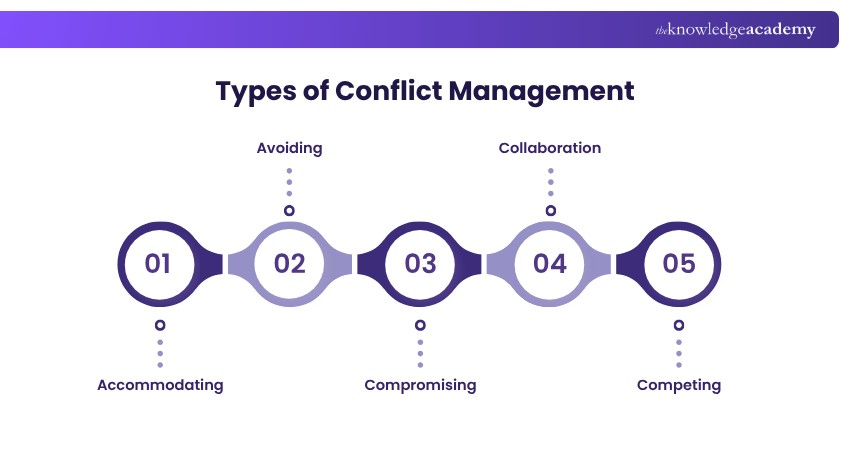
1) Accommodating
In order to preserve harmony, the accommodating style entails prioritising the needs of others over your own. It is frequently employed when maintaining the relationship or when the other person values the issue more. Although it can foster goodwill, excessive use can result in personal discontent.
Example: Two colleagues want different presentation designs for an upcoming client project proposal. One employee prefers a detailed slide deck, but the other is short on time before a client meeting. To avoid stress and delays, the first employee agrees to use the simpler format even though it is not their preference.
2) Avoiding
Avoiding is a passive strategy in which people avoid or postpone dealing with the conflict. For low-stakes situations or when emotions are running high and some time is needed to calm down, this approach might work well. However, tension can increase if issues are ignored for an extended period of time.
Example: A team member feels irritated about a co-worker’s small mistakes in emails. Instead of confronting them during a busy deadline week, they postpone the discussion until the workload is lighter and both can talk calmly.
3) Compromising
Finding a middle ground through compromise necessitates concessions from both sides. It works best when there is a time constraint, and both parties have equal authority or legitimate concerns. Even though it promotes equity, neither party's needs may be entirely met.
Example: Two departments disagree about a project deadline. The marketing team wants two extra weeks, while the operations team wants it to be completed in one week. They settle on a one-and-a-half-week extension, allowing both sides to adjust their plans.
4) Collaboration
By candidly addressing disagreements and cooperating to find a common solution, collaboration seeks to produce a win-win result. This approach is perfect for complicated or relationship-based disputes because it promotes respect for one another and a deeper level of understanding.
Example: A manager and employee disagree about remote work. Instead of insisting on one option, they discuss workload, communication needs, and productivity. They agree on a hybrid schedule, combining office days for meetings and home days for focused work.
5) Competing
The competing style is assertive and goal-driven, prioritising one’s position regardless of others’ views. It can be effective in urgent situations, like making quick decisions during crises. However, if used excessively, it may damage trust and hinder teamwork.
Example: During a safety emergency in a factory, a supervisor orders everyone to stop operations immediately, even though some workers want to finish a task. The supervisor insists on a shutdown because safety rules must take priority over opinions.
Master the art of problem-solving and make better decisions with our Problem Solving Training – Sign up now!
Tips and Strategies for Conflict Management
Effective Conflict Management requires more than just knowing the styles; it demands practical strategies that help guide discussions toward resolution. Below are actionable tips drawn from proven techniques that can help individuals and teams handle disagreements constructively.
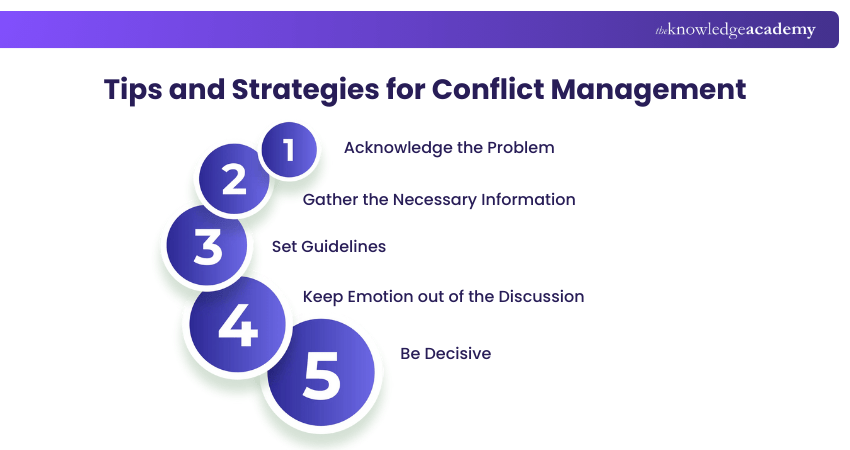
1) Acknowledge the Problem
Acknowledging the existence of an issue is the first step towards resolving any conflict. Misunderstandings can grow worse if tensions are ignored. The tone for a fruitful conversation is established by politely and openly acknowledging the problem.
2) Gather the Necessary Information
Before jumping to conclusions, take time to understand all perspectives. Ask questions, listen carefully, and collect facts that clarify what’s really going on. This ensures your decisions are informed rather than reactive.
3) Set Guidelines
Establish ground rules for the discussion to create a safe, respectful environment. These might include avoiding interruptions, using respectful language, and focusing on behaviours rather than personal attacks. Clear boundaries help prevent conversations from becoming unproductive or emotional.
4) Keep Emotion out of the Discussion
While emotions are natural, allowing anger or frustration to dominate can derail conflict resolution. Stay calm and focus on facts and solutions, not blame. Practising emotional control encourages rational thinking and collaborative problem-solving.
5) Be Decisive
Once all viewpoints have been heard and considered, take decisive action to address the conflict. Prolonging decisions can lead to confusion or resentment. A timely, fair resolution demonstrates leadership and builds trust among team members.
Become a more effective leader and achieve professional goals with our Personal and Organisational Development Training – Sign up now!
Conflict Resolution Examples
Here are a few examples of Conflict Management and how these conflict resolution strategies can be applied in real-world situations.
1) Accommodating an Angry Customer
A consumer contacts a retail store to complain about obtaining a damaged product. The customer service representative immediately apologises and acknowledges the problem. Understanding the importance of the situation, they provide a complete refund or exchange, as well as a discount on future orders.
The employee makes the customer feel valued and appreciated, focusing on their happiness to handle the issue peacefully and establish an excellent connection.
2) Avoiding a Trivial Argument
During a team meeting, there is a small dispute on the colour scheme for a project. Realising that the argument is silly and could develop unnecessarily, the team leader advises temporarily putting the subject on hold to focus on more urgent issues.
By avoiding unnecessary conflict over tiny matters, the team may stay focused on their objectives without wasting time and energy on trivial disagreements.
3) Compromising When Reaching an Impasse
Two business partners have hit an impasse in their negotiations over contract conditions. Recognising the necessity for compromise, they changed their initial expectations to meet. Each side makes compromises to meet the other's interests, resulting in a beneficial agreement that enables the partnership to grow effectively.
This approach ensures neither party feels sidelined nor defeated. By compromising, it helps to maintain trust and keep future collaboration seamless.
Build confidence to manage teams effectively with the Introduction to Managing People Course – Register today!
Valuable Skills for Conflict Management
It is important to have the right set of skills to resolve conflicts effectively. Here is a list of valuable skills for strong Conflict Management
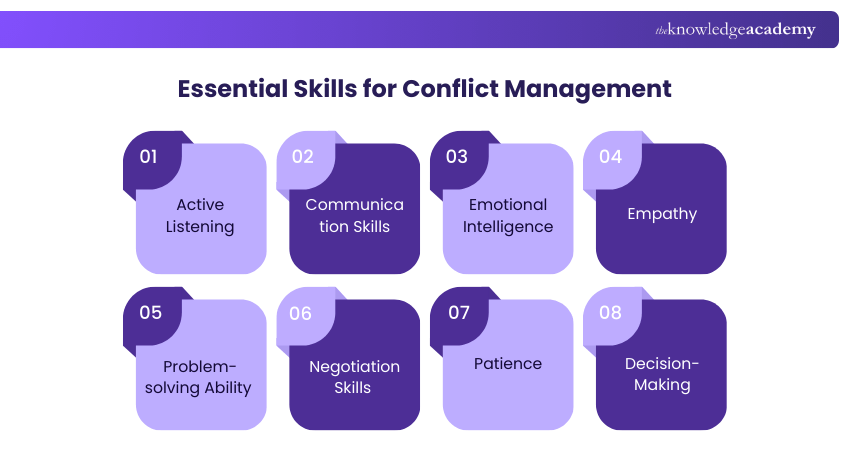
1) Active Listening
Active listening means giving full attention to the speaker instead of preparing a response while they talk. It involves maintaining eye contact, asking clarifying questions, and acknowledging what the other person is saying. This helps people feel heard and reduces defensiveness.
2) Communication Skills
Clear and respectful communication is essential during disagreements. Expressing concerns politely, using simple language, and avoiding blame prevents escalation. Phrases such as “I understand your concern” or “Let’s find a solution together” can calm tense situations.
3) Emotional Intelligence
Emotional intelligence helps individuals recognise and control their own emotions while understanding others’ feelings. When people manage frustration, anger, or stress, they can respond rationally rather than react impulsively, which keeps discussions constructive.
4) Empathy
Empathy is the ability to see a situation from another person’s perspective. By understanding why someone feels upset or concerned, it becomes easier to identify solutions that meet the needs of both parties and strengthen relationships.
5) Problem-solving Ability
Conflict often arises from unmet needs or misunderstandings. Strong problem-solving skills help identify the root cause and generate practical solutions. Instead of focusing on who is right, the focus shifts to what will fix the issue.
6) Negotiation Skills
Negotiation helps both sides reach a mutually acceptable agreement. It involves flexibility, fairness, and willingness to adjust expectations. Effective negotiation ensures neither party feels ignored or treated unfairly.
7) Patience
Conflicts rarely resolve instantly. Patience allows time for emotions to settle and for a thoughtful discussion to take place. Rushing decisions can worsen the disagreement, while calm discussion encourages cooperation.
8) Decision-Making
Sometimes a final decision needs to be made to end the disagreement. Good decision-making ensures that the chosen solution is practical, fair, and aligned with team or organisational goals. It also builds confidence within the team, as members trust that conflicts will be resolved with clarity and accountability.
What is the Best Style of Conflict Management?
When faced with the question of What is Conflict Management, one approach consistently stands out: collaborative negotiation. A collaborative style not only resolves disputes but also helps build stronger, long-term working relationships. This win-win method focuses on clearly identifying each side’s needs and interests and working together toward a solution that satisfies both.
While it takes time and requires open communication, collaboration often delivers deeper, more sustainable outcomes than competing or compromising alone. True collaboration transforms conflict into an opportunity, rather than contention, enabling teams to thrive.
What is Conflict Management in the Workplace?
Conflict Management in the workplace refers to the strategies and tools utilised to manage disagreements and disputes. It focuses on resolving issues in a respectful and professional manner to keep the workflow smooth without unnecessary tension. The main goal is to solve the problem but also protect the healthy working relationships and workplace environment.
Conclusion
Conflicts will arise in workplaces, but the way they are handled makes the difference. Understanding What is Conflict Management, it empowers employees and leaders to turn disputes into growth opportunities. Adopting the right strategies, improving communication, and developing essential resolution skills are essential to promote a productive, supportive, and respectful environment.
Improve your management skills and become a more capable leader with our Management Courses – Sign up now!
Frequently Asked Questions
What are the Five Conflict Resolution Strategies?

The Five Conflict Resolution Strategies are collaborative, competitive, compromising, accommodating and avoiding. Each approach handles disagreement differently, ranging from yielding to others, delaying discussion, sharing concessions, solving issues together, or asserting authority when necessary.
What is the Need for Conflict Management?
Conflict Management is essential for resolving conflicts, avoiding escalation, and maintaining relationships. It encourages communication and mutually beneficial solutions, resulting in a peaceful and productive environment.
What are the Other Resources and Offers Provided by The Knowledge Academy?
The Knowledge Academy takes global learning to new heights, offering over 3,000+ online courses across 490+ locations in 190+ countries. This expansive reach ensures accessibility and convenience for learners worldwide.
Alongside our diverse Online Course Catalogue, encompassing 17 major categories, we go the extra mile by providing a plethora of free educational Online Resources like Blogs, eBooks, Interview Questions and Videos. Tailoring learning experiences further, professionals can unlock greater value through a wide range of special discounts, seasonal deals, and Exclusive Offers.
What is The Knowledge Pass, and How Does it Work?
The Knowledge Academy’s Knowledge Pass, a prepaid voucher, adds another layer of flexibility, allowing course bookings over a 12-month period. Join us on a journey where education knows no bounds.
What are the Related Courses and Blogs Provided by The Knowledge Academy?
The Knowledge Academy offers various Management Courses, including Managing Remote Teams Course, Introduction To Managing People Course, and Performance Management Training. These courses cater to different skill levels, providing comprehensive insights into the Behavioural Theory of Leadership.
Our Business Skills Blogs cover a range of topics related to Conflict Management, offering valuable resources, best practices, and industry insights. Whether you are a beginner or looking to advance your Business skills, The Knowledge Academy's diverse courses and informative blogs have got you covered.

William Brown


Senior Business Analyst and Strategic Advisor
William Brown is a senior business analyst with over 15 years of experience driving process improvement and strategic transformation in complex business environments. He specialises in analysing operations, gathering requirements and delivering insights that support effective decision making. William’s practical approach helps bridge the gap between business goals and technical solutions.
View Detail
Upcoming Business Skills Resources Batches & Dates
Date
 Conflict Management Training
Conflict Management Training
Fri 15th May 2026
Conflict Management Training
Fri 17th Jul 2026
Conflict Management Training
Fri 18th Sep 2026
Conflict Management Training
Fri 13th Nov 2026

 If you wish to make any changes to your course, please


