


 Top Rated Course

We may not have the course you’re looking for. If you enquire or give us a call on +46 850282424 and speak to our training experts, we may still be able to help with your training requirements.
International Trade: A Comprehensive Overview
The Knowledge Academy 24 February 2026Global economies thrive on International Trade, the lifeblood of commerce that connects nations through imports and exports. It fuels innovation, and shapes industries worldwide. But what makes it so powerful? This blog uncovers What is International Trade, its key benefits, challenges, and the forces driving global trade today.

Training Outcomes Within Your Budget!
We ensure quality, budget-alignment, and timely delivery by our expert instructors.
Table of Contents
If you are starting as a new entrepreneur or want to expand your business beyond your country, you need to be aware and know everything about International Trade. But What is International Trade? It can be defined as an intricate network of transactions which transcends borders, connects economies and fosters interdependence.
Are you planning to begin your journey in this form of business? If you are, remember the factors influencing this trade are tariffs, trade agreements, and geopolitical influences. In this blog, we will help you through this process and help you understand more about What is International Trade, its advantages, policies and more!
Table of Contents
1) What is International Trade?
2) Types of International Trade
3) What Are the Benefits of International Trade for a Business?
4) Challenges in International Trade
5) Role of Major Institutions in International Trade
6) Future of International Trade
7) What is Comparative Advantage?
8) What is the Balance of Trade?
9) Conclusion
What is International Trade?
International trade involves the exchange of goods or services between different countries. These exchanges can be either imports, which are goods or services brought into a country, or exports, which are goods or services sold to other countries.
This type of trade is a key aspect of economic interaction between nations and is a prime example of economic linkage. Other forms of economic linkages include foreign financial investments, multinational corporations, and the employment of foreign workers. The expansion of these economic connections is what we refer to as globalisation.

Types of International Trade
International Trade includes import and export activities, and entrepot trade. These types enable nations to tap resources effectively, improve economic relationships, and maximise on production by involving itself in the world market.
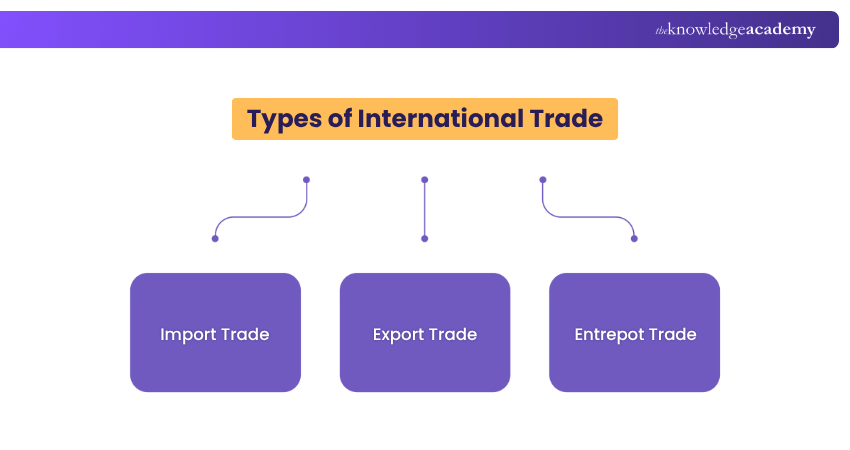
Import Trade
Import trade is the investing of goods and services in foreign countries whenever there is a lack of local production or a costly one. This is because countries depend on imports to satisfy the demand, access specialised goods and take advantage of cheaper prices internationally or advanced capabilities.
Export Trade
Export trade means the sale of home-produced goods and services in overseas markets. It stimulates national earnings, improves on local industries and enables countries to derive optimum utilisation of resources through providing what the countries produce to international consumers in an efficient manner.
Entrepot Trade
Entrepot trade combines both importing and exporting as trading activities where goods are to be processed or repackaged, then exported. It favours those countries that have good logistics, good trade policies, or strategic position between two or more nations trading.
Learn the essential principles of international trade with our Import Export Course – Join now!
What Are the Benefits of International Trade for a Business?
Global trade gives businesses access to a wider customer base as well as additional growth opportunities in the international markets.
1) It maximizes its revenue possibilities by accessing greater and diverse global markets.
2) It is seen that companies experience less competition in foreign markets that are emerging or untapped.
3) Good foreign exchange rates and inflows of investment favor businesses.
4) It saves costs due to international procurement and accessibility to cheaper input.
5) Since competing globally and consumer expectations foster innovation and efficiency in trade, trade contributes to innovation and efficiency.
Unleash your product potential! our Product Management Training will equip you with the skills to drive innovation. Start your journey today.
Challenges in International Trade
Global trade is more complex with its risks, but it presents its prospects of growth. Legal compliance, the effect of currency variations among others are all challenges that businesses need to take care of in a strategic way that prevents unnecessary hitches in the running of their operations around the globe.
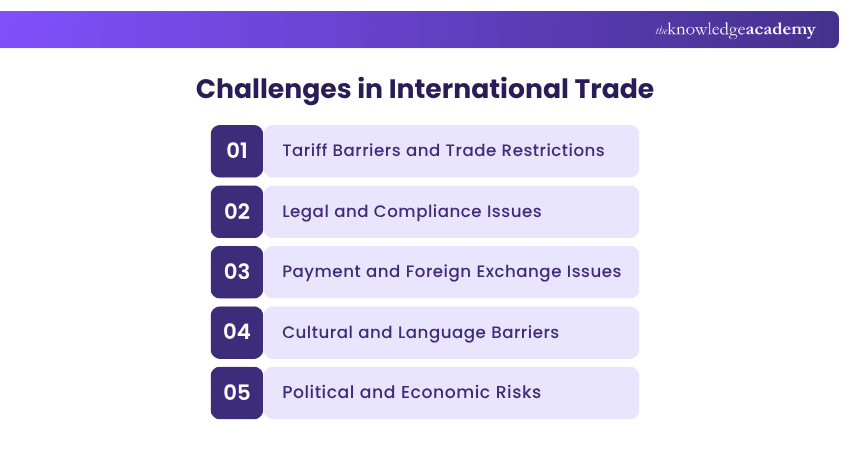
Tariff Barriers and Trade Restrictions
Problem: Trade barriers such as tariffs, quotas or anti-dumping duties as well as barriers such as lack of tariffs raise the costs above those in free trade and thus shrink the ability to compete internationally. They are imposed by states to safeguard their local industry and affect their access to exporters and profitability.
Solutions:
1) Carry out policy research and ensure compliance with the local trading rules
2) Complying with international standards of products and packaging
3) Liaise with trade bodies and global organizations when it comes to advocacy and updates
Legal and Compliance Issues
Problem: There are different legislations regarding imports, exports, labour standards and environmental standards in every country. Failure to comply might result in legal fines, detention of shipments or prohibition of business, particularly lack of appropriate certifications or domestic legal expertise.
Solutions:
1) Seek the advise of legal experts or employ in-house lawyers to assist with compliance obligations
2) Perform due diligence on venturing into new markets
3) Conduct standard compliance and regulatory trainings among employees
4) Payments and Foreign Exchange Problems
Payment and Foreign Exchange Issues
Problem: Fluctuations in exchange rates, bank delays, different versions of international payments may have a total impact on the value of transaction, delay and in the end they cut the profit margins particularly in situations where there is too much trade or long-term trade agreements.
Solutions:
1) Limits on the currency risk by using hedging tool and forward contracts
2) Join forces with international banks that are credible and safety in transaction is guaranteed
3) Provide various ways to make payments such as letters of credit and implications related to wire transfer methods of payments.
Cultural and Language Barriers
Problem: Negotiations, contracts and business connections may be influenced by misunderstandings due to the difference in languages and cultural norms. Ignorance and disregard of local practices may put the deals at risk and impede cooperation.
Solutions:
1) Provide cross-cultural communication training to staff
2) Hire multilingual professionals or translation services for key processes
3) Learn and adapt to local business etiquette and norms
Political and Economic Risks
Problem: Any political instability, trade sanctions or economic decline may affect international trade, halt deliveries and break down investments. These variables are highly erratic, and in addition they differ according to region.
Solutions:
1) Monitor global political and economic developments regularly
2) Diversify markets to reduce dependency on high-risk regions
3) Purchase political risk insurance for major transactions or investments
Role of Major Institutions in International Trade
International Trade is defined and facilitated by international institutions that maintain fair play, economic prosperity and development finance. The main players such as WTO, IMF, and World Bank ensure cooperation in trade, resolution of disputes and financial aid among the countries.
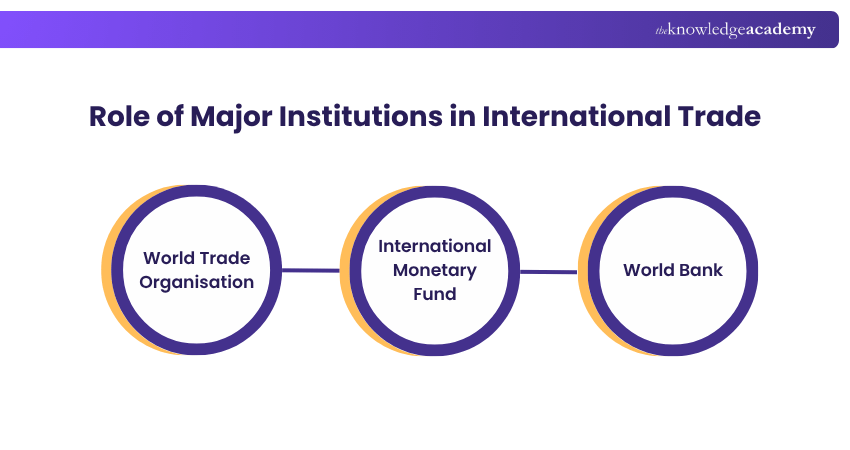
World Trade Organisation
The World Trade Organization (WTO) formulates and oversees trade agreements that enhance harmonious trade across boundaries. It assists to settle parts of disagreement, trade obstacles and integrity of consistent global business regulation by the decision of guiding and international discussions among members.
International Monetary Fund
The IMF promotes stability of the international monetary systems by providing economic data, financing, and policies. It assists nations in financial crisis, a reinforcement of stability in the exchange rates as well as an encouragement to international economic cooperation and global trade strategies via lending strategies and surveillance.
World Bank
The World Bank finances development projects in infrastructure, health, education, and economy in developing countries. It enhances poverty reduction and sustainable development via long-term lending, grants, technical assistance, and collaboration with both the global and local governments.
Future of International trade
The face of International Trade is changing fast as geopolitical volatility, new markets, urban centers of trade, and green business enterprises dominate the trend. The knowledge of these forces will enable businesses to change and remain competitive in the global market.
Geopolitical Factors
Trade policies, arrangements, and market access are influenced a lot by geopolitical developments. Since Brexit, US-China antagonism, and the threat of tariffs, there is a reshaping of the global trade landscape through new alliances and trade regulations. Companies need to be dynamic and aware to take advantage of new opportunities and lessen the impacts of changing and dynamic events.
Emerging Markets Play a Role in Shaping International Trade Dynamics
The emergence of economies is restructuring the trade environment in the world. Nations like India, Brazil, and China are attracting foreign direct investment with better infrastructure, technology, and digital trade policies making them major influencers in global trade.
Cities’ Contribution to Exporting: Global Hubs Driving Trade
The leading cities are strategic in the facilitation of international business. Cities such as Singapore, Dubai, and Rotterdam facilitate exports by using their high-quality infrastructure and logistics and favourable regulations, as well as playing the role of global hubs that attract and stimulate trade, innovation, and economic growth among different continents.
Sustainability and Ethical Practices in Trade are Now Standard
The contemporary trends in trade are concentrating on sustainability and ethics. Businesses are now supposed to have eco-friendly logistics practices, fair labour practices and transparent sourcing. Going green also saves costs and emissions as well as enhances the strength of a brand and brings it in line with international regulations.
Train to manage end-to-end logistics and improve service delivery across the board with our Logistics Management Training!
What is Comparative Advantage?
Comparative advantage explains why countries benefit from specialising in what they do best and trading for the rest. It’s like teamwork—everyone wins by focusing on strengths!
The Concept in Action
Countries have different resources and skills, making some goods cheaper to produce than others. Instead of making everything, they specialise and trade, saving costs and boosting efficiency.
England & Portugal Example
a) Portugal excels at making wine.
b) England is better at producing cloth.
c) By specialising and trading, both get more for less effort.
Why Trade Works
a) Specialisation maximises efficiency and reduces costs.
b) Trading ensures both nations access what they need at lower costs.
Comparative vs Absolute Advantage
a) Absolute advantage: A country is the best at something.
b) Comparative advantage: A country produces at a lower opportunity cost.
Even countries without absolute advantage gain from trade by focusing on their strengths. That’s the power of comparative advantage!
What is the Balance of Trade?
The Balance of Trade (BOT) refers to the comparison between exports and imports of any nation at a particular time point. It indicates the presence or absence of a nation's trade surplus, or trade deficit and is an important element of the same nation's balance of payments.
Conclusion
We hope you understood the basic concept of What is International Trade and why it is necessary to take your business beyond your country’s waters. In today’s world, it is a dynamic force shaping the global economy. It fosters economic interdependence, promotes efficiency through specialisation, and drives innovation.
Enhance your knowledge about managing Supply Chain – sign up now for our Supply Chain Management Training!
Frequently Asked Questions
What is a Free Trade Agreement?

A Free Trade Agreement is a pact between countries to reduce or eliminate tariffs, quotas, and trade barriers, promoting smoother exchange of goods and services. It encourages International Trade by fostering open, competitive, and regulated market access.
What are Some of the Examples of International Trade Policies?
International Trade policies regulate global commerce through tariffs, quotas, and trade agreements. Examples include Free Trade Agreements (FTAs) like NAFTA (now USMCA), tariff policies such as the EU’s Common External Tariff, and sanctions like those imposed on restricted nations. These policies shape global trade by influencing costs, supply chains, and market access.
What are the Other Resources and Offers Provided by The Knowledge Academy?
The Knowledge Academy takes global learning to new heights, offering over 3,000+ online courses across 490+ locations in 190+ countries. This expansive reach ensures accessibility and convenience for learners worldwide.
Alongside our diverse Online Course Catalogue, encompassing 17 major categories, we go the extra mile by providing a plethora of free educational Online Resources like Blogs, eBooks, Interview Questions and Videos. Tailoring learning experiences further, professionals can unlock greater value through a wide range of special discounts, seasonal deals, and Exclusive Offers.
What is The Knowledge Pass, and How Does it Work?
The Knowledge Academy’s Knowledge Pass, a prepaid voucher, adds another layer of flexibility, allowing course bookings over a 12-month period. Join us on a journey where education knows no bounds.
What are related Industry courses and blogs provided by The Knowledge Academy?
The Knowledge Academy offers various Industry Training, including Facilities Management Training, Product Management Training and Supply Chain Management Training. These courses cater to different skill levels, providing comprehensive insights into Facility Management.
Our Business Skills Blogs cover a range of topics related to Facilities Management, offering valuable resources, best practices, and industry insights. Whether you are a beginner or looking to advance your Facilities Asset Management skills, The Knowledge Academy's diverse courses and informative blogs have got you covered.

The Knowledge Academy


Global Training Provider
The Knowledge Academy is a world-leading provider of professional training courses, offering globally recognised qualifications across a wide range of subjects. With expert trainers, up-to-date course material, and flexible learning options, we aim to empower professionals and organisations to achieve their goals through continuous learning.

Upcoming Business Skills Resources Batches & Dates
Date
 Import Export Course
Import Export Course
Fri 10th Apr 2026
Import Export Course
Fri 10th Jul 2026
Import Export Course
Fri 2nd Oct 2026

 If you wish to make any changes to your course, please


